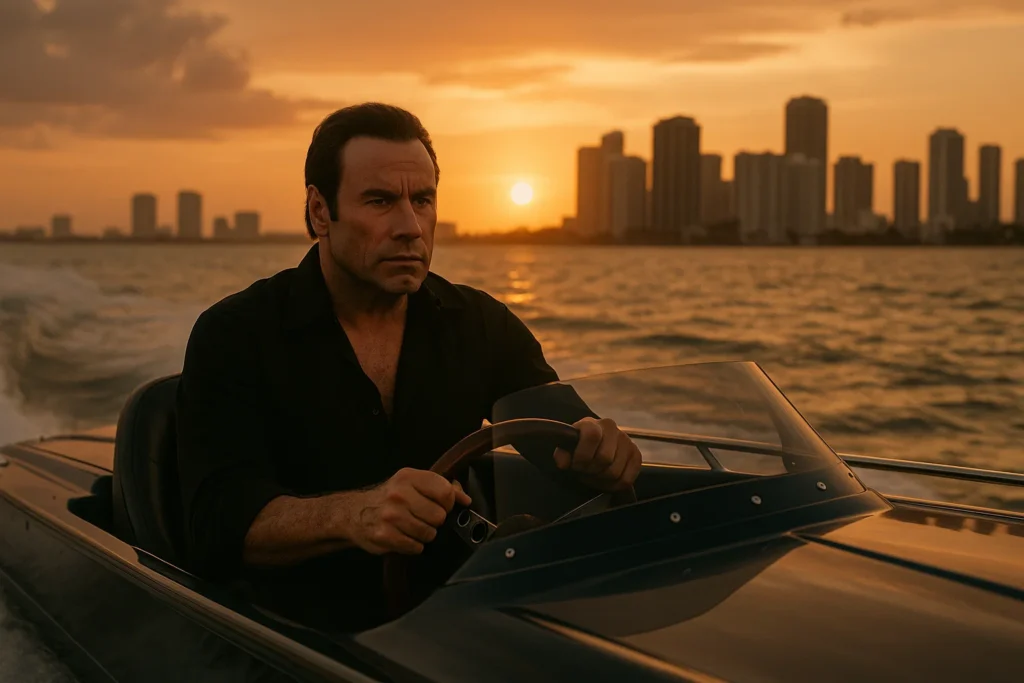
This article explores what’s fact, what’s fiction, and how Speed Kills drew inspiration from a story that ended in blood and mystery.
The Man Behind the Legend: Who Was Don Aronow?
Before Speed Kills hit the screens in 2018, the legend of Don Aronow had already been told in whispers across Florida’s elite marinas.
He wasn’t just any man with a love for boats he built an empire on water.
Aronow, a New York–born construction magnate turned boat designer, moved to Miami in the 1960s after making a fortune in real estate. But he wasn’t ready for a quiet retirement. He began crafting high-performance speedboats sleek, dangerous machines that could slice through the ocean at record speeds. Soon, the world’s richest and most powerful people wanted one.
Among his buyers?
- Vice President George H.W. Bush
- Elvis Presley
- The Shah of Iran
And even as later reported drug smugglers, who saw these boats as perfect for outrunning the Coast Guard.
Don Aronow lived at the intersection of glamour and danger, the kind of man who could charm presidents one day and cross paths with criminals the next. His most famous creation, the Cigarette boat, became both a symbol of wealth and a weapon of the drug wars.
From Real Life to Reel Life: How Speed Kills Was Born
The movie Speed Kills (2018), starring John Travolta, is “inspired by true events.” That phrase a Hollywood favorite gives filmmakers room to blend fact with drama.
Travolta plays Ben Aronoff, a thinly veiled version of Don Aronow. The names are changed, but the parallels are unmistakable: a fast-talking entrepreneur, a fleet of luxury boats, ties to politicians and gangsters, and a violent end.
Director Jodi Scurfield shaped the film as a loose biography, drawing from the 1999 book Speed Kills by Arthur J. Harris. The story paints Aronow/Aronoff as a man addicted to speed and success, caught in a world where his creations serve both heroes and villains.
The film opens with the glitz speedboat races, luxury cars, and waterfront mansions before spiraling into betrayal, corruption, and murder. It’s cinematic, yes, but beneath the fiction lies a chilling reality.
How True Is Speed Kills?
Like most “true story” movies, Speed Kills takes artistic liberties.
The timeline is compressed, characters are fictionalized, and events are dramatized for emotional impact. Yet the backbone of the film a successful speedboat builder entangled with criminals and government officials is firmly rooted in truth.
Here’s how the movie aligns (and diverges) from reality:
| Movie Element | Real-Life Connection |
|---|---|
| Ben Aronoff’s success in the boat world | Don Aronow really was a pioneer in the high-performance boat industry. His brands included Donzi, Formula, and Cigarette Racing. |
| Political connections | True. Aronow was close to influential figures, including George H.W. Bush. They even shared a friendly correspondence. |
| Involvement with criminals | Also true. Some of Aronow’s boats ended up in the hands of drug smugglers during the 1980s Miami drug wars. |
| His murder | Tragically true. Aronow was shot and killed outside his Miami office on February 3, 1987, at the age of 59. The case shocked the boating world. |
| The murderer’s link to Aronow’s circle | Fact. The eventual conviction tied back to individuals involved in both the boat business and drug trade. |
So while the film amplifies drama and compresses history, its emotional truth the rise and fall of a man who flew too close to power remains intact.
The Real Tragedy: The Murder of Don Aronow
On that February afternoon in 1987, Aronow’s life ended in a single burst of violence. He was sitting in his white Mercedes on “Thunderboat Row,” the stretch of NE 188th Street in Miami where his boat companies once thrived. A car pulled up beside him. Shots were fired. Aronow died instantly.
The murder was as mysterious as it was brutal. For years, the case remained unsolved, feeding rumors and conspiracy theories. Was it revenge? Business rivalry? A silencing act tied to drug-running secrets?
It took nearly a decade before the truth began to surface.
According to reports from Motor Boat & Yachting and later confirmed by Florida law enforcement, the killing was linked to Ben Kramer, a speedboat racer and business associate involved in drug smuggling. Kramer was eventually convicted and sentenced to life in prison. But even today, parts of the story remain cloudy some believe more powerful figures were behind it.
(Source: MBY News – “Hit man’s death closes notorious Aronow case”)
Hollywood’s Version vs. History’s Version
The cinematic Speed Kills wraps Aronoff’s story into a digestible 100 minutes. But real life was far more complicated. Aronow’s world wasn’t black and white it was a swirl of wealth, danger, and moral gray zones.
The film portrays Aronoff as both hero and villain, a man of passion undone by his own excess. That duality resonates with Aronow’s true legacy. He wasn’t a simple victim; he was a man whose pursuit of speed both literal and symbolic put him in the crosshairs of power and greed.
Yet where the movie falls short, history fills the gaps. Aronow wasn’t just living fast he was redefining boat design, pushing marine engineering into a new era. His innovations in hull design and engine power transformed competitive racing and luxury boating alike.
In many ways, Speed Kills is less a crime story and more a cautionary tale: when brilliance and ambition collide with corruption, even the fastest man on the water can’t escape the tide.
What Inspired the Movie?
The film was primarily inspired by three things:
- Arthur J. Harris’s 1999 book Speed Kills – a fact-based account of Don Aronow’s life and death.
- Aronow’s real-world fame – his boats won world championships and appeared in movies and TV shows, including Miami Vice.
- The mystery of his murder – decades later, it still evokes fascination as one of Florida’s most notorious crimes involving sports, power, and politics.
According to Pajiba’s film review, Travolta’s version “tries to capture the thrill and danger of Aronow’s world but loses focus in a script that speeds past the real human cost.” Still, the movie managed to rekindle public interest in Aronow’s story, reminding new audiences of the blurred lines between heroism and hubris.
Beyond the Screen: Aronow’s Legacy Today
Though his life ended violently, Don Aronow’s influence never disappeared. The Cigarette brand he founded continues to thrive, now symbolizing high-end performance and luxury across the world. His innovations are still celebrated by racers and engineers who study his designs.
In Miami, “Thunderboat Row” stands as a memorial of sorts a place that once echoed with the roar of engines and the dreams of a man who wanted to go faster than anyone else.
For boating enthusiasts and crime historians alike, Aronow’s story remains a reminder that every empire built on speed eventually meets friction.
The Takeaway: So, Is Speed Kills a True Story?
The short answer: Yes but with cinematic polish.
Speed Kills is inspired by real events, not a documentary. It captures the essence of Don Aronow’s journey his brilliance, charm, and downfall while dramatizing the details for entertainment. The movie mirrors a life where glory and danger raced side by side, and where one man’s obsession with powerboats became his triumph and his undoing.
Final Thought
Don Aronow once said that speed was freedom. But in his world, freedom came with a cost.
His life and death became a story Hollywood couldn’t resist telling.
And while Speed Kills may not reveal every truth, it keeps his legend alive reminding us that behind every great chase lies a man running from something far more dangerous than time.

Jessica Savitch, with a deep passion for journalism, brings her expertise to istruestory.com as a dedicated author. MA in Arts & Journalism.