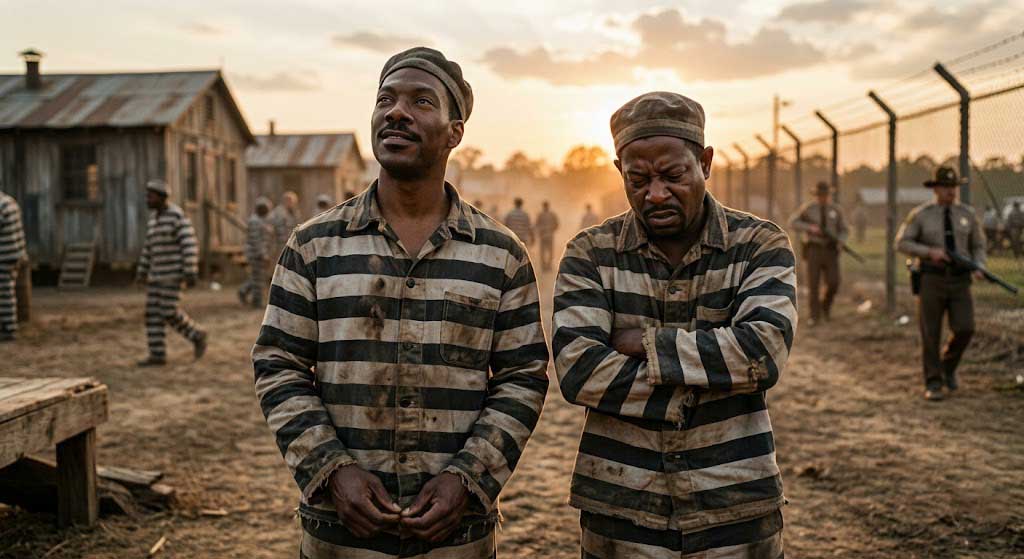
Maybe it is the friendship between Ray Gibson and Claude Banks. Maybe it is the sadness of watching two men lose decades of their lives for a crime they did not commit. Or maybe it is because the story feels so painfully real that many viewers leave the film asking the same question:
Were Ray Gibson and Claude Banks real people?
The short answer is no. Ray and Claude were fictional characters created for the 1999 movie Life. But the deeper truth is more complicated than that.
Even though the characters themselves were invented, the world around them was built from very real pieces of American history. The movie pulls inspiration from racial injustice, chain gangs, wrongful convictions, and the brutal prison conditions Black Americans faced during the early 20th century.
That is exactly why the film feels authentic.
Directed by Ted Demme and starring Eddie Murphy and Martin Lawrence, Life mixed comedy with heartbreak in a way very few movies manage to do. At first, it looks like a funny crime story. Then slowly, it becomes something heavier. Something emotional. Something human.
By the end of the film, viewers are not laughing as much anymore. They are thinking about time, freedom, friendship, and everything stolen from Ray and Claude.
Here is the real story behind the movie, the truth about Ray Gibson and Claude Banks, and why so many people still believe Life was based on real events.
Movie Snapshot
| Category | Details |
|---|---|
| Movie Title | Life |
| Release Year | 1999 |
| Genre | Comedy, Drama, Crime |
| Director | Ted Demme |
| Writers | Robert Ramsey, Matthew Stone |
| Main Characters | Ray Gibson and Claude Banks |
| Played By | Eddie Murphy and Martin Lawrence |
| Setting | Mississippi prison camp during the 1930s–1990s |
| Is It Based on a True Story? | No, the characters and main plot are fictional |
| Real Historical Inspiration | Jim Crow era racism, prison labor camps, wrongful convictions |
| Prison Featured in Film | Fictional Camp 8 prison farm |
| Core Theme | Friendship, injustice, survival, freedom |
| Tone of the Movie | Mix of comedy, emotional drama, and tragedy |
| Runtime | Approximately 108 minutes |
| Most Emotional Element | Ray and Claude losing decades of their lives in prison |
| Why People Think It’s Real | Realistic storytelling, historical setting, emotional ending |
| Famous Supporting Cast | Bernie Mac, Bokeem Woodbine, Rick James, Anthony Anderson |
| Ending Summary | Ray and Claude finally escape as elderly men and return to Harlem |
| Cult Classic Status | Considered one of the most underrated Eddie Murphy and Martin Lawrence films |
| Best Known For | Blending humor with heartbreaking prison drama |
| Audience Appeal | Fans of emotional true-story-style movies and friendship dramas |
Who Were Ray Gibson and Claude Banks?
Ray Gibson and Claude Banks are the two main characters in Life.
Ray, played by Eddie Murphy, is a smooth-talking hustler from Harlem. Claude, played by Martin Lawrence, is a straight-laced bank employee trying to stay out of trouble. The two men meet in New York during the 1930s and immediately clash because their personalities are completely different.
Ray talks too much. Claude trusts too little.
But after getting arrested together in Mississippi for a murder they did not commit, their lives become permanently connected.
They are sentenced to life in prison at a brutal labor camp called Camp 8. Over the decades, they fight, joke, survive, and slowly become like brothers.
The emotional power of the film comes from watching their entire adult lives disappear behind prison walls.
Even though the characters are fictional, audiences connected deeply with them because they felt believable. Their fears, arguments, dreams, and regrets felt like real human experiences.
That realism is one reason the movie still has such a loyal following today.
Is Life Based on a True Story?
No, Life is not directly based on one true story.
The screenplay was written by Robert Ramsey and Matthew Stone, who created the characters and plot as fictional storytelling. The movie was never marketed as a biographical film.
Still, the film absolutely borrows from real historical conditions in America during the 1930s and 1940s.
That includes:
- Segregation in the American South
- Racially biased arrests
- Corrupt legal systems
- Forced prison labor
- Harsh chain gang environments
- Wrongful convictions involving Black men
Many Black prisoners during that era faced terrible treatment and unfair trials. Some were arrested with little evidence. Others were trapped in prison systems designed to exploit cheap labor.
The prison camp shown in Life reflects those realities.
The movie also captures how easily a Black man’s life could be destroyed during that period, especially in the Deep South. Ray and Claude are arrested far from home, accused quickly, and denied real justice.
Sadly, stories like that happened in real life far too often.
So while Ray and Claude were not real individuals, the pain and injustice shown in the movie came from real history.
Why So Many People Thought the Story Was Real
One reason viewers believed the movie was true is because of its emotional tone.
Most comedy films stay light from beginning to end. Life does not.
The movie changes slowly over time. It begins with fast jokes and playful energy, then gradually becomes more serious as decades pass. Viewers watch characters age, lose hope, and struggle with regret.
That emotional realism tricks the brain into treating the story like history instead of fiction.
Another reason is the film’s ending.
At the end of Life, Ray and Claude finally escape prison as old men after spending nearly their entire lives behind bars. A closing narration explains what happened to them afterward, almost like the ending of a documentary.
That style made many people assume the movie was based on real events.
But the ending was simply a storytelling choice designed to make the audience feel connected to the characters one last time.
What Happened to Ray and Claude in the Movie?
Inside the story, Ray and Claude spend more than 60 years in prison.
Over that time, they witness deaths, friendships, betrayals, and major changes in American society. Younger prisoners come and go while they remain trapped at Camp 8.
The movie carefully shows how prison steals time.
That becomes the film’s deepest emotional theme.
Ray starts as a charming hustler who believes he can talk his way out of anything. Claude begins as an ambitious man hoping for a respectable future. Prison slowly changes both of them.
But strangely, it also strengthens their friendship.
One of the saddest moments comes when Claude learns his father died while he was imprisoned. Another heartbreaking scene shows how the outside world moved on without them.
Their lives kept going physically, but emotionally they became frozen in time.
Near the end of the film, they finally escape during a baseball game and return to Harlem as elderly men. They sit together in a nightclub, free at last, before peacefully passing away.
It is emotional, bittersweet, and surprisingly beautiful for a movie that started as a comedy.
The Real Historical Inspiration Behind Life
Although no single real case inspired the movie, historians and film critics often point to real prison labor camps as major influences.
During the Jim Crow era, Southern prisons were notorious for harsh conditions. Many inmates, especially Black prisoners, worked on farms, railroads, or chain gangs under brutal supervision.
Some prison camps operated almost like slave labor systems after slavery officially ended.
This historical background shaped the environment seen in Life.
The movie’s fictional Camp 8 resembles several real prison farms that existed in the Southern United States during the early 1900s.
One major influence was likely Mississippi State Penitentiary, better known as Parchman Farm. That prison became infamous for violence, racial abuse, and forced labor.
Writers and filmmakers often use places like Parchman as inspiration when creating stories about Southern prison systems.
That historical connection gives Life much of its emotional weight.
The audience understands that while Ray and Claude may not have existed, men like them certainly did.
Eddie Murphy and Martin Lawrence Changed the Movie Completely
Another reason the film feels authentic is the chemistry between Eddie Murphy and Martin Lawrence.
The two comedians gave performances far deeper than many viewers expected.
Martin Lawrence brought nervous energy and emotional vulnerability to Claude. Eddie Murphy balanced humor with quiet sadness as Ray aged through the decades.
Their friendship feels natural because it grows slowly.
At first, they barely tolerate each other. Later, they become inseparable.
That emotional progression makes the story believable.
Many fans still consider Life one of the best performances of both actors’ careers because it allowed them to do more than tell jokes.
They made audiences care.
Even supporting actors added realism to the film. Bernie Mac, Bokeem Woodbine, Rick James, and Anthony Anderson helped create a prison world that felt alive and unpredictable.
The performances grounded the movie emotionally, which helped fuel the belief that the story might have been real.
Why Life Became a Cult Classic
When Life released in 1999, reactions were mixed.
Some viewers expected a pure comedy because of Eddie Murphy and Martin Lawrence. Instead, they got a film that mixed humor with tragedy.
Over time, though, audiences started appreciating the movie more deeply.
Today, many people see Life as one of the most underrated films of the late 1990s.
The movie stands out because it refuses to fit neatly into one genre.
It is:
- A prison drama
- A friendship story
- A historical reflection
- A comedy
- A tragedy
Very few films balance all those elements successfully.
The movie also explores aging in a surprisingly emotional way. Viewers watch Ray and Claude lose their youth while never giving up completely on freedom.
That idea hits harder as audiences grow older themselves.
The Bigger Meaning Behind the Story
At its core, Life is really about survival.
Not physical survival alone, but emotional survival.
Ray and Claude survive because they keep each other human.
They joke.
They argue.
They dream.
They remember who they were before prison.
Without that friendship, both men probably would have broken completely.
That emotional message explains why the film still connects with audiences decades later.
People may come for the comedy, but they stay because of the relationship between the two men.
The movie quietly asks painful questions:
- What would happen if your best years were stolen?
- Could friendship keep you alive through hopelessness?
- How do people survive injustice without losing themselves?
Those questions feel timeless.
So, Were Ray Gibson and Claude Banks Real?
No. Ray Gibson and Claude Banks were fictional characters created for the movie Life.
But the history surrounding them was very real.
The racism, prison abuse, wrongful convictions, and stolen lives shown in the film reflected painful truths from American history. That realism made audiences emotionally invest in the story and believe it might have actually happened.
In many ways, that is why Life remains powerful today.
The movie reminds viewers that fiction can still carry truth inside it.
Ray and Claude may never have existed as real individuals, but countless people throughout history experienced similar injustice, suffering, and lost years.
That connection between fiction and reality is what makes the story unforgettable

Jessica Savitch, with a deep passion for journalism, brings her expertise to istruestory.com as a dedicated author. MA in Arts & Journalism.