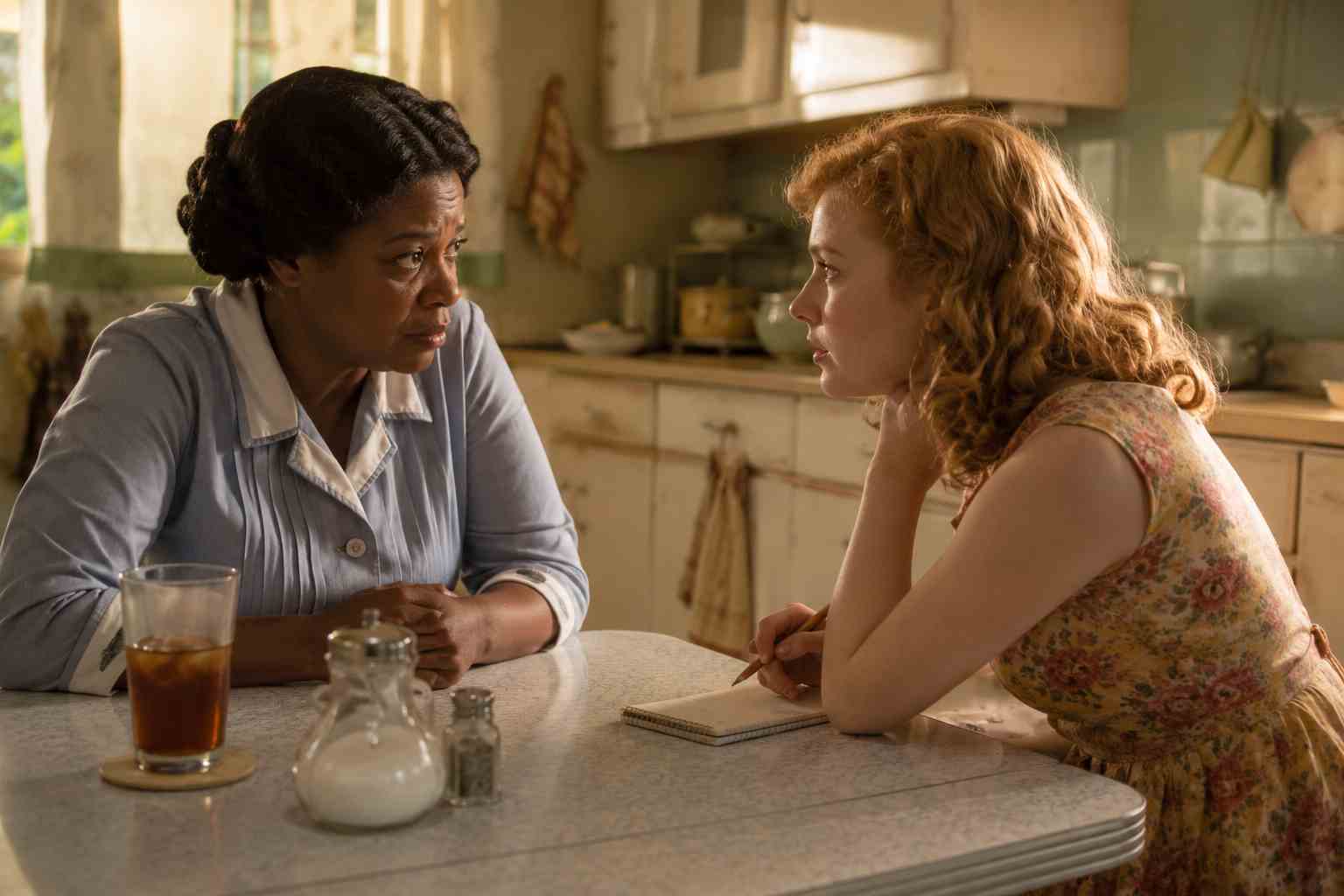
Was The Help actually based on a true story?
The short answer is no. The movie is not a direct retelling of real events. There was no real Skeeter writing a secret book exactly like the one shown in the film. Aibileen and Minny were fictional characters created by author Kathryn Stockett.
But here’s where things become more complicated.
Even though the main story was fictional, the world behind The Help was very real. The segregation laws, the treatment of Black maids, the fear of speaking openly, and the social pressure inside 1960s Mississippi all came from actual history. Many women who worked as domestic helpers during that era later said parts of the movie felt painfully familiar.
That mix of fiction and reality is exactly why the film continues to create debate today.
Released in 2011 and directed by Tate Taylor, The Help became a huge success. It earned multiple Academy Award nominations and won Octavia Spencer an Oscar for her performance as Minny Jackson. The cast included Viola Davis, Emma Stone, Bryce Dallas Howard, Jessica Chastain, and Allison Janney.
Yet behind the awards and praise, the movie also faced criticism from historians, journalists, and even some of its own stars.
Viola Davis later admitted she regretted making the film because she felt the deeper voices of Black women were never fully explored. That confession changed how many people looked at the movie years later.
So what parts were inspired by real life? Did Kathryn Stockett borrow from real people? Why did the film become controversial? And what was actually happening in Mississippi during that time?
Let’s look deeper at the truth behind The Help.
Fast Truths About The Help
| Topic | Quick Answer |
|---|---|
| Is The Help based on a true story? | No. The main story and characters are fictional. |
| What inspired the movie? | Real experiences of Black maids during segregation in 1960s Mississippi. |
| Who wrote The Help? | Kathryn Stockett wrote the original novel in 2009. |
| Who directed the movie? | Tate Taylor directed the 2011 film adaptation. |
| Was Aibileen a real person? | No, but the character may have been partly inspired by real-life maid Ablene Cooper. |
| Did someone sue over the story? | Yes. Ablene Cooper filed a lawsuit claiming similarities to her life. |
| Why did Viola Davis regret the film? | She later said the voices of Black maids were not fully represented. |
| Did The Help win any Oscars? | Yes. Octavia Spencer won Best Supporting Actress. |
| Is Skeeter based on a real journalist? | No. She was a fictional character created for the story. |
| What time period does the movie take place in? | Early 1960s during the Civil Rights Movement. |
| Was racism in the movie historically accurate? | Many parts reflected real segregation and discrimination from that era. |
| Why was Minny rude to Celia at first? | She distrusted wealthy white women because of past mistreatment. |
| What disease did Hilly get? | None was confirmed. The pie incident was symbolic revenge, not a medical storyline. |
| Where was the movie filmed? | Mostly in Greenwood, Mississippi, USA. |
| Who played Aibileen? | Viola Davis. |
| Who played Minny? | Octavia Spencer. |
| Who played Skeeter? | Emma Stone. |
| Genre of the movie | Drama / Historical Fiction |
| Release year | 2011 |
| Based on a book? | Yes, the film was adapted from Kathryn Stockett’s bestselling novel. |
The Real History Behind The Help
To understand where The Help came from, you first need to understand Mississippi in the early 1960s.
This was the height of the Jim Crow era in the American South. Segregation laws controlled nearly every part of life. Black Americans and white Americans were separated in schools, buses, restaurants, hospitals, and even bathrooms.
For Black women working as maids in white households, life was especially difficult.
Many worked long hours while raising their own children at home. Some were underpaid. Others faced constant disrespect, fear, and emotional exhaustion. In many homes, maids were treated as “part of the family” only when it benefited the employers. Real equality did not exist.
That uncomfortable reality sits at the center of The Help.
The movie follows Eugenia “Skeeter” Phelan, a young white writer who secretly interviews Black maids about their experiences working for wealthy white families in Jackson, Mississippi.
The women risk their jobs and safety by speaking honestly.
That fear was completely real.
During the Civil Rights Movement, Black Americans who challenged the system could lose employment, face threats, or become targets of violence. Mississippi was one of the most dangerous states for civil rights activists at the time.
Medgar Evers, a civil rights leader mentioned during the events surrounding the film’s timeline, was assassinated in Mississippi in 1963. That tragedy was real history, not fiction.
The movie uses these real tensions as its backdrop, even though the characters themselves were fictionalized.
Kathryn Stockett’s Personal Inspiration
Author Kathryn Stockett grew up in Jackson, Mississippi, where The Help takes place.
As a child, she was cared for by an African American maid named Demetrie McLorn. Stockett later said Demetrie deeply influenced her life and inspired some of the emotional foundation for the novel.
In interviews, Stockett explained that she began thinking more seriously about race, silence, and inequality after becoming an adult and reflecting on her childhood memories.
She wondered questions she never asked as a child:
- What was life actually like for Black maids?
- What did they feel when raising white children while leaving their own kids at home?
- What were they unable to say openly?
Those questions became the emotional starting point for The Help.
Still, Stockett repeatedly stated that the book was fiction, not biography.
That distinction became important later because controversy soon followed.
The Lawsuit That Changed the Conversation
One of the biggest real-life controversies around The Help involved a woman named Ablene Cooper.
Cooper worked as a maid for Kathryn Stockett’s brother. She claimed the character Aibileen was heavily based on her own life and personality. She also pointed out similarities between her name “Ablene” and the character name “Aibileen.”
According to Cooper, she never gave permission for her likeness or experiences to be used.
She filed a lawsuit against Stockett in 2011.
The case attracted major media attention because many people started questioning how much of the story may have been drawn from real people without acknowledgment.
Eventually, the lawsuit was dismissed because the legal filing came after the statute of limitations had expired.
Even though the court case ended, the public debate did not.
For some viewers, the lawsuit made the story feel more connected to reality. For others, it raised ethical questions about who gets to tell painful historical stories and who profits from them.
That debate still follows the movie today.
Is Skeeter Based on a Real Person?
Skeeter Phelan, played by Emma Stone, was not based on one specific real journalist or author.
However, many critics and historians believe Skeeter represented a certain type of Southern white woman during the Civil Rights era. Some young white Americans at the time slowly began questioning segregation after growing up inside the system.
The movie portrays Skeeter as someone waking up to truths she ignored for years.
That character arc helped mainstream audiences connect emotionally with the story, but it also became one of the movie’s biggest criticisms.
Some viewers argued that The Help focused too heavily on the white character’s emotional growth instead of fully centering the Black women whose lives carried the real pain.
This criticism is often described as the “white savior” problem in Hollywood storytelling.
The idea is simple: stories about racism sometimes end up focusing more on the white person learning lessons than on the people actually suffering under racism.
That criticism became especially loud years after the movie’s release.
Why Viola Davis Regrets The Help
Viola Davis delivered one of the most powerful performances in the movie as Aibileen Clark.
Her work earned an Academy Award nomination and widespread praise.
Yet years later, Davis openly admitted she regretted participating in the film.
In a 2018 interview, she explained that she felt the movie failed to fully capture the authentic voices and experiences of Black maids.
One of her most quoted comments was:
“I just felt that at the end of the day that it wasn’t the voices of the maids that were heard.”
That statement shocked many fans because Davis had been one of the movie’s emotional centerpieces.
Her criticism was not aimed at the cast members personally. In fact, Davis praised many people involved in the production. Instead, her concern was about the broader storytelling perspective.
She believed the film simplified painful realities and presented racism in a way that felt safer and more comfortable for mainstream audiences.
Over time, more viewers began revisiting the movie through that lens.
Some still appreciate its performances and emotional moments. Others now see it as a film that handled serious historical trauma too gently.
That divide explains why The Help remains controversial even today.
Why Was Minny So Mean to Celia?
This question surprises many first-time viewers because Celia Foote appears kind and lonely throughout the movie.
So why does Minny initially treat her harshly?
The answer becomes clearer when you look at Minny’s life experiences.
Minny has spent years surviving racism, judgment, and humiliation while working for wealthy white families. She has learned not to trust easily because trust could cost her safety or employment.
When she first meets Celia, Minny assumes she is just another rich white woman pretending to be nice.
She expects hidden cruelty because that was common during the era.
But over time, Minny slowly realizes Celia is genuinely different. Celia herself is isolated and rejected by Jackson’s wealthy social circles.
Their relationship becomes one of the film’s most emotional storylines because both women feel unwanted in different ways.
Jessica Chastain’s performance as Celia added warmth and vulnerability that made this friendship memorable for many audiences.
Even critics of the movie often praise the emotional chemistry between Minny and Celia.
What Disease Did Hilly Get in The Help?
This question comes from one of the film’s most famous scenes.
After Hilly Holbrook unknowingly eats Minny’s “special pie,” rumors spread that she becomes sick afterward.
But the movie never states that Hilly had a real disease.
The pie incident was meant as symbolic revenge and dark comedy rather than a medical storyline.
Hilly represents racist social power throughout the film. The shocking pie reveal humiliates her publicly and weakens some of her control over others.
That scene became one of the most talked-about moments in the movie because audiences reacted with a mix of horror, laughter, and satisfaction.
Even today, it remains the scene most commonly associated with The Help online.
How Accurate Was The Help?
The answer depends on what part of the movie you mean.
Historically Accurate Elements
The film accurately reflects many realities of segregated Mississippi, including:
- Separate bathrooms for Black workers
- Social inequality
- Fear of retaliation
- Civil Rights era tensions
- Domestic work culture in Southern homes
- Limited opportunities for Black women
Historians generally agree those elements were grounded in reality.
Fictionalized Elements
The central storyline involving Skeeter secretly publishing the maids’ stories was fictional.
The movie also compresses and softens many harsh realities of the era to fit a mainstream Hollywood drama structure.
Some critics argue the film made racism appear more polite and less violent than it truly was in Mississippi during the early 1960s.
That criticism is important because real Civil Rights history involved brutal violence, arrests, intimidation, and murders.
The film touches those dangers but often stays emotionally safer than reality actually was.
Why The Help Still Connects With Audiences
Despite the controversy, millions of people still emotionally connect with The Help.
Part of that comes from the performances.
Viola Davis, Octavia Spencer, and Jessica Chastain brought enormous emotional depth to their characters. Their scenes feel human and believable even when the larger story becomes simplified.
Another reason is that the movie deals with universal emotions:
- loneliness
- dignity
- courage
- friendship
- fear
- motherhood
- speaking the truth
Those themes resonate across generations.
For some viewers, The Help opened conversations about racism and domestic labor they had never seriously considered before.
For others, it became a frustrating example of Hollywood reshaping Black history into something easier for white audiences to consume.
Both reactions can exist at the same time.
That tension is exactly why the movie still gets discussed years later.
The Truth Behind The Help
So, is The Help based off a true story?
Not directly.
The characters and main plot were fictional creations by Kathryn Stockett. There was no exact real-life Skeeter, Aibileen, or Minny telling this specific story.
But the world surrounding them was absolutely real.
The racism, segregation, unequal treatment of Black maids, and fear inside 1960s Mississippi came from real American history. The movie borrowed emotional truth from thousands of women whose stories were rarely heard publicly at the time.
That blend of fiction and historical reality is what gives The Help its emotional power and its controversy.
For some audiences, the movie remains heartfelt and moving. For others, it represents a missed opportunity to tell a deeper and more honest story about Black women in the South.
Either way, The Help continues to matter because it keeps people talking about history, memory, race, and whose voices get heard

Jessica Savitch, with a deep passion for journalism, brings her expertise to istruestory.com as a dedicated author. MA in Arts & Journalism.