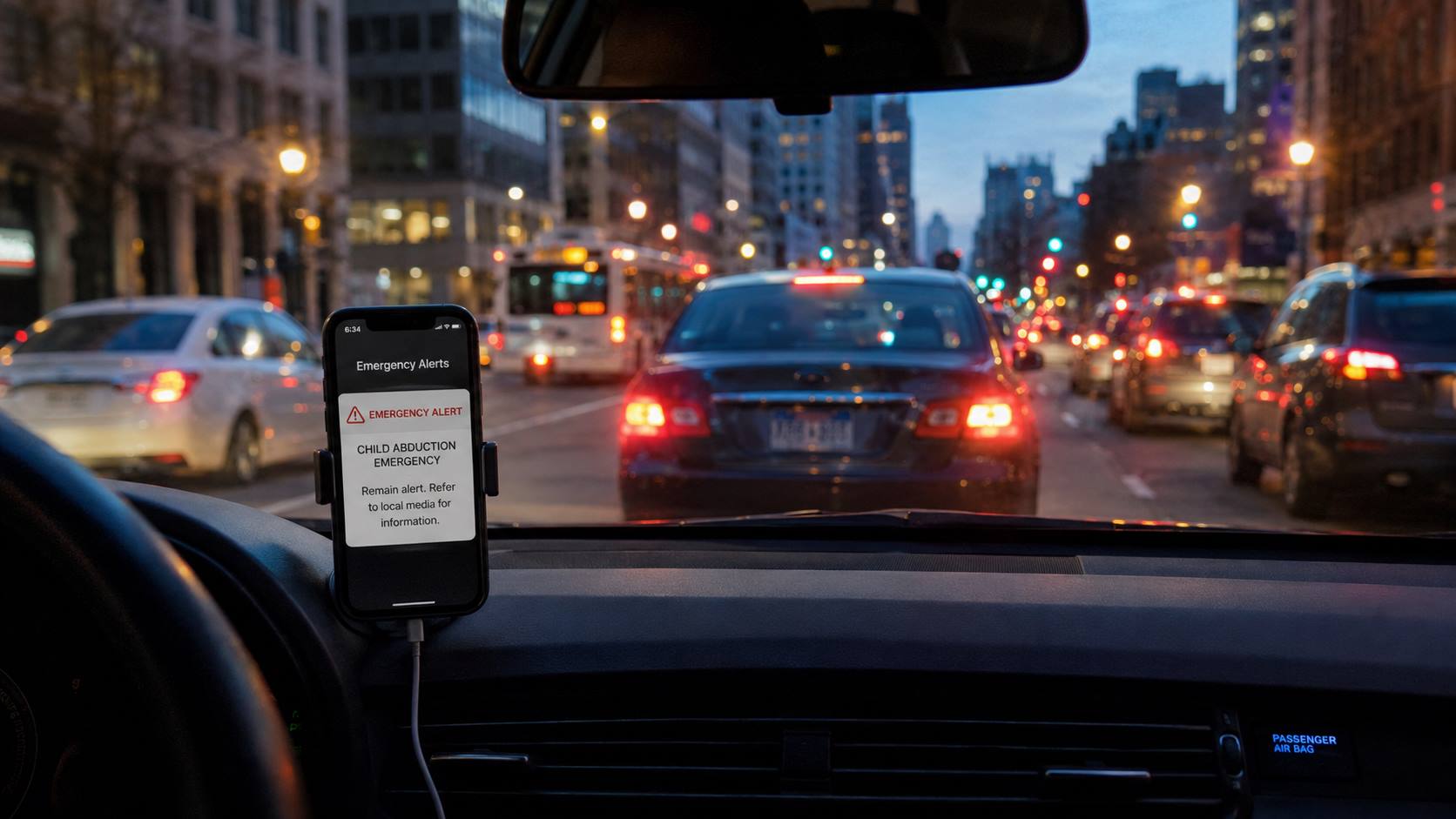
But the Amber Alert movie is not based on one specific true story.
There are actually two movies with this title. The original Amber Alert was released in 2012. A larger remake followed in 2024. Both tell fictional stories built around the real AMBER Alert system. The newer film also grew from a real moment when filmmaker Kerry Bellessa and his wife saw an AMBER Alert while driving and began discussing what they would do if the suspected vehicle appeared in front of them.
The movies do not recreate the kidnapping of Amber Hagerman. However, the alert system used in their stories exists because of her real and deeply tragic case.
The answer at a glance
| Question | Answer |
|---|---|
| Is Amber Alert based on a real story? | No. Its main characters and kidnappings are fictional. |
| Is the 2012 movie real footage? | No. It is a scripted found-footage thriller. |
| Who kidnaps the girl in the 2024 movie? | A fictional man named Aaron kidnaps Charlotte Bryce. |
| Who kidnaps the girl in the 2012 movie? | Michael Muller kidnaps Brooke Layton. |
| Was the real Amber Hagerman found? | Yes. Her body was found four days after her abduction. |
| Was Amber’s killer caught? | No. Her murder remains unsolved. |
Two Amber Alert movies can cause confusion
When someone asks whether Amber Alert is real, they may be talking about either the 2012 film or the 2024 remake.
The two movies share the same basic idea. Regular people notice a car connected to a child-abduction alert and choose to follow it. Yet their characters, filming styles, and some plot details are different.
Amber Alert from 2012
The 2012 movie follows Samantha Green, Nathan Riley, and Samantha’s brother Caleb. They are making a video when they notice a vehicle matching the description shown in an active AMBER Alert.
Instead of ignoring it, they follow the car.
That decision turns their ordinary drive into a dangerous search for an abducted girl. Rotten Tomatoes describes the story as a group of friends following a vehicle posted in an AMBER Alert, while the cast records identify the main characters and Michael Muller, played by Jasen Wade.
The movie was designed to resemble video recovered after a real crime. Shaky camera movement, natural arguments, rough sound, and long scenes inside the car all make it feel less polished than a normal Hollywood production.
That realism is deliberate. It does not mean the recording is authentic.
Amber Alert from 2024
The 2024 version stars Hayden Panettiere as Jaq and Tyler James Williams as Shane.
Jaq is taking a rideshare driven by Shane when both receive an alert about a missing child. They soon notice a car that appears to match the alert. Jaq believes the kidnapped girl may be inside, and she persuades Shane to follow it.
The official synopsis describes their ride as a dangerous race against time after they realize they may be driving behind the kidnapper’s vehicle.
This version is not presented as recovered footage. It is a conventional scripted thriller with professional actors, controlled camera work, police scenes, emergency operators, and a wider view of the search.
Director Kerry Bellessa described the 2012 production as an early found-footage version of the idea. More than a decade later, he returned to the same concept and expanded it into the 2024 film.
Is Amber Alert based on a real story?
No. Neither movie tells the true story of a particular abducted child.
Charlotte Bryce, Jaq, Shane, Aaron, Samantha, Nathan, Brooke Layton, and Michael Muller are fictional characters. They were created to explore a real question:
What should an ordinary person do after noticing a vehicle that matches an AMBER Alert?
That question came from a real experience. Kerry and Summer Bellessa said the original idea developed during a drive from Los Angeles to Phoenix. They saw an AMBER Alert and began talking about what they might do if they spotted the car mentioned in it.
The conversation became the foundation for the 2012 movie and, later, the 2024 remake.
So the most accurate description is:
The Amber Alert movies are fictional stories inspired by a real public-warning system and a real-life conversation, not by one documented kidnapping case.
Who kidnapped the girl in the Amber Alert movie?
The answer depends on which version you watched.
Who is the kidnapper in the 2024 film?
In the 2024 movie, Aaron kidnaps a young girl named Charlotte Bryce.
When Jaq and Shane first question him, Aaron tries to explain away the suspicious situation. He claims the child is connected to him and gives them a story meant to stop their pursuit.
Jaq eventually notices details that do not fit his explanation. She realizes that the child is Charlotte and that Aaron has been hiding the truth. The cast credits identify Kurt Oberhaus as Aaron and Ducky Cash as Charlotte.
Aaron is not based on the unknown man who abducted Amber Hagerman. He is a fictional villain written for the movie.
Who is the kidnapper in the 2012 film?
In the 2012 version, Michael Muller is the man connected to the abduction of Brooke Layton.
Michael attempts to make the people following him believe that the alert is a misunderstanding. His calm explanations create doubt, which makes the situation more unsettling.
The official film listings credit Jasen Wade as Michael Muller and Brooke Thompson as Brooke Layton.
Once again, these are fictional characters. Michael Muller is not a real criminal connected to Amber Hagerman’s murder.
Is the movie Amber Alert real footage?
No.
The confusion mainly surrounds the 2012 movie because it uses the found-footage style.
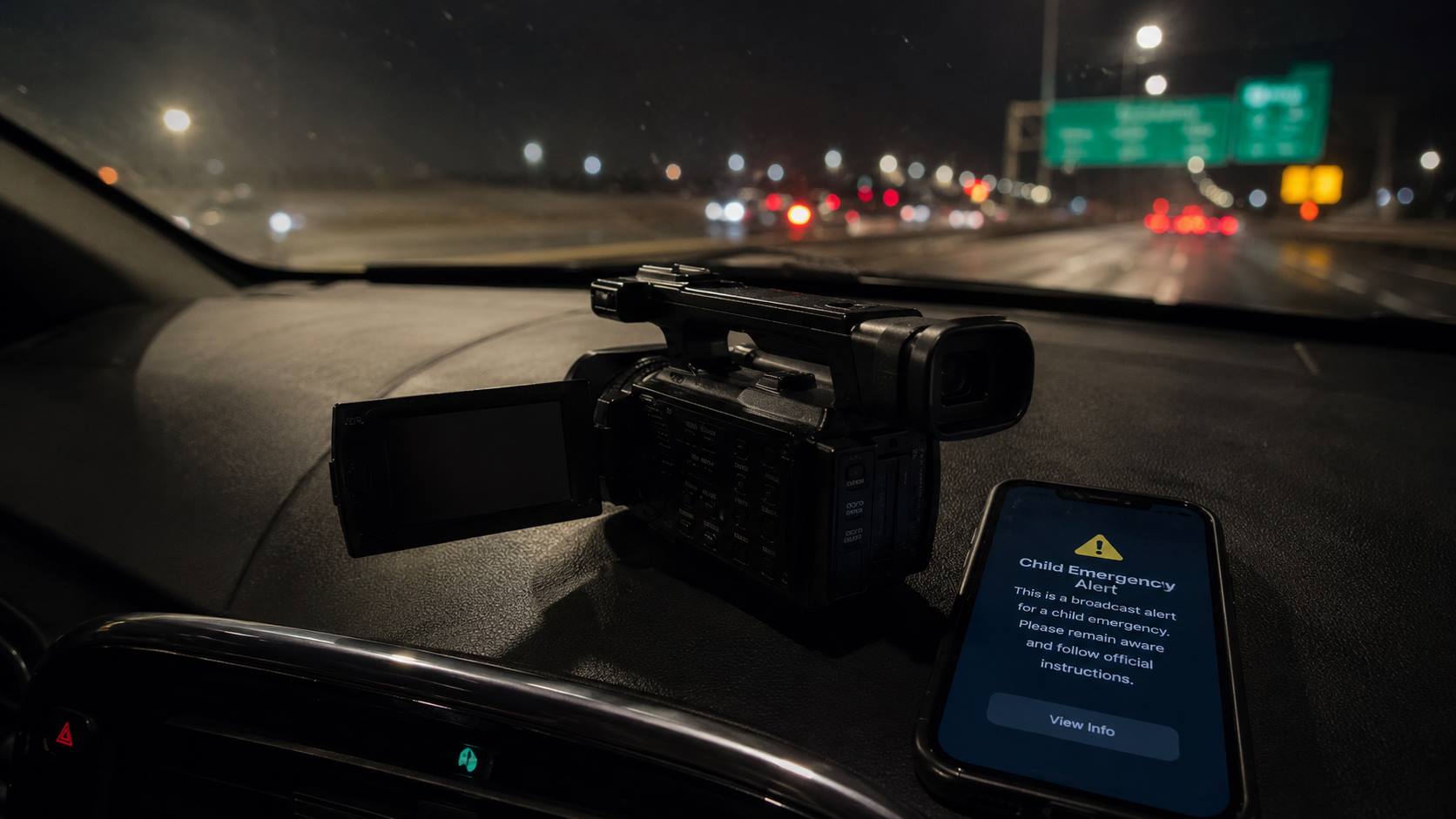
Found-footage films are scripted movies made to look like recordings discovered after an incident. The actors may speak over each other. The camera may shake or lose focus. Scenes may appear poorly lit. Information can seem incomplete because viewers only see what the person holding the camera records.
The 2012 movie has named actors, writers, producers, a director, a theatrical release and official production credits. Summer Bellessa plays Samantha Green, Chris Hill plays Nathan Riley, and Jasen Wade plays Michael Muller.
The footage was therefore created for the film.
The 2024 version is even clearer. It is a professional Lionsgate thriller starring Hayden Panettiere and Tyler James Williams. It does not pretend to be recovered evidence.
The real girl behind the name Amber Alert
Although the movies are fictional, the name AMBER Alert carries a real history.
Amber Rene Hagerman was nine years old when she was abducted in Arlington, Texas, on January 13, 1996. She had been riding her pink bicycle near her grandparents’ home when a man in a black pickup truck grabbed her.
A witness saw the kidnapping and contacted police. Searches began, but Amber could not be rescued in time.
Her body was discovered in a creek four days later. Her killer was never identified, and the murder investigation remained open decades after her death.
Amber’s case exposed a serious problem. Police might know that a child had been abducted, and a witness might have information about a vehicle, but there was no fast national method for sending that information to everyone nearby.
A local resident, Diana Simone, suggested using emergency broadcasts for child abductions in the same way authorities used alerts for dangerous weather. Dallas-Fort Worth broadcasters and law-enforcement agencies then worked together to develop an early warning plan.
AMBER later became an acronym for:
America’s Missing: Broadcast Emergency Response
The name also preserves Amber Hagerman’s memory.
Did they ever find Amber’s body?
Yes.
Amber Hagerman’s body was found in a creek four days after she was taken. This fact is sometimes confused with the endings of the fictional films, but Amber was a real child whose case led to the alert system.
Her body was found, but her killer was not.
Investigators examined thousands of leads over the years. Police also continued looking at evidence as forensic technology improved. No person has been convicted of Amber’s kidnapping or murder.
The answer is painful but important:
Amber was found, yet justice for her family has never been completed.
How the real system works
An AMBER Alert is not issued for every missing child.
Law enforcement first determines whether the case meets the required child-abduction criteria. When an alert is approved, information may be shared through television, radio, highway signs, digital billboards, websites and mobile-phone notifications.
The system turns the public into thousands of extra eyes.
A person driving home may recognize a license plate. A store worker may notice a child or suspect. Someone may remember seeing a vehicle near the place where the child disappeared.
As of December 31, 2025, the U.S. Department of Justice reported that 1,312 children had been successfully recovered because of AMBER Alert activations. At least 252 of those children were rescued with help from Wireless Emergency Alerts.
Those numbers explain why Amber’s legacy reaches far beyond a movie title.
Why the films feel believable
The movies work because their central situation is simple and possible.
Most people have received an emergency alert on a phone. Many have seen a child-abduction message on a television screen or highway sign. The films take that familiar moment and add one frightening possibility:
What happens when the described car is directly in front of you?
The 2012 version creates realism through its rough found-footage presentation. The 2024 version uses recognizable technology, rideshare travel, phone alerts, dispatch calls and ordinary people who are unsure whether their suspicions are correct.
Neither movie needs to copy a true case. The real alert system already gives the story emotional weight.
What the story is really asking
At its heart, Amber Alert is not only about a car chase.
It is about responsibility.
Jaq and Shane could continue with their day. Samantha and Nathan could assume someone else will report the vehicle. Instead, they become emotionally involved because they understand that delay may cost a child’s life.
The movies exaggerate that choice for suspense. Real situations require greater caution. Members of the public should observe identifying details, follow the instructions in the alert and contact law enforcement. A person should not place themselves, the child or other drivers in greater danger by attempting a movie-style confrontation.
That difference matters. Cinema asks what makes an exciting scene. A real AMBER Alert asks what gives a missing child the safest and fastest path home.
The truth behind Amber Alert
Amber Alert is not a true-crime recreation. The kidnappers, victims and civilian pursuers in both versions are fictional.
The 2012 film is not real recovered footage. It uses a found-footage technique to create that impression. The 2024 film is a professionally produced remake that expands the same idea into a larger thriller.
Yet there is a true story beneath the title.
Amber Hagerman was a real nine-year-old girl. Her body was found four days after her abduction, but her killer was never brought to justice. The emergency system created in her memory has helped return more than a thousand children to safety.
That is why the movie can feel real even when its plot is invented. Every alert carries a possibility that is not fictional: somewhere, a child may be waiting for one person to notice.

Jessica Savitch, with a deep passion for journalism, brings her expertise to istruestory.com as a dedicated author. MA in Arts & Journalism.