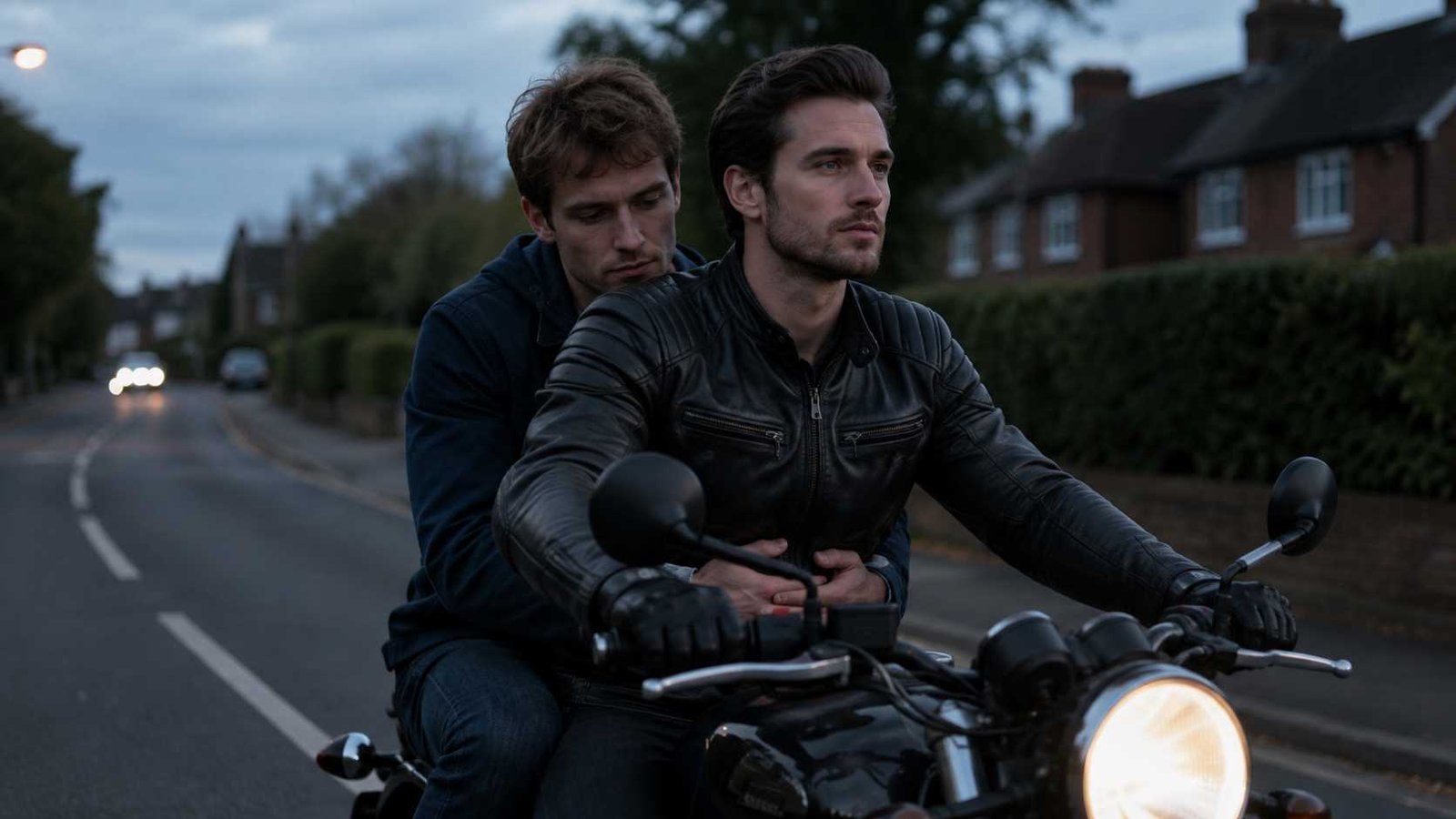
The clear answer is that Pillion is not a direct true story. It is a fictional film adapted from Adam Mars-Jones’s 2020 novella Box Hill. However, the novel was reportedly loosely inspired by the experience of one of Mars-Jones’s friends. That makes the film fiction with a small real-life seed rather than a factual retelling.
What Is the Movie Pillion Based On?
Writer-director Harry Lighton based Pillion on Box Hill: A Story of Low Self-Esteem. The novella follows Colin, a shy young man who becomes involved with Ray, an older and more confident biker, within the gay biker culture of 1970s England.
Lighton kept the central relationship but changed many details. The film moves the story into the present day, makes Colin older, gives him a job as a traffic warden, and builds a lighter romantic-comedy tone around material that is darker and more tragic in the book.
These changes matter. The movie is not simply the novel placed on screen. It uses the same emotional engine: Colin is drawn toward a man who offers excitement, identity, structure, and belonging, but very little ordinary reassurance.
The official Cannes description presents the setup simply: a timid man is swept away by a mysterious biker who takes him on as his submissive. Harry Melling plays Colin, while Alexander Skarsgård plays Ray.
Is There a Real Story Behind Box Hill?
There is a limited real-life connection.
A literary review referencing a 2020 interview with Mars-Jones states that Box Hill was loosely based on a friend’s true story. According to that account, the friend later said the novel brought back happy memories.
That does not mean every event involving Colin and Ray happened. Mars-Jones shaped the material into fiction, creating characters, scenes, themes, and a carefully controlled narrative voice. The movie then changed that fictional story again.
So, when asking whether Pillion is based on a true story, the most accurate answer is:
No, not directly. It is based on a fictional novella that drew loose inspiration from a real person’s memories.
Did Ray Have Feelings for Colin in Pillion?
Spoilers ahead.
Ray’s affection is present but guarded
Ray appears to have feelings for Colin, although he refuses to express them in the way Colin wants.
His affection appears through small changes in behaviour rather than open declarations. He allows Colin deeper into his home, routine, and biker circle. At vulnerable moments, his hard exterior briefly softens. These signs suggest that Colin matters to him.
Yet Ray keeps emotional control. He is comfortable defining rules, giving commands, and receiving devotion. He becomes uncomfortable when Colin asks for ordinary closeness, equality, or a clearer romantic commitment.
That tension is the heart of their relationship. Colin does not merely want to submit. He also wants to be seen, valued, and loved. Ray may care for him, but he cannot or will not offer the kind of mutual relationship Colin begins to need.
The film never turns Ray into a simple villain. He is emotionally closed, controlling, and often selfish, but he is not without tenderness. His feelings seem real. His ability to build a healthy future around them is much less certain.
This reading is an interpretation of Ray’s actions rather than a confirmed answer spoken by the character. Alexander Skarsgård’s restrained performance deliberately leaves much of Ray’s inner life hidden. Critics have similarly noted that his sensitivity is communicated through small hints instead of open emotion.

How Realistic Is the Pillion Movie?
The film worked hard to make its biker and BDSM world feel lived-in rather than invented for shock.
Lighton spent time with Britain’s Gay Bikers Motorcycle Club while researching the film. Club members advised the production on clothing, behaviour, posture, and nonverbal signs of submission. Several people from the biker community also appeared in the movie.
This helps explain why the group scenes feel natural. The bikers do not appear only as threatening background figures. They joke, socialise, form friendships, and create a sense of community.
However, Ray and Colin’s arrangement should not be treated as a guide to every dominant-submissive relationship. Lighton has said their relationship was not intended to be aspirational. The film also shows different practices within the wider community, including moments of communication and aftercare.
The realistic part is not that every relationship works like theirs. It is that people within the same subculture can have different rules, limits, needs, and standards.
What Is the Deeper Meaning of the Movie Pillion?
Colin begins in the passenger seat
A pillion is the passenger seat behind a motorcycle rider. The passenger does not steer, choose the speed, or control the direction.
That image describes Colin at the beginning of the film. He lets Ray lead him physically and emotionally. Being chosen by Ray gives him confidence and a sense of identity, but it also encourages him to ignore his own needs.
Colin’s submission is not shown as the problem by itself. He genuinely finds pleasure and meaning in it. The deeper problem is that he struggles to ask for what he needs in return.
The title therefore carries two meanings. Colin is literally Ray’s passenger, but he is also a passenger in his own emotional life.
Desire can reveal a person and hide them
Through Ray, Colin discovers a side of himself that had remained unexplored. He learns what excites him, where he feels comfortable, and what kind of connection he wants.
But desire can become a hiding place. Colin sometimes treats obedience as proof of love. He accepts emotional distance because he fears asking for more might end the relationship.
The story is therefore not about Colin escaping his sexuality or rejecting submission. It is about separating his genuine desires from his fear of being unwanted.
Learning how to negotiate love
Lighton explained that the film explores how entering situations with little control can lead to pain, heartbreak, or abuse, but can also teach someone about their desires and help them negotiate future relationships more clearly.
That idea shapes Colin’s journey. He does not finish the story by rejecting submission or becoming a completely different person. He finishes with a better understanding of his boundaries.
He learns that knowing what you desire is only part of becoming yourself. You must also know what you cannot accept.
How Pillion Differs From a Typical Romance
Most romantic films ask whether two people will finally admit that they love each other. Pillion asks a harder question:
Is love enough when two people want different kinds of intimacy?
Colin wants devotion and emotional recognition. Ray wants control without the same level of vulnerability. Their attraction is powerful, but attraction cannot settle every difference.
That is why the movie can feel tender and troubling at the same time. Colin is not simply trapped. He experiences real happiness. Ray is not simply heartless. He shows flashes of care. Yet the relationship remains painfully unequal whenever Colin tries to change its terms.
The Associated Press described the film less as a traditional love story and more as a sexual coming-of-age journey in which Colin must learn that he cannot always give without asking for something in return.
The Truth Behind Colin and Ray
Pillion is not the hidden biography of a real biker couple. Colin and Ray are fictional characters shaped first by Adam Mars-Jones and then reimagined by Harry Lighton.
Still, the film’s emotions feel truthful. It understands the thrill of being chosen, the safety some people find in surrender, and the pain of discovering that the person who awakened you may not be able to grow with you.
Colin begins the story holding tightly to someone else while that person controls the road. By the end, he has started deciding where he wants to go.
That is the deeper truth inside Pillion: sometimes a relationship does not last, but it can still teach you how to stop living as a passenger.

Jessica Savitch, with a deep passion for journalism, brings her expertise to istruestory.com as a dedicated author. MA in Arts & Journalism.