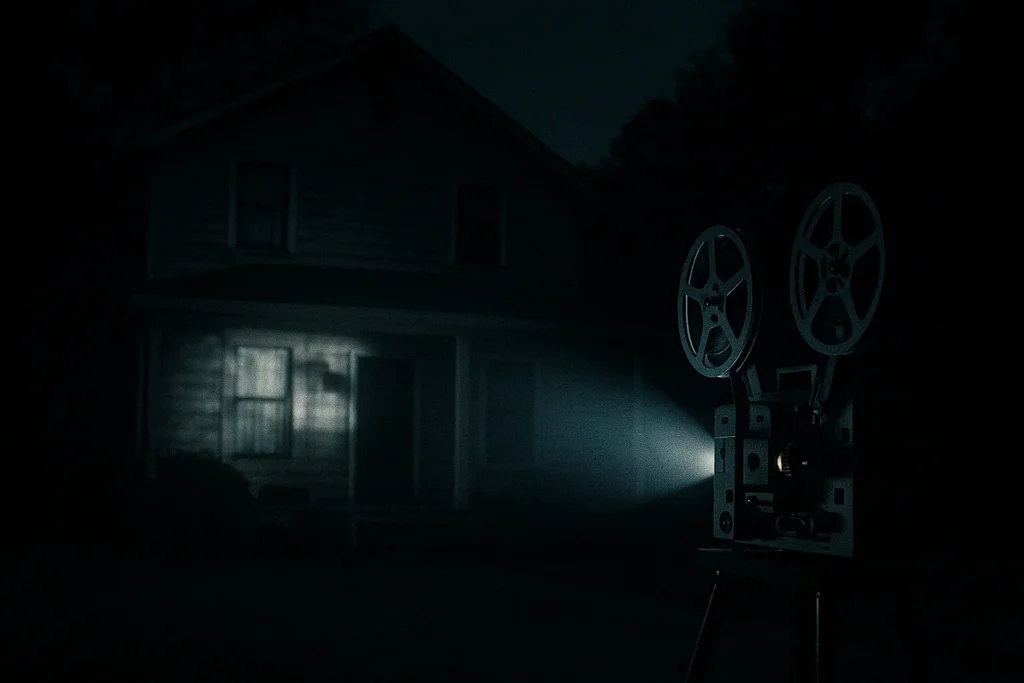
So the question that’s followed it ever since is simple but haunting:
Was Sinister based on a true story?
Let’s rewind the reel and look at what really inspired this modern horror gem.
Where the Story Really Came From
Director Scott Derrickson and writer C. Robert Cargill didn’t dig up a police file or base the script on a known haunting. The seed came from something far more relatable a nightmare after watching a found-footage movie.
Cargill once shared that he had a terrifying dream after seeing The Ring (2002). In it, he discovered an old box of home movies in his attic each film showing a different family being murdered. When he woke up, he couldn’t shake the feeling. That nightmare became the outline for Sinister.
So no, Sinister isn’t “based on a true story.” But it is based on something we’ve all felt: that late-night fear when familiar spaces suddenly feel unsafe.
A Horror Formula That Feels Too Real
One reason Sinister feels so believable is the way it blurs everyday life with something ancient and unexplainable.
The film follows true-crime author Ellison Oswalt (Ethan Hawke), who moves his family into a house where a horrific murder occurred. While researching his next book, he finds reels of home movies that document a series of gruesome killings each one filmed by an unseen hand.
The setup alone echoes real-life cases where journalists or authors chase tragedy for their next story, only to get lost in it. That human weakness ambition blinding morality is what grounds the film.
What Was Sinister Inspired By?
Derrickson has said that Sinister is “a movie about the seduction of evil through curiosity.”
The inspiration was less about real events and more about human psychology. He wanted to explore why people, even good ones, get drawn toward dark things they know will destroy them.
Here’s what fed that inspiration:
- True-crime obsession. The idea of someone risking their sanity for fame mirrors real journalists who blur the line between storytelling and exploitation.
- Found-footage horror trends. Films like The Ring, Paranormal Activity, and Blair Witch Project showed how audiences feared what looked “real.” Sinister built on that but used it inside a scripted story.
- Ancient myth. The movie’s villain, Bughuul, was crafted from fragments of old legends, not any single real myth.
The Myth of Bughuul: Real or Made-Up?
Every good horror film needs a monster and Sinister gave us one of the most chilling in modern cinema.
Bughuul, the so-called “Eater of Children,” looks like a mix between a metal-album cover and a pagan deity. Many viewers assumed he was pulled from real folklore.
But the truth?
Bughuul is completely fictional.
Cargill invented him from scratch, pulling vague elements from Mesopotamian mythology and Christian demonology to make him feel ancient. Fans on Reddit even tried to connect Bughuul to real figures like Moloch or Ba’al, both known for child sacrifices, but there’s no historical record of a god named Bughuul.
The brilliance lies in how they designed him his appearance and the mystery around him are convincing enough to make you Google it just to be sure.
Is Sinister a Found-Footage Film?
Technically, Sinister isn’t a full found-footage movie. It’s a hybrid a traditional narrative with disturbing home-video segments woven in. Those reels, labeled “BBQ,” “Sleepy Time,” and “Lawn Work,” feel authentic because they were shot using real Super 8 cameras.
To keep the illusion raw and unnerving, the filmmakers:
- Used real Super 8 film stock instead of digital filters.
- Avoided actors’ faces for most of the reels.
- Scored them with eerie, distorted sound design instead of a normal soundtrack.
That choice gave Sinister its notorious realism. When audiences ask, “Is this based on real footage?” it’s a compliment to how convincing the craftsmanship was.
The Psychology Behind the Fear
While most horror movies rely on jump scares, Sinister weaponizes something subtler: the dread of discovery.
Every time Ellison threads the projector, we brace for the next revelation. That tension mirrors real human behavior we can’t look away from tragedy, even when it’s destroying us.
Psychologists call this morbid curiosity. The same instinct that drives people to watch true-crime documentaries fuels Sinister’s suspense. We want to understand evil, hoping knowledge will make us safe. But as the movie shows, it can do the opposite.
What Makes It Feel Like a True Story
Even though Sinister isn’t real, it feels real because it uses details that echo true-crime cases and suburban horror stories:
- A writer exploiting tragedy for fame.
- A family moving into a crime scene without telling anyone.
- Home movies revealing violence that once seemed ordinary.
- An unseen evil passed from one home to another like a curse.
Those are all things that could happen and have, in bits and pieces, throughout real history. That blurred edge between fiction and possibility is why the film hits so hard.
The Real “True Story” Behind Sinister
If you look closely, the “true story” isn’t about demons or curses. It’s about what happens when people trade morality for ambition.
Ellison Oswalt’s downfall mirrors countless real-life figures authors, reporters, influencers who chase sensationalism until it consumes them.
The evil in Sinister may be supernatural, but the temptation that fuels it is deeply human. That’s the real horror: our willingness to risk everything for recognition.
Fun Fact: The Science of Fear Loves Sinister
A 2020 study by BroadbandChoices named Sinister the scariest movie ever made, based on viewers’ heart-rate spikes. Participants’ heartbeats rose by an average of 32 bpm during key scenes higher than Insidious or The Conjuring.
That’s not supernatural proof, but it is scientific evidence that the film knows exactly how to trigger fear on a primal level.
So, Is Sinister Based on a True Story?
Here’s the truth in one line:
No, Sinister isn’t based on any real event but it’s inspired by a nightmare rooted in our very real fears.
It takes bits of truth the obsession with crime, the danger of curiosity, and the myths we invent to explain evil and spins them into something that feels authentic. That’s why it works.
Behind the projector glow and screams, Sinister holds up a mirror to our fascination with the macabre and dares us to keep watching.
The Legacy of Sinister
More than a decade later, Sinister stands as one of the most effective horror films of the 2010s. It reminded Hollywood that terror doesn’t need huge budgets or constant gore it just needs atmosphere, tension, and imagination.
It also gave us Bughuul, now a cult horror icon, and reignited the trend of psychological, slow-burn horror that films like Hereditary and The Babadook would later perfect.
So next time you watch Sinister in the dark and that projector starts humming, remember no true story needed. The fear works because it feels possible.

I am Jeremy Jahns – Your Cinematic Explorer
Immerse in movie reviews, Hollywood insights, and behind-the-scenes stories.