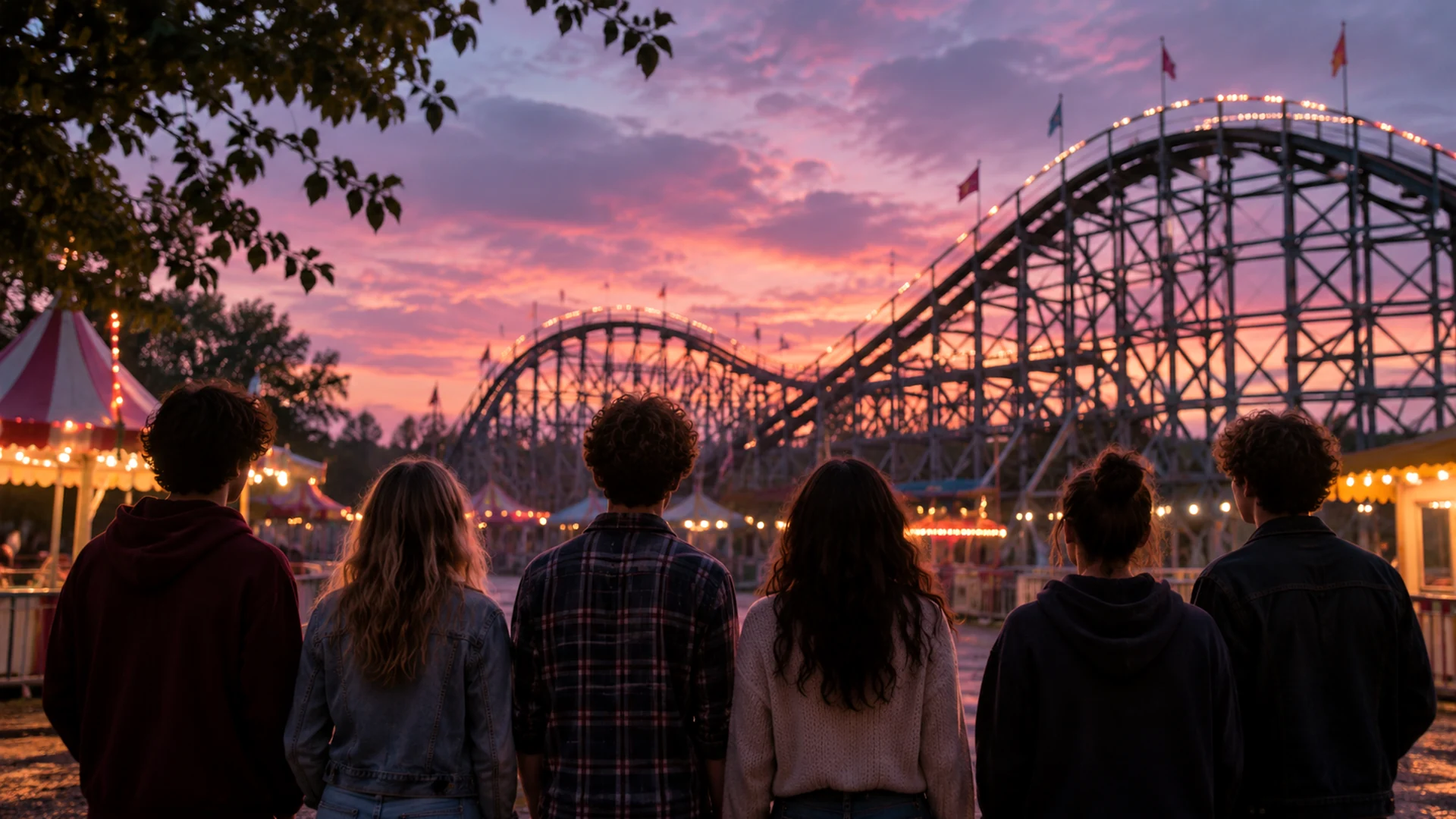
Six teenagers die on a roller coaster. A talking fortune-telling machine gives them one impossible opportunity: tell their stories and compete for a second life. It sounds like an unsettling newspaper headline, which raises an obvious question: is Ride the Cyclone based on a true story?
No. Ride the Cyclone is a fictional stage musical, not a retelling of a documented roller-coaster disaster. Writers Jacob Richmond and Brooke Maxwell drew on recognizable feelings about sudden death, grief, missed chances, and what makes a life meaningful. The premise is invented, but the emotions behind it are real. That distinction comes directly from the creators’ accounts of their work in Playbill and an interview with Curtain Call.
Is Ride the Cyclone Based on a True Story?
The short answer is no. There is no identified historical choir from Uranium, Saskatchewan, whose deaths and afterlife contest form the musical’s plot. The fortune teller, the competing teenagers, and the unusual rules of their second chance belong to the story’s imaginative world.
According to the official licensing synopsis from Concord Theatricals, six members of a Canadian chamber choir die in a freak accident and awaken in limbo. The Amazing Karnak, a mechanical fortune teller, offers one of them the chance to return to life. The students try to explain what they would do with that opportunity through a series of highly personal songs.
That makes the musical different from a historical adaptation such as Newsies, which draws on the real 1899 newsboys’ strike. Ride the Cyclone does not start with a documented event and dramatize the details. It begins with a fictional disaster and asks real human questions.
What Is the Story Behind Ride the Cyclone?
The story follows the Saint Cassian High School chamber choir after an outing to a traveling fair turns fatal. Instead of moving straight to an unknown afterlife, six students find themselves in a strange setting controlled by Karnak. Only one can be brought back, and each must present a case for why their life deserves another chapter.
Ocean O’Connell Rosenberg expects to win. Mischa Bachinski hides a romantic heart behind a tough persona. Noel Gruber dreams of a different life. Ricky Potts turns to imagination; Constance Blackwood learns to value ordinary moments. Jane Doe cannot remember her own identity.
The changing musical styles reveal each student’s inner life. Can anyone fairly decide whose life matters most? Concord’s description emphasizes memory, friendship, and the meaning of a life well lived. It is best understood as a dark comedy with a moving story, not a supernatural investigation.
What Inspired Jacob Richmond and Brooke Maxwell?
Jacob Richmond and Brooke Maxwell developed the musical out of the creative world of Atomic Vaudeville, a theatre company associated with Victoria, British Columbia. Their early work combined strange characters, quick jokes, and contrasting songs. A full-length musical offered space for a darker idea.
In a 2022 interview with Curtain Call, Richmond recalled suggesting a musical about six children killed on a roller coaster. Maxwell initially thought the premise sounded bleak; Richmond explained that the point was to make something life-affirming. They developed the idea together rather than adapting a known local tragedy.
Richmond offered a more personal explanation in Playbill’s track-by-track conversation: people sometimes lose loved ones through arbitrary accidents and illnesses. He wanted to give dramatic attention to lives interrupted without warning. This helps explain the musical’s attention to the teenagers’ wishes and lost futures.
The show reached Off-Broadway in 2016, according to Concord’s production history. Its path from an unusual local stage idea to a widely discussed musical is a real story. The deadly roller-coaster event inside it is not.
Was the Roller-Coaster Accident Based on a Real Disaster?
There have been real amusement-park accidents, so it is easy to assume that the musical borrowed one. However, the creators’ published explanations do not identify a particular crash as the source of the choir’s deaths. Without a direct statement or convincing documentary evidence, connecting the plot to a specific tragedy would be speculation.
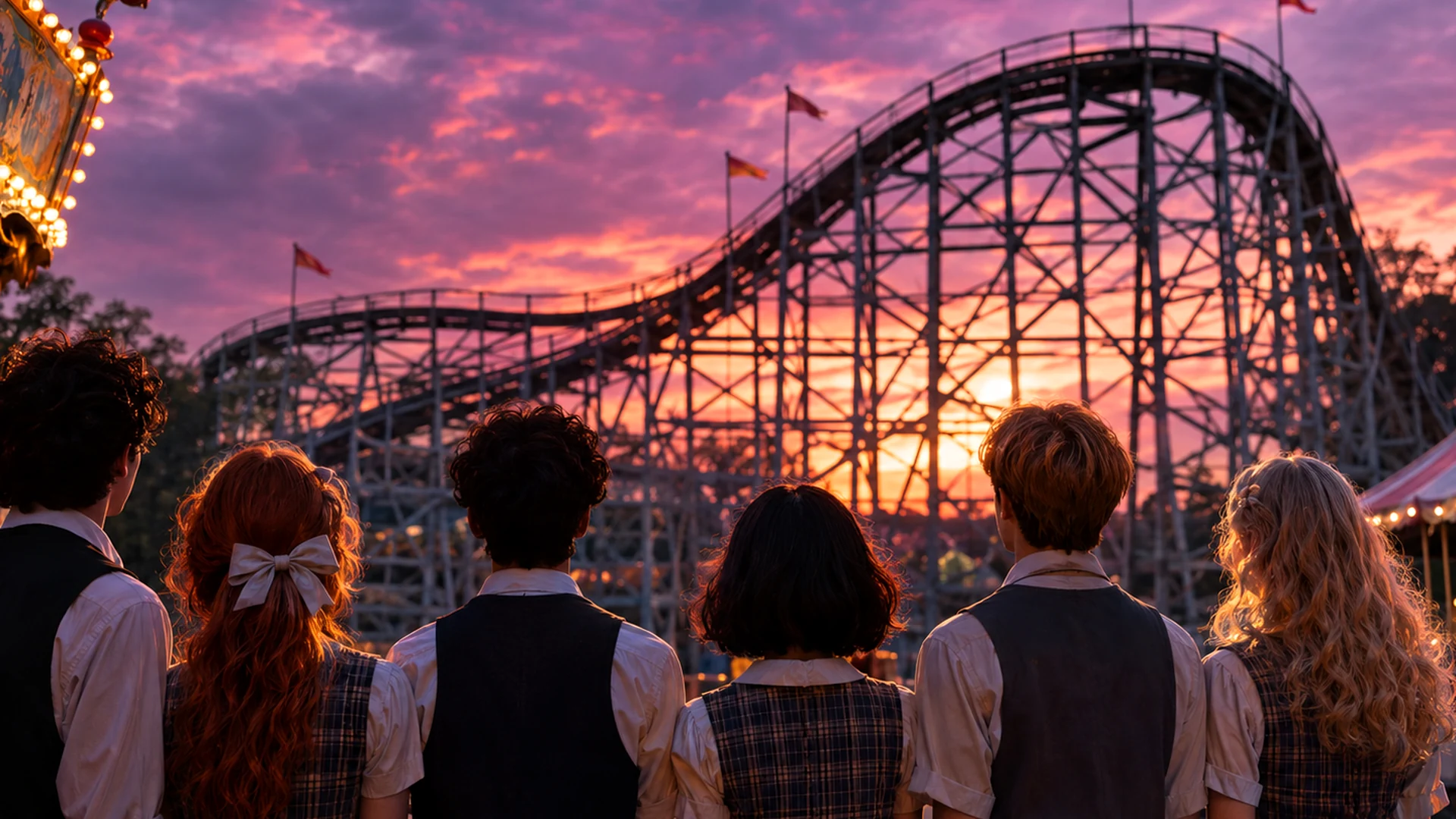
The roller coaster works as a storytelling device: one moment feels thrilling and ordinary, and the next changes everything. That sudden reversal allows the musical to talk about lost futures without presenting a real family’s experience as entertainment. The same separation between invented characters and believable feeling appears in Mr. Holland’s Opus, another fictional story with recognizable emotional stakes.
Important distinction: a story can be inspired by the reality of accidental loss without being based on one verified accident. That is the most accurate way to describe Ride the Cyclone.
What Is Jane Doe’s Real Name in Ride the Cyclone?
Spoiler warning: the name associated with Jane Doe is Penny Lamb. Concord Theatricals explicitly identifies Penny Lamb as Jane Doe’s true identity in its production and video guidance. The show’s ending connects the mysterious girl to that name and to the possibility of life beyond the contest.
Jane has lost more than her life: she cannot remember who she was. The name Jane Doe signals an unknown identity. Her song explores what it means to be forgotten.
There is another interesting connection. Penny Lamb also appears in Richmond’s earlier stage work Legoland, which follows Penny and her brother Ezra. The University of Victoria’s 2008 production archive confirms those characters existed in that play. That is a link within a writer’s fictional world, not evidence that Penny was a historical person.
Fans debate Jane’s timeline, but Penny Lamb is the named identity used in the production materials, while not every detail of Jane’s experience has to be treated as an ordinary, literal timeline.
Is There LGBTQ Representation in Ride the Cyclone?
Yes. Noel Gruber is gay, and his identity is explicitly part of the musical. The official character description identifies him as the only gay teenager in Uranium and describes his love of French New Wave cinema and tragic romantic fantasy.
Noel’s musical number, Noel’s Lament, allows him to invent a dramatic life far removed from his small-town experience. In Playbill’s interview, Richmond discusses the song as a way for Noel to perform the fictional figure he imagines. The sequence is intentionally theatrical; it is not a documentary account of Noel’s experiences or a claim that his fantasy really happened.
Noel is more than a label, just as the others are more than their first impressions. The musical asks viewers to take each teenager’s inner life seriously.
Is Talia a Real Person in Ride the Cyclone?
Talia is a character within the musical, not a verified real-life person. She is connected to Mischa’s online romance and his dreams of love and belonging. His song Talia reveals the tenderness behind the tough identity he tries to project.
But another question is more interesting: is Talia truly who Mischa believes she is within the story? Richmond has deliberately refused to settle that issue. In the Curtain Call interview, he discussed fans asking whether Talia is a catfish and said he prefers leaving such mysteries open to interpretation.
That means it would be misleading to claim either that she is definitely fake or that her online relationship with Mischa has been independently confirmed inside the musical’s world. What is clear is Mischa’s love and what it tells us about him. Richmond and Maxwell explained to Playbill that they wanted the musical’s interrupted lives to include a love story.
What Does Ride the Cyclone Really Mean?
The musical asks what happens when people are judged by the small number of facts others know about them. Karnak turns the students’ return to life into a competition. But each song reveals how difficult it is to rank lives by ambition, confidence, talent, or even how much a person remembers.
It is also about small futures lost without warning: relationships, skills, and conversations that never get a chance to grow. That is why its sudden-death premise carries emotion even though the situation is fantastical.
It helps to compare the musical with other fictional stories that explore big choices. Questions about what Wicked changes in its telling also remind us that stage stories use imagined situations to examine recognizable human behavior. And The Sound of Music shows another relationship between theatre and reality: that musical reshapes an actual family’s experiences, while Ride the Cyclone invents its central event entirely.
So, Ride the Cyclone is not based on a true story. Its choir, accident, fortune teller, and afterlife contest are fiction. What its creators drew from real life is less sensational and more familiar: people lose one another unexpectedly, nobody can know every detail of another person’s life, and even a brief existence can matter deeply.
I am Jeremy Jahns – Your Cinematic Explorer
Immerse in movie reviews, Hollywood insights, and behind-the-scenes stories.