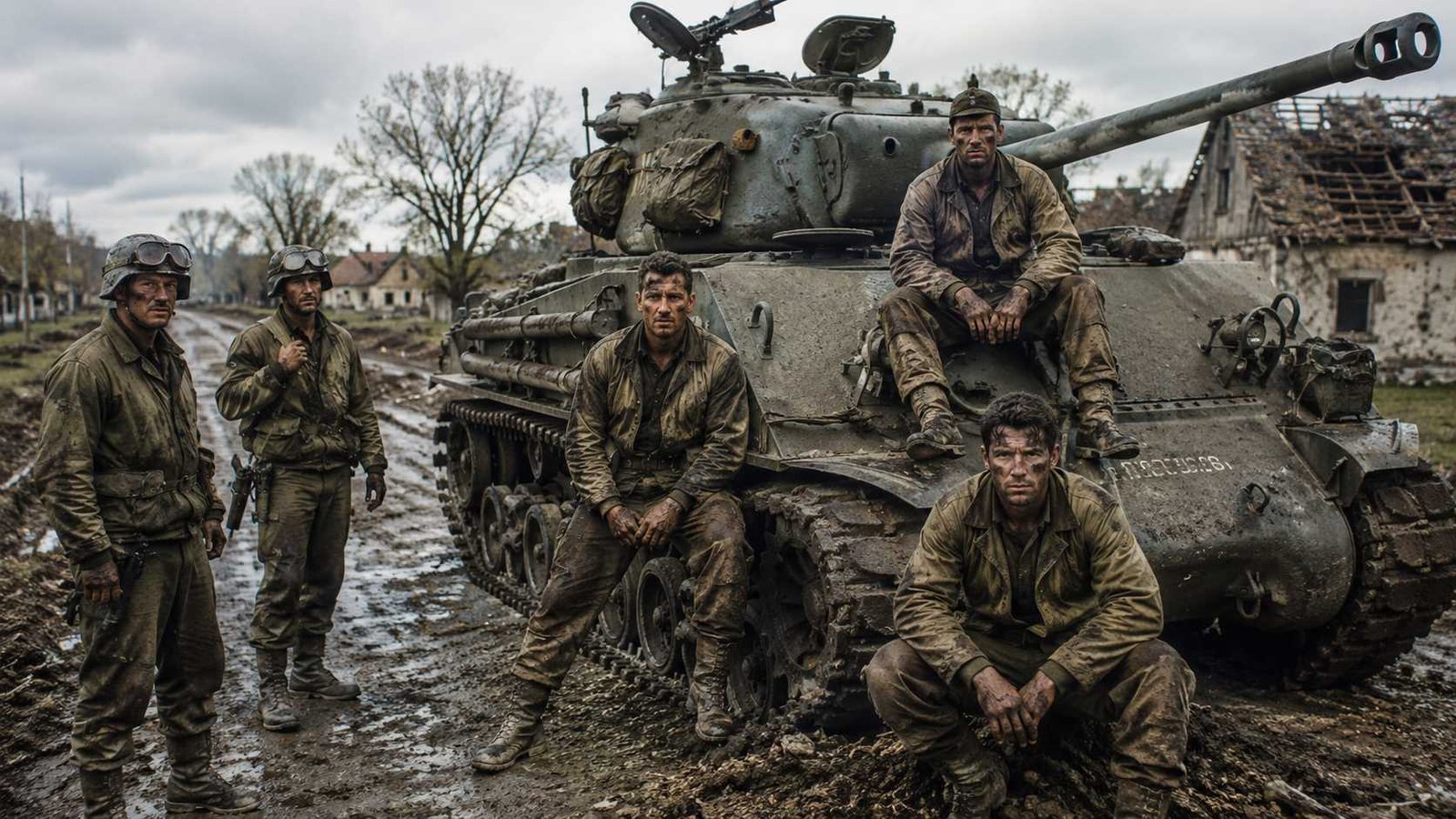
The mud looks real. The tanks are real. The soldiers look exhausted rather than heroic. Even the conversations inside the tank feel uncomfortable and lived-in.
But is Fury based on a true story?
The short answer is no, not one specific true story.
Don “Wardaddy” Collier, Norman Ellison, Boyd “Bible” Swan, Trini “Gordo” Garcia, and Grady Travis are fictional characters. There was no documented American tank crew named Fury that fought the exact battles shown in the movie.
What makes the answer interesting is everything underneath that fiction.
Writer-director David Ayer built Fury from real World War II tanker experiences, military records, veteran interviews, historical photographs, and books about American armored warfare. He wanted the fictional crew to experience things that could have happened to real soldiers.
So Fury is best described as historical fiction constructed from real wartime experiences.
Fury Was Fiction, but Its World Was Carefully Researched
The movie takes place in April 1945, during the final weeks of the war in Europe.
American forces are pushing deeper into Germany. Nazi Germany is collapsing, but the fighting has not stopped. That detail matters.
The soldiers in Fury know the war may soon end, yet every road, village, anti-tank weapon, and German unit can still kill them.
That is the emotional situation David Ayer wanted to capture.
Ayer said he researched primary sources, military reports, veteran accounts, and recurring experiences rather than recreating one mission. His goal was to build a representative day in the life of soldiers fighting inside a tank.
The production also consulted World War II veterans from the 2nd Armored Division. Military and tactical advisers helped the filmmakers understand how tank crews worked, communicated, and depended on one another.
That explains why the film can feel historically true even when its main story is fictional.
What True Stories Inspired Fury?
One important influence was Belton Y. Cooper’s 1998 memoir, Death Traps: The Survival of an American Armored Division in World War II.
Cooper served with the U.S. 3rd Armored Division and wrote about American tanks, battlefield losses, damaged vehicles, replacement crews, and the terrible conditions armored troops experienced.
Ayer was influenced by Death Traps while developing Fury.
The film should not, however, be treated as an adaptation of Cooper’s book.
Ayer combined different accounts, historical details, military research, and fictional storytelling.
There is no single chapter of Death Traps that can be labeled “the true story of Fury.”
That distinction is important.
Real experiences inspired the movie. The movie did not reproduce one real crew’s biography.
Was Wardaddy a Real Person?
Brad Pitt’s Don “Wardaddy” Collier is fictional, but his nickname has genuine World War II connections.
One famous American tank commander was Lafayette G. Pool, who served with the U.S. 3rd Armored Division.
The U.S. Army confirms that Pool became known by nicknames including War Daddy and Tank Ace of Aces. He earned the Distinguished Service Cross and became one of the best-known American tank commanders of World War II.
That resemblance has led many people to say that Wardaddy was simply Lafayette Pool renamed for the movie.
The evidence is not quite that simple.
David Ayer explained that “Wardaddy” was a real wartime name. He referred both to wartime tank naming and to tank commanders who carried versions of the nickname.
So Lafayette Pool is useful when understanding the historical world behind Don Collier, but Brad Pitt’s character should not be treated as a direct biography of Pool.
Collier is a composite fictional commander.
What Happened to the Real Fury Tank?
This question has a surprising answer.
There was no real wartime tank whose documented adventures exactly match the movie. But the actual Sherman used to portray Fury is real, and it still exists.
The Tank Museum in Bovington, England, owns the Sherman that played Fury.
It is an M4A2E8 Sherman, built at the Fisher Tank Arsenal in Michigan in March 1945. Its serial number is 65016.
The museum still displays the vehicle and describes it as the mechanical star of the 2014 film.
There is one fascinating historical catch.
The Movie’s Fury Was Disguised as a Different Sherman
The physical tank used during filming is an M4A2E8.
In the movie, however, Fury represents an M4A3E8, the type appropriate for the U.S. Army crew being portrayed.
The Tank Museum explains that filmmakers dressed its M4A2E8 to resemble an M4A3E8 because the U.S. Army did not use the museum’s particular M4A2E8 configuration in Northwest Europe.
It is a perfect example of the way Fury handles history.
The machine you see is genuinely from the World War II era, but it is being used to represent a slightly different machine for the story.
Was the Tiger Tank in Fury Real?
Yes.
And this is one of the movie’s most remarkable achievements.
The German Tiger seen fighting the Shermans was Tiger 131, owned by The Tank Museum.
Tiger 131 was captured in Tunisia in 1943 and is the world’s only operating Tiger I. The museum allowed the historic vehicle to participate in Fury, giving the filmmakers something almost impossible to reproduce with ordinary movie props.
The production carefully controlled how much the fragile historic tank could move, start, stop, change gears, and travel during filming.
For shots where the Tiger had to appear damaged, the filmmakers used a reproduction rather than risking the original vehicle.
That is why the Tiger battle has such physical weight on screen.
You are not simply looking at a digital recreation of a Tiger.
For significant parts of the sequence, you are looking at a genuine surviving Tiger I moving under its own power.
How Accurate Was the Sherman Versus Tiger Battle?
The broad danger shown in the scene was real.
Tiger tanks possessed heavy armor and powerful guns. Sherman crews had genuine reasons to fear encounters with heavily armed German tanks.
World War II Sherman veteran Bill Betts later watched Fury and considered the Tiger confrontation one of the movie’s more convincing combat sequences. He recalled the vulnerability Sherman crews felt when facing heavily armed German tanks.
But that does not mean every tactical decision in the scene should be treated as a military lesson.
The Tiger leaves its protected position and closes the distance with the Shermans, creating the dramatic maneuvering that allows Fury eventually to attack it from behind.
That makes excellent cinema.
A real tank commander who had a strong defensive firing position would have powerful reasons not to surrender that advantage voluntarily.
This is one of several places where Fury uses authentic machinery and believable danger while shaping the battle for dramatic effect.
Was Fury’s Final Battle a True Story?
The final stand is the part most likely to make viewers search for the real Fury crew.
Fury hits a mine and becomes immobilized at a crossroads.
Norman discovers a large Waffen-SS force approaching.
The crew could leave.
Wardaddy chooses to remain with the tank.
One by one, the others decide to stay with him.
The damaged Sherman is disguised to look abandoned, and five American soldiers prepare to fight a vastly larger German force.
It is powerful.
It is also not a documented reconstruction of one known battle involving a tank called Fury.
Ayer strongly defended the historical foundation of his movie. He said the individual experiences portrayed in the film came from research, veterans, reports, and primary-source material.
That is different from saying the entire final battle happened exactly as shown.
A useful way to understand the ending is this:
The ingredients may come from wartime experience, but the finished scene is dramatic fiction.
Even a Sherman veteran who praised much of the film’s realism considered the climactic fight against the large Waffen-SS force far less believable than the earlier tank combat.
How Many Germans Were Killed by Fury?
There is no reliable official number for the Germans killed by Fury.
That is partly because Fury’s final battle never happened as a documented historical event.
The movie shows the crew killing a large number of Waffen-SS soldiers with the Sherman’s main gun, machine guns, grenades, and personal weapons.
By morning, the camera reveals dozens of German bodies around the disabled tank.
Various unofficial internet body-count lists assign exact numbers to the characters, but these are fan calculations rather than figures provided by the filmmakers or historical records.
So claims that the “real Fury killed 100 Germans” or some other precise number can be misleading.
There was no real Fury battle for historians to count.
The safest answer is:
The fictional Fury crew kills dozens of German soldiers during the final battle, but the movie provides no authoritative exact total.
Why Did the SS Soldier Let Norman Go?
This may be the most memorable unanswered question in the film.
Near the end, Wardaddy tells Norman to escape through the tank’s bottom hatch.
Norman crawls beneath Fury while German soldiers finish attacking the tank.
Then a young Waffen-SS soldier looks underneath.
He sees Norman.
Norman sees him.
For a moment, neither man moves.
The German soldier could expose Norman and almost certainly get him killed.
Instead, he silently leaves him there.
The Movie Never Gives an Official Explanation
There is no dialogue explaining the soldier’s decision.
That appears intentional.
The scene works better as a moral choice than as a military explanation.
One strong interpretation is that the young German acts as a mirror of the Norman we met at the beginning of the movie.
Early Norman does not want to kill.
He hesitates.
He still recognizes the person standing on the other side of a uniform.
By the final battle, Norman has been transformed into “Machine.” He can now kill quickly because war has taught him that hesitation may get his friends killed.
Then, unexpectedly, mercy returns from the enemy side.
The young German looks at Norman and refuses to kill him.
It reverses Norman’s journey for a few seconds.
The film spends more than two hours showing men becoming capable of terrible violence. Then one anonymous soldier proves that war has not completely erased individual choice.
We cannot say that this is definitively what the German soldier was thinking. The movie never tells us.
But dramatically, his act of mercy gives Norman the survival that his own earlier mercy could not give others.
Was Norman Ellison a Real Soldier?
No evidence identifies Norman Ellison as a specific historical soldier.
Logan Lerman’s character is fictional.
Norman begins as a young replacement with little preparation for tank combat. His lack of experience creates one of the film’s central conflicts.
Wardaddy sees him differently.
To Norman, refusing to kill is a moral position.
To Wardaddy, a gunner who refuses to fire can get an entire tank crew killed.
Ayer compared Norman’s situation to entering a military unit without knowing its equipment, people, or unwritten rules. That outsider perspective became the vehicle for showing the audience how someone could be psychologically transformed by combat.
Norman therefore represents something broader than one soldier.
He represents the replacement soldier entering a veteran unit and discovering that survival may demand things he never imagined himself doing.
What Was Inaccurate About Fury?
Fury deserves credit for extraordinary attention to physical detail.
Real tanks were used. Military advisers were involved. Veterans spoke with the cast. Uniforms, equipment, tank interiors, mud, exhaustion, and crew relationships received serious attention.
But historical realism and literal historical accuracy are not the same thing.
Several important parts were changed or exaggerated.
The Main Characters Are Fictional
Wardaddy and his crew are not a documented historical tank crew.
Their personalities and experiences were assembled to represent aspects of wartime service.
Fury’s Exact Sherman Variant Is Wrong
The surviving museum tank used as Fury is an M4A2E8 dressed to represent an M4A3E8.
The Tank Museum itself notes that the U.S. Army did not use that M4A2E8 configuration in Northwest Europe.
This was a practical filmmaking compromise rather than an accidental mistake.
The Final Battle Is Highly Dramatized
Five men inside an immobilized Sherman destroying large numbers of Waffen-SS troops makes for an unforgettable ending.
It should not be mistaken for a recreation of a verified battle involving Wardaddy and Norman.
The enormous German losses and the way soldiers repeatedly expose themselves to Fury’s weapons are among the most commonly questioned elements of the film.
The Tank Museum has itself acknowledged controversy surrounding Fury’s historical accuracy and notes that compromises were made for cinematic convenience.
Some German Tactical Choices Help the Story
The Tiger sequence requires the German tank to give up some of the advantages created by its initial position.
The final Waffen-SS assault also places large numbers of soldiers directly into Fury’s fields of fire.
Real commanders could make disastrous decisions, especially in the chaos of April 1945. That does not make every action impossible.
But the battles are clearly organized partly around what creates tension for an audience.
The Film Compresses the Experience of War
Norman undergoes an enormous psychological transformation over a very short period.
He moves from refusing to kill to becoming an effective combat soldier.
Real soldiers certainly experienced rapid psychological change under extreme circumstances, but Fury compresses that transformation because a movie has only a few hours to tell its story.
What Fury Gets Surprisingly Right
The movie’s strongest historical truth may not be a particular tank model or battle formation.
It may be the feeling inside the tank.
Five men live inside an armored box.
They depend on one another for survival.
One man’s mistake can kill everyone.
There is little privacy. Little sleep. Little distance from death.
The filmmakers deliberately consulted veterans and military advisers to understand this relationship.
That effort shows.
The crew argues like a dysfunctional family because, in a sense, that is what they have become.
Wardaddy can appear cruel toward Norman while also trying desperately to keep him alive.
Bible holds tightly to his faith.
Gordo carries years of exhaustion.
Grady’s aggression often feels less like confidence than damage that has found nowhere else to go.
And Norman enters their world before he has learned how to protect himself from it.
Those characters may be fictional.
The human pressures behind them were not.
Did Sherman Crews Really Suffer Heavy Losses?
Tank warfare could be terrifying.
A Sherman offered enormous firepower and mobility, but crews could still find themselves trapped inside a burning steel vehicle after an armor penetration.
That fear is present throughout Fury.
Ayer wanted the tank itself to function almost like another character: sheltering the men while simultaneously becoming the place where they could die.
The production’s use of functioning Sherman tanks helped create the cramped physical behavior visible on screen. Instead of actors simply standing on a studio set, they had to work around the restrictions of real armored vehicles.
The Tank Museum says five practical working Shermans participated in production work.
That physical reality helps explain why the crew movements often feel different from those in older war movies.
There genuinely is not much room.
Is Fury Historically Accurate Overall?
The best answer depends on what you mean by accurate.
If you are asking:
Did Wardaddy, Norman, Bible, Gordo, and Grady really fight together in a Sherman called Fury?
No.
Did the exact final crossroads battle happen?
There is no evidence that it did exactly as shown.
Were real Sherman crews exhausted, frightened, close-knit, and exposed to horrifying violence during the campaign into Germany?
Absolutely.
Did David Ayer use real veteran experiences and historical research?
Yes.
Did the production use genuine World War II tanks?
Yes, including the Tank Museum’s Sherman and Tiger 131.
That mixture explains why debates about Fury continue.
It is historically convincing without being literal history.
Fury’s Real Story Is Bigger Than One Tank Crew
So, is Fury based on a true story?
Not in the traditional sense.
There was no real Staff Sergeant Don Collier leading Norman, Bible, Gordo, and Grady through the exact events shown on screen.
There was no documented “real Fury tank” making that exact last stand.
Yet dismissing the movie as completely invented misses what David Ayer was trying to do.
He took veteran memories, military records, historical photographs, real armored vehicles, and accounts of men who fought inside tanks and shaped them into one fictional crew.
That is why Fury can sometimes feel more like a memory than a conventional Hollywood war movie.
The details are not always exact. The final battle stretches credibility. Some tactical choices clearly serve drama.
But the fear underneath them is real.
Real young men climbed into Sherman tanks without knowing whether they would climb out again. Real crews became families because their survival depended on one another. Real replacements entered units where everyone else already understood things they had not yet learned. And real soldiers discovered that victory did not make the final weeks of a war any less deadly.
Fury’s crew never existed exactly as we see them.
The world that created men like them certainly did.

Jessica Savitch, with a deep passion for journalism, brings her expertise to istruestory.com as a dedicated author. MA in Arts & Journalism.