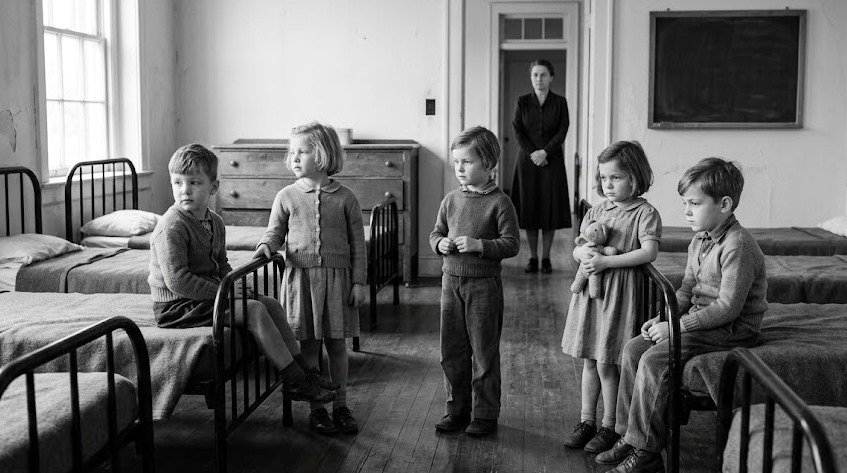
It is that she did not have to imagine the system that made it possible.
Before We Were Yours is not the true story of one real family named Foss. Rill Foss, Camellia, Fern, Lark, Gabion, Queenie, and Briny are fictional characters. But the world they enter is based on a documented American scandal involving Georgia Tann and the Tennessee Children’s Home Society in Memphis.
For decades, children were separated from their birth families, records were changed or destroyed, and children were placed for adoption, often with wealthier families far from Tennessee. Some parents were poor. Some were unmarried mothers. Some believed their children were only being cared for temporarily. Others were reportedly told their babies had died.
That history is what gives Wingate’s novel its painful sense of reality.
So, is there any truth to Before We Were Yours?
Yes. A great deal of historical truth sits behind the novel, but the Foss family itself is fictional. Wingate has explained that researching Georgia Tann made her wonder what it would feel like for children to suddenly be taken from everything they knew. That question eventually led her to create Rill Foss and her four siblings.
Is Before We Were Yours Based on a True Story?
Before We Were Yours is best described as historical fiction inspired by true events.
Lisa Wingate did not take the life of one Georgia Tann survivor and simply change the names. Instead, she created fictional characters and placed them inside circumstances inspired by the experiences of real children.
The novel follows 12-year-old Rill Foss and her younger siblings, who live with their parents aboard a Mississippi River shantyboat.
Their lives change after their mother, Queenie, experiences complications during childbirth. While their parents are away, the children are taken from the boat and eventually brought into the Tennessee Children’s Home Society system.
That part of the Foss story is fictional.
Georgia Tann was not.
The Tennessee Children’s Home Society was not.
And the removal of children from vulnerable families was not simply a frightening invention created to make the book more dramatic.
Wingate says the novel grew directly from her research into the real history of Tann and the children caught in her system.
That distinction matters.
| In the novel | Historical reality |
|---|---|
| Rill Foss | Fictional |
| Camellia Foss | Fictional |
| Queenie and Briny Foss | Fictional |
| The Foss shantyboat family | Fictional |
| Georgia Tann | Real |
| Tennessee Children’s Home Society | Real |
| Questionable and illegal adoptions | Real |
| Children being separated from vulnerable families | Documented |
| Altered or destroyed records | Documented |
| 1950 investigation | Real |
The Foss children give readers someone to follow emotionally. The history surrounding them gives the book its unsettling weight.
The Actual Background Behind Before We Were Yours
To understand the Before We Were Yours true story, you have to understand Georgia Tann.
Tann became one of the most powerful figures connected with adoption in Memphis during the first half of the 20th century. She operated through the Memphis branch of the Tennessee Children’s Home Society and presented herself publicly as someone finding good homes for needy children.
Behind that respectable image was a very different story.
Records preserved by the Memphis Public Library describe the Tennessee Children’s Home Society as being connected to the kidnapping of children and illegal adoptions. A 1950 state investigation uncovered thousands of questionable adoptions, secret financial accounts, and serious irregularities in records.
Lisa Wingate and journalist Judy Christie later explored the experiences of actual Tennessee Children’s Home Society survivors in the nonfiction companion book Before and After. Their account says Tann’s operation placed more than 5,000 children and that many children described as orphans were not actually orphans at all.
Some had living parents who wanted them.
That is the part that can be difficult to absorb.
This was not simply an old-fashioned adoption agency using standards that would look unusual today. Historical investigations found serious misconduct involving the removal and placement of children.
How Were Children Taken From Their Families?
There was no single method.
The historical accounts describe vulnerable families being separated from children in several ways.
Poor families were particularly exposed. Unmarried mothers had little social or legal power. Some parents temporarily placed children in care during periods of illness or financial trouble, only to discover later that the children were gone.
Wingate’s historical background also points to reports of children being taken through hospitals, public assistance systems, clinics, and other institutions.
The nonfiction Before and After describes cases involving parents who did not realize their children would be permanently placed for adoption and women who were told in maternity wards that their babies had died.
This explains why the Foss children’s experience feels so believable.
Rill’s story did not literally happen.
But situations frighteningly close to it happened to real families.
Why Could Georgia Tann Get Away With It?
Power helped.
So did social prejudice.
Many of the birth families affected by Tann’s operation lacked money, political influence, or the ability to fight an institution that appeared respectable.
Tann, meanwhile, had powerful connections.
Historical material preserved by the Memphis Public Library says she received support from influential people and worked closely with Memphis Juvenile Court Judge Camille Kelley, who finalized many adoptions. The later investigation found that many cases had not been handled according to proper legal requirements.
There was also a dangerous idea beneath the system: that wealthier people could automatically provide a more worthy home than poor parents.
Once poverty is treated as evidence that someone does not deserve a child, abuse can hide behind the language of rescue.
That is one of the most uncomfortable ideas running through Before We Were Yours.
The Foss family has very little money. Their life on the river is unconventional. But the children are loved.
Wingate forces us to see the difference between being poor and being an unfit parent.
They are not the same thing.
What Happened During the 1950 Investigation?
By 1950, Georgia Tann’s operation was finally facing serious scrutiny.
The Tennessee State Library and Archives preserves material from the investigation. The records describe allegations of questionable adoptions, falsified records, force and persuasion being used to obtain children, financial wrongdoing, and failures in the medical care of children.
The Memphis Public Library archive likewise states that investigators uncovered secret bank accounts and numerous irregularities connected with adoption records.
But there would be no courtroom reckoning with Tann.
Georgia Tann died on September 15, 1950, during the investigation and only days before charges were filed against the orphanage. Judge Camille Kelley later retired and died in 1955 without being prosecuted for her role.
That lack of accountability makes the history especially painful.
Families had lost children.
Children had lost their identities.
Records had been compromised.
Yet the person at the center of the scandal never stood trial.
Were the Foss Children Real?
No.
This is probably the most important distinction for anyone researching the Before We Were Yours true story.
Rill Foss and her four siblings are fictional.
Lisa Wingate says that after learning about Georgia Tann, she began wondering what it would have been like to be a child suddenly taken from home and placed under Tann’s control.
From that question, Rill and the other Foss children were created.
That means you should not search historical adoption records expecting to find Rill Foss, Camellia Foss, Fern Foss, Lark Foss, or Gabion Foss as a documented real family behind the novel.
They serve another purpose.
They allow readers to experience history from a child’s point of view.
Instead of reading only dates, investigations, and court records, we experience confusion.
Where are our parents?
Why did nobody ask us what happened?
Why are our names being changed?
Will our family ever find us?
Those questions may belong to fictional children in the novel, but versions of them belonged to real Tennessee Children’s Home Society adoptees.
What Happened to Camellia Foss in Before We Were Yours?
Spoilers ahead.
Camellia is one of the most heartbreaking characters in the book.
She is Rill’s younger sister and perhaps the most openly defiant of the Foss children. She fights against the people controlling them instead of quietly accepting what is happening.
At the children’s home, Camellia comes into contact with Mr. Riggs, the groundskeeper.
The novel strongly indicates that Riggs sexually assaults Camellia. Wingate handles the incident through Rill’s understanding of what has happened rather than dwelling on graphic details.
Afterward, Rill tries to protect her sister and seeks help.
Instead of receiving justice, Camellia disappears from the home.
When questions are asked about her, the adults controlling the institution effectively erase her presence.
And this is where an important distinction is needed:
The novel does not definitively tell us that Camellia was murdered.
Her final fate remains unresolved.
Her disappearance and the refusal of adults to acknowledge what happened create a terrible implication, but readers should not turn that implication into a confirmed fact.
Camellia herself is also fictional.
There is no historical Camellia Foss whose disappearance the novel is documenting.
Still, her story reflects the larger theme of children becoming powerless once their identities and family connections were taken away.
Was Ric Flair Adopted Through the Tennessee Children’s Home Society?
Yes.
And this is one of the surprising real-life connections readers often discover after learning about Georgia Tann.
Professional wrestling legend Ric Flair, born in Memphis in 1949, was adopted through the Tennessee Children’s Home Society.
In his autobiography Ric Flair: To Be the Man, Flair discusses his adoption at length. He says surviving documents give different versions of his original name, including Fred Phillips, Fred Demaree, and Fred Stewart.
He was eventually adopted by Richard and Kathleen Fliehr and renamed Richard Morgan Fliehr.
Because of the dishonesty surrounding the Tennessee Children’s Home Society, Flair wrote that he could never know with certainty exactly what happened around his birth and separation from his biological family.
That does not mean Ric Flair is secretly represented by one of the Foss children.
He is not.
His case is important because it demonstrates that the world Wingate writes about was connected to real people whose identities and family histories could remain uncertain for decades.
Was Ric Flair Kidnapped as a Baby?
This requires more careful wording than a simple yes or no.
Flair was unquestionably adopted through the Tennessee Children’s Home Society.
His autobiography explains that the surviving documents surrounding his birth and adoption contain conflicting information. He also discusses the larger pattern of deception associated with the agency.
The official publisher’s description of his autobiography says that, like many children adopted through the Society, Flair had apparently been stolen from his birth parents.
But Flair himself makes an important point: because the records surrounding the agency were unreliable, he cannot know every detail of what happened to him.
So the most accurate answer is:
Ric Flair’s adoption was arranged through Georgia Tann’s Tennessee Children’s Home Society, but the exact circumstances by which he entered the agency remain uncertain.
Did Georgia Tann Really Change Children’s Identities?
The historical record shows serious problems with documentation.
The Memphis Public Library’s Tennessee Children’s Home Society collection notes that the agency lost an endorsement from the Child Welfare League of America in 1941 after concerns involving the destruction of paperwork connected with child placements. The 1950 investigation later uncovered further record irregularities.
For adoptees, missing or unreliable paperwork created a problem that could last a lifetime.
Who were their parents?
Where had they been born?
Did their birth family willingly surrender them?
Were they really abandoned?
Sometimes the paperwork could not provide trustworthy answers.
That is why the Tennessee Department of Children’s Services still has specific rules for people seeking records involving adoptions completed or attempted before March 16, 1951, including records connected with the Tennessee Children’s Home Society. Eligible adoptees and certain family members can request access to these records.
The scandal is not simply a closed chapter preserved in an old newspaper.
Families are still tracing what happened.
How Much of Before We Were Yours Is Historically Accurate?
Think of the novel as having two layers.
The fictional layer
This includes:
- Rill Foss
- Camellia Foss
- Fern Foss
- Lark Foss
- Gabion Foss
- Queenie and Briny Foss
- Avery Stafford and the Stafford family mystery
- The specific events involving the Foss siblings
These characters and their individual storylines were created for the novel.
The historical layer
This includes:
- Georgia Tann
- The Tennessee Children’s Home Society
- The removal of children from vulnerable families
- Questionable and illegal adoption practices
- Problems with adoption records
- Children being sent to adoptive families in other states
- The involvement of powerful people
- The 1950 state investigation
- The lasting difficulty some adoptees faced in discovering their origins
These elements have a documented historical foundation.
Wingate’s achievement was bringing those two layers together without presenting the Foss family as a documentary reconstruction of one real family.
Were There Real Survivors Like Rill Foss?
Yes, although none should be described simply as the real Rill.
There were survivors of the Tennessee Children’s Home Society who spent decades trying to learn where they came from.
That became so important after the novel’s publication that Lisa Wingate worked with journalist Judy Christie on Before and After: The Incredible Real-Life Stories of Orphans Who Survived the Tennessee Children’s Home Society.
Unlike Before We Were Yours, Before and After is nonfiction.
It follows real adoptees and families affected by the scandal. Some discovered information about their histories after Wingate’s novel renewed public attention around Georgia Tann. Some eventually found siblings or other biological relatives decades after they had been separated.
If you finish Before We Were Yours wondering what happened to real children caught in this system, Before and After is the natural book to read next.
It removes the fictional Foss family and gives the survivors their own names and voices.
Is There Any Truth to the Book Before We Were Yours?
There is a painful amount of truth behind it.
The main family is invented, but the historical injustice is not.
Children really passed through Georgia Tann’s Tennessee Children’s Home Society.
Families really struggled with questionable adoptions.
Investigators really uncovered serious problems.
Records really disappeared or became unreliable.
And decades later, some adoptees were still trying to reconstruct their identities and find relatives.
Lisa Wingate did not write Before We Were Yours to claim that Rill Foss was a forgotten historical person.
She created Rill to help us imagine something that official records struggle to communicate:
what it might feel like to be a child when adults suddenly decide that your home, your parents, your siblings, and even your name can be taken away.
What Is the Actual Background Based on the Story Before We Were Yours?
The real background is the Georgia Tann adoption scandal in Memphis, Tennessee.
From the 1920s until 1950, Tann operated a powerful child-placement system through the Tennessee Children’s Home Society. Historical records describe thousands of questionable adoptions and allegations involving children taken from vulnerable families, improper legal procedures, altered or destroyed records, financial misconduct, and neglect.
A state investigation finally exposed much of the operation in 1950.
Tann died before she could be prosecuted.
The children, however, had to live with the consequences.
And that is ultimately where the Before We Were Yours true story becomes larger than the novel itself.
Rill Foss never existed.
Camellia Foss never existed.
But children who knew the same fear, loss, confusion, and uncertainty certainly did.
The clearest evidence comes from what happened after the novel became a bestseller. Real Tennessee Children’s Home Society adoptees began contacting Wingate. Some searched for biological relatives. Some found siblings they had never known. Their experiences eventually became Before and After, a nonfiction record of lives shaped by the very scandal Wingate had fictionalized.
That may be the most powerful way to understand the book.
Before We Were Yours is fiction.
The history that made it possible is real.

Jessica Savitch, with a deep passion for journalism, brings her expertise to istruestory.com as a dedicated author. MA in Arts & Journalism.