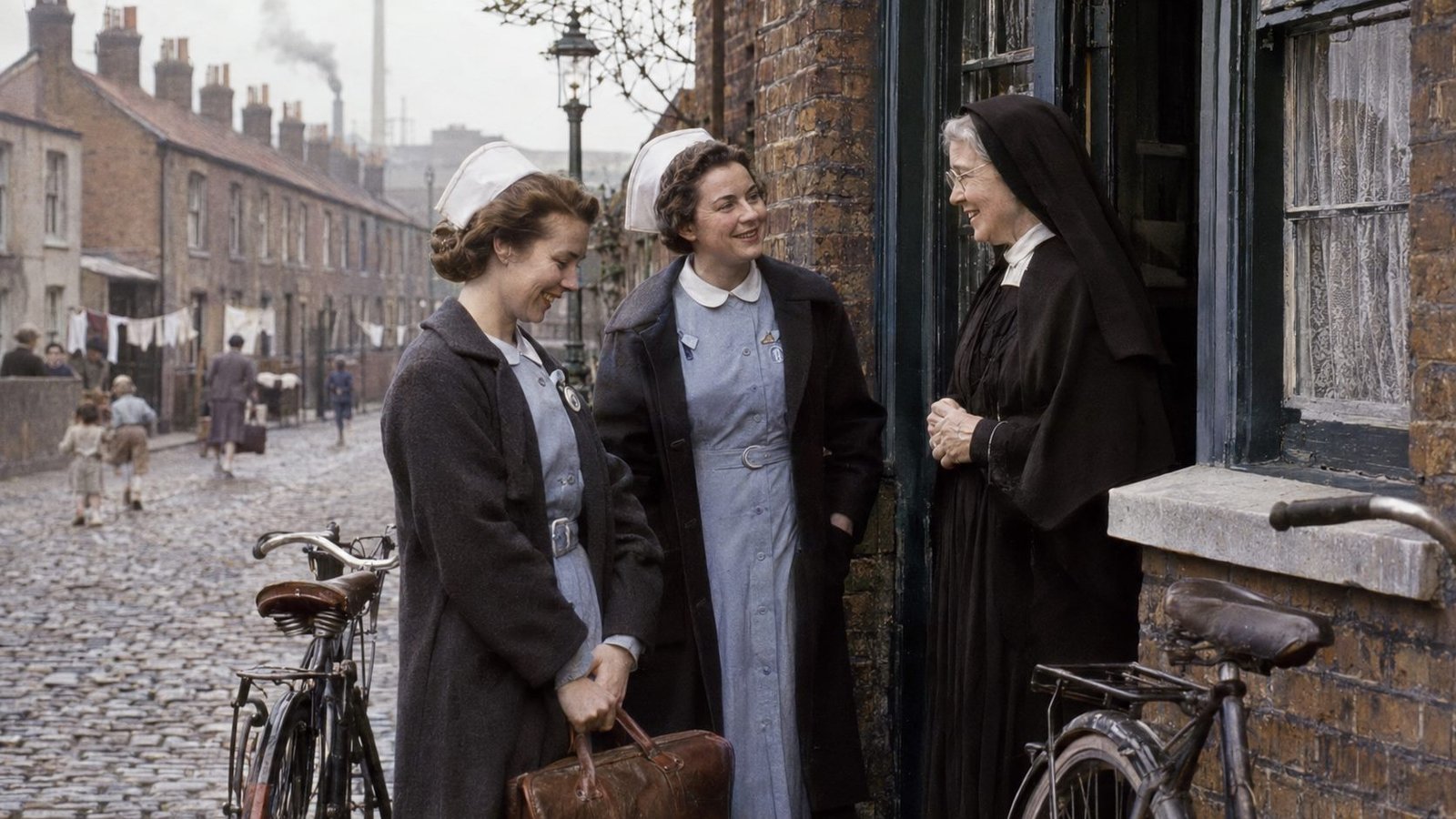
But as you watch these stories unfold, one question naturally comes to mind: Is Call the Midwife based on a true story?
The answer is yes, but not entirely. The beloved British television series was inspired by the real experiences of Jennifer Worth, a nurse and midwife who cared for families in London’s East End during the 1950s.
Her memories became three books, which later inspired the BBC drama. Some characters are based on people Worth knew, and many early situations came from her accounts. However, other characters and storylines were invented or changed for television.
And there’s an even more interesting story behind it all: the real nurses, religious sisters, and struggling families whose lives helped shape this remarkable series.
The Real Woman Behind Call the Midwife
Before Call the Midwife became a television favorite, there was a young nurse named Jennifer Worth.
Born Jennifer Lee in 1935, she trained as a nurse before moving to London to become a midwife. She worked in the East End, where many families lived in overcrowded homes and faced serious financial difficulties.
For a young woman, it was an eye-opening experience.
Worth encountered mothers raising large families, people living with illness, and women giving birth in conditions that could be frightening and uncomfortable.
Yet she also witnessed extraordinary kindness.
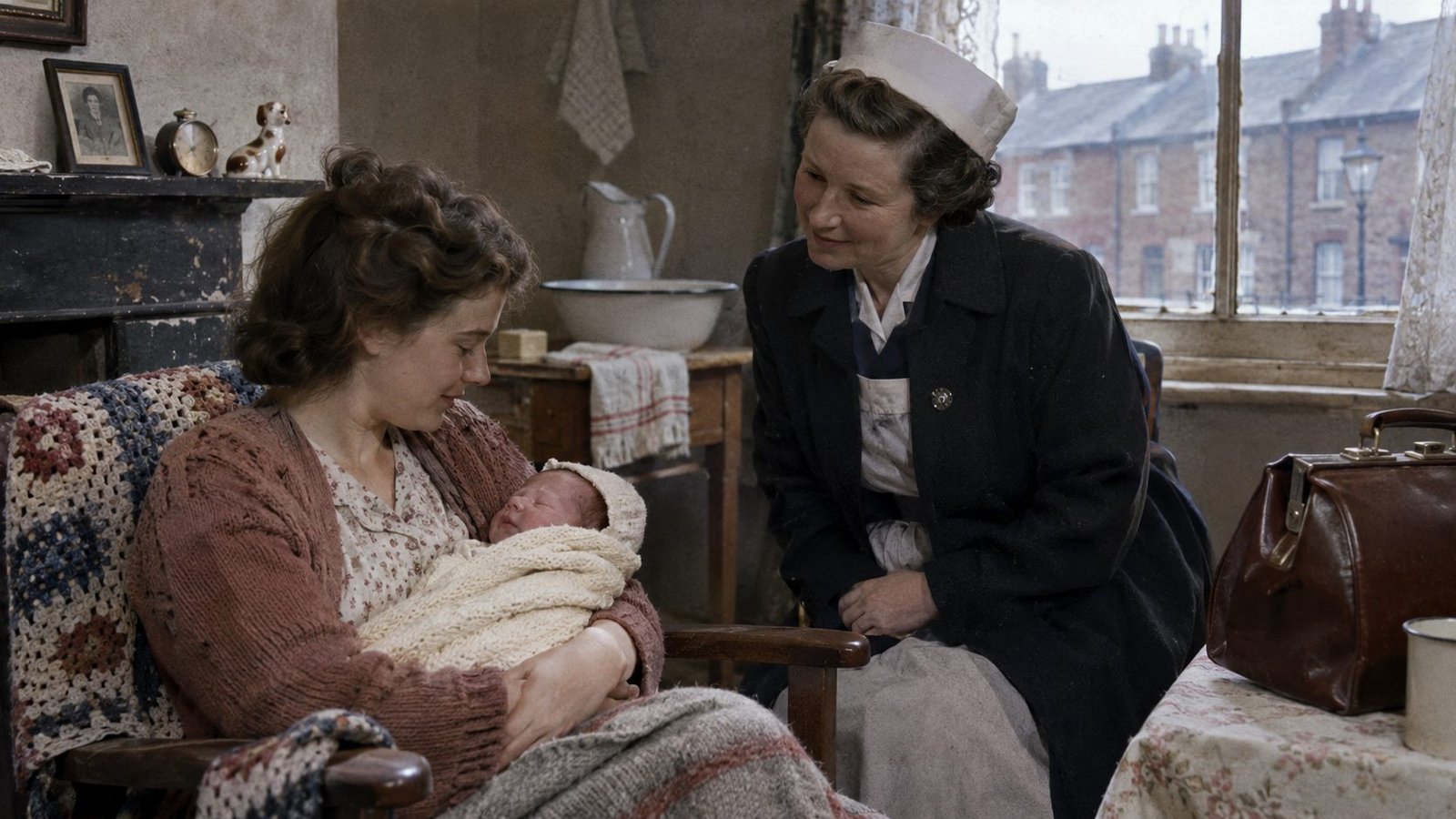
Nurses visited homes, checked on mothers, delivered babies, and helped families through difficult moments. They often became trusted members of the communities they served.
The people Worth met stayed in her memory long after she left nursing.
How Jennifer Worth’s Memories Became Books
Years later, Worth began writing about her experiences.
Her stories eventually became a trilogy:
- Call the Midwife (2002)
- Shadows of the Workhouse (2005)
- Farewell to the East End (2009)
The books were more than simple accounts of delivering babies. They explored poverty, relationships, illness, community life, and the struggles of women who were rarely given much attention.
Worth wanted people to understand a part of London that many others had overlooked.
Her first book attracted the attention of television producers, who recognized that these personal stories could become a moving drama.
Writer Heidi Thomas adapted Worth’s work into Call the Midwife, which premiered on BBC One on January 15, 2012.
Sadly, Jennifer Worth died in May 2011, before the television series reached audiences.
She never saw how much her stories would come to mean to viewers around the world.
How Much of Call the Midwife Is Based on a True Story?
The most important thing to understand is that Call the Midwife is historical fiction inspired by real experiences, rather than a documentary.
Its early seasons follow Jennifer Worth’s books more closely. As the series continues, it introduces new characters, relationships, and medical cases that go beyond her original writing.
Even Worth’s memoirs were not intended to be exact records of every conversation and event.
In a Television Academy interview, executive producer Pippa Harris explained that Worth combined real memories with creative storytelling.
This means a story can reflect something that genuinely happened without every detail being historically exact.
Here’s a helpful way to separate the facts from the fiction:
| Part of the series | What is true? |
|---|---|
| Jennifer Worth | A real nurse and midwife whose memoirs inspired the show |
| Jenny Lee | A fictionalized version of Jennifer Worth |
| London’s East End | A real setting with severe poverty and housing problems |
| Nonnatus House | A fictional name inspired by a real mission house |
| Religious nursing sisters | Based on an actual Anglican religious community |
| Sister Julienne | Based on a real woman who knew Jennifer Worth |
| Sister Monica Joan | A fictionalized character with some real-life inspiration |
| Dr. Patrick Turner | An invented character |
| Birth and medical stories | Drawn from memoirs, historical research, and fictional scripts |
| Later seasons | Historical drama largely developed beyond Worth’s original memoirs |
There’s no trustworthy percentage showing exactly how much of the entire series is true.
What we can say is that its historical foundation is real, while its storytelling is a mixture of fact and fiction.
Did Nonnatus House Really Exist?
If you’ve ever wished you could visit Nonnatus House, there’s a fascinating answer waiting for you.
Nonnatus House did not exist under that name, but it was inspired by a real place.
Jennifer Worth worked alongside a religious nursing community called the Community of St John the Divine.
These Anglican sisters provided nursing and midwifery care to people living in London’s East End.
They were associated with St. Frideswide’s Mission House on Lodore Street in Poplar.
Unlike the fictional Nonnatus House, this historical building was real.
The sisters’ work was also real. They visited homes, cared for mothers and children, and supported people who had few other resources.
According to a 2026 PBS article about the real sisters of Poplar, the community had deep roots in nursing and public health.
So although the television series changed the name of the house and religious order, it preserved something important about their mission.
These women truly dedicated their lives to helping others.
Why Was the Name Changed?
The religious community in Worth’s books and the television series was given the fictional name of the Order of St. Raymond Nonnatus.
St. Raymond Nonnatus is traditionally associated with childbirth and expectant mothers, making the name appropriate for the story.
Using a fictional name also gives the writers freedom to create characters and situations without presenting every event as part of the real sisters’ history.
It’s one of the clearest examples of how the series blends authentic history with television drama.
Which Call the Midwife Characters Were Real?
One reason the series feels so personal is that its characters seem like people you might actually know.
Some were inspired by real individuals. Others were created or developed through fiction.
Jenny Lee: The Closest Connection to Real Life
Jenny Lee, played by Jessica Raine in the first three seasons, is based on Jennifer Worth herself.
Like Worth, Jenny enters the unfamiliar world of East London and discovers the challenges faced by its poorest families.
Her experiences help viewers understand the people and places around her.
The older Jenny is voiced by Vanessa Redgrave, whose narration connects the series to its original memoir-based perspective.
While Jenny Lee follows Worth’s general life story, her television relationships and experiences should not all be treated as exact biography.
Was Sister Monica Joan Based on a Real Person?
Sister Monica Joan is one of the show’s most memorable characters.
Played by Judy Parfitt, she is an elderly nun known for her unusual habits, love of cake, intelligence, and surprising wisdom.
But was there really a Sister Monica Joan?
Not as the exact character shown on television.
Executive producer Pippa Harris revealed that Sister Monica Joan included elements of Monica Merlin, an actress who had once been Jennifer Worth’s lodger.
That is an unusual source of inspiration. It does not mean Monica Merlin was the elderly nun portrayed in the series.
Instead, Monica Joan is a fictionalized character whose personality draws partly from real life.
The character also reflects the experiences of older women who spent decades serving communities through nursing.
Her struggles with aging, memory, and independence give her story an emotional depth that extends beyond the question of whether she existed.
Is Trixie Based on a Real Person?
Nurse Trixie Franklin, played by Helen George, is another audience favorite.
She’s fashionable, outspoken, funny, and deeply committed to her patients.
But there’s an important difference between Trixie and Jennifer Worth.
There is no clearly verified single real-life woman whose biography matches Trixie Franklin’s television story.
Trixie’s character belongs to the fictionalized world of Call the Midwife, even though the work she performs reflects the experiences of real midwives.
Her personal relationships, struggles with alcohol, and later developments should not be presented as documented events from one historical nurse’s life.
Still, Trixie represents something real: the young professional women who worked long hours, faced difficult medical situations, and tried to build independent lives.
That’s part of what makes her believable.
Was Sister Julienne a Real Person?
Yes. Sister Julienne has a stronger direct connection to Jennifer Worth’s real life.
Played by Jenny Agutter, she represents a religious sister who knew Worth and remained close to her for many years.
Worth’s daughter Suzannah Hart has recalled receiving affectionate letters and drawings from Sister Julienne.
Those personal memories suggest a friendship that lasted well beyond their nursing days.
However, as with other characters, the television version includes dramatized situations and dialogue.
What About Dr. Turner?
Dr. Patrick Turner, played by Stephen McGann, is fictional.
Pippa Harris confirmed that the character was invented for the series.
That doesn’t make his medical work meaningless. Through Dr. Turner, the writers explore changes in public health, family medicine, and treatment during the period.
He is a fictional doctor working within a real historical setting.
Were the Childbirth Stories Real?
Some of the earliest births and medical cases were adapted from Jennifer Worth’s experiences.
Others were developed from historical records, medical research, and the writers’ own stories.
The show’s medical details are not simply invented for excitement.
A real midwife and medical adviser, Terri Coates, worked with the production to help make childbirth scenes accurate and believable.
Actor Stephen McGann also described the show’s research process in a published medical article, From How to Who: Accuracy and Authenticity in the Portrayal of the Medic in TV Drama.
He explained that medical procedures were reviewed by clinical advisers and that the writers used historical reports and contemporary medical information.
This is why some birth scenes can feel so convincing.
The team tries to show the practical work of midwives, not just the dramatic moment when a baby is born.
Still, medical accuracy is not the same as proof that a particular patient or event existed.
The procedure may be authentic while the people involved are fictional.
What Was Life Really Like for Midwives in the 1950s?
To understand why Call the Midwife feels so different from modern hospital dramas, it helps to understand the world Jennifer Worth entered.
Postwar Britain was changing rapidly.
The National Health Service, or NHS, began in 1948, giving people access to healthcare without charges at the point of use.
But creating a new healthcare system did not instantly solve every problem.
Families still struggled with overcrowded housing, poor sanitation, illness, and limited resources.
Midwives working in the community were especially important because they visited families in their homes.
They helped during pregnancy, attended births, and cared for mothers and newborn babies.
The show captures the close relationship that could develop between these nurses and the people they served.
Did Most Women Give Birth at Home?
The series contains many home births, but that doesn’t mean most British women delivered their babies at home during the 1950s.
According to the Nuffield Trust’s history of the NHS, around 65% of births during that decade took place in hospitals nationally.
Home births remained important, especially in districts where community midwives provided care.
This distinction matters because the series concentrates on a particular group of nurses serving a particular neighborhood.
Their experiences were real, but they didn’t represent every woman’s experience across Britain.
Why Is Call the Midwife So Popular?
There’s a reason this series has lasted so long.
It isn’t simply about babies being born.
It’s about the people whose lives change when those babies arrive.
A difficult birth might bring a family together. A young mother might discover courage she didn’t know she had. A nurse might learn something that changes how she sees the world.
And sometimes, despite everyone’s best efforts, there is loss.
The series doesn’t avoid those moments.
Its characters face illness, prejudice, poverty, disability, loneliness, and changing social expectations.
But the stories often return to one simple idea: people can make a difference by caring for each other.
Creator Heidi Thomas has explained in a PBS interview that audiences can enjoy the series at different levels.
Some viewers love the period fashion, music, humor, and friendships. Others connect with its social history and deeper questions about life, death, and family.
That balance is one of its greatest strengths.
The show can be comforting without pretending life was always easy.
What Is Call the Midwife on Netflix?
Call the Midwife is a British historical medical drama created by Heidi Thomas.
It follows nurses, midwives, and Anglican sisters caring for families in London’s East End.
The story begins in the late 1950s and moves through the changing decades. By its fifteenth season, the drama has reached 1971.
Its cast includes Jenny Agutter, Helen George, Judy Parfitt, Laura Main, and Stephen McGann, among others.
Although it’s a period drama, its subjects often feel relevant today.
It explores pregnancy, family relationships, healthcare, personal freedom, and the way society treats people who need help.
As of November 2026, Netflix’s US catalog lists 15 seasons of Call the Midwife. However, streaming availability differs by country and may change.
Viewers can check the official Netflix listing to see whether the program is available in their region.
In the UK, the series is also associated with BBC One and BBC iPlayer.
Is Call the Midwife Worth Watching?
Yes, especially if you enjoy emotional stories, historical dramas, and characters who grow over time.
You don’t need to know anything about nursing or British history to follow the series.
The characters introduce you to their world naturally.
One episode might make you smile. The next might leave you thinking about a family’s struggle long after the credits end.
The relationships between the nurses and sisters are often just as engaging as the medical stories.
There are also reasons it might not suit every viewer.
Some episodes involve difficult births, pregnancy loss, serious illness, abuse, and death. These subjects can be upsetting, particularly for people with personal experiences of similar events.
The show’s slower, character-focused storytelling may also feel different from fast-moving medical thrillers.
But if you’re looking for a series that combines warmth with meaningful subjects, Call the Midwife is worth considering.
Starting with Season 1 is the best way to understand Jennifer Worth’s role in the original story.
Did the Series Stay Faithful to Jennifer Worth’s Books?
Not completely.
The first seasons borrowed heavily from Worth’s memoirs, especially the experiences of Jenny Lee.
But television series need new stories to continue.
Once the original material had been adapted, Heidi Thomas and the production team developed further plots.
These later stories still draw on the social and medical history of their period.
They address changing attitudes toward childbirth, women’s rights, healthcare, disability, and relationships.
For example, Season 15 takes place in 1971, when the Women’s Liberation movement was becoming an increasingly visible part of British life.
That historical background is real.
The specific situations faced by the characters, however, remain part of a scripted drama.
This is why it’s more accurate to call Call the Midwife a historically grounded television series than a fully true account.
The Real Legacy Behind the Fiction
Perhaps the most meaningful part of Call the Midwife isn’t whether every character once lived or whether every birth happened exactly as shown.
It’s what the series helps us remember.
There really were women cycling through London’s streets to care for mothers and children. There really were nursing sisters who devoted their lives to poor communities. And there really were families whose daily struggles rarely appeared in history books.
Jennifer Worth witnessed that world.
When she wrote about it decades later, she gave those lives a place in the public imagination.
The television adaptation changed some names, added stories, and created characters of its own. Yet the real history behind the series remains important.
So, is Call the Midwife based on a true story? Yes. It began with a real midwife, real memories, and a real community.
What makes the series meaningful is not that every scene is factual. It’s that the fiction continues to remind us of the compassion, courage, and quiet dedication of women whose work deserves to be remembered.

Katie Couric, MA in Arts & Journalism. Crafting compelling narratives at istruestory.com. Passionate about bringing untold stories to light.