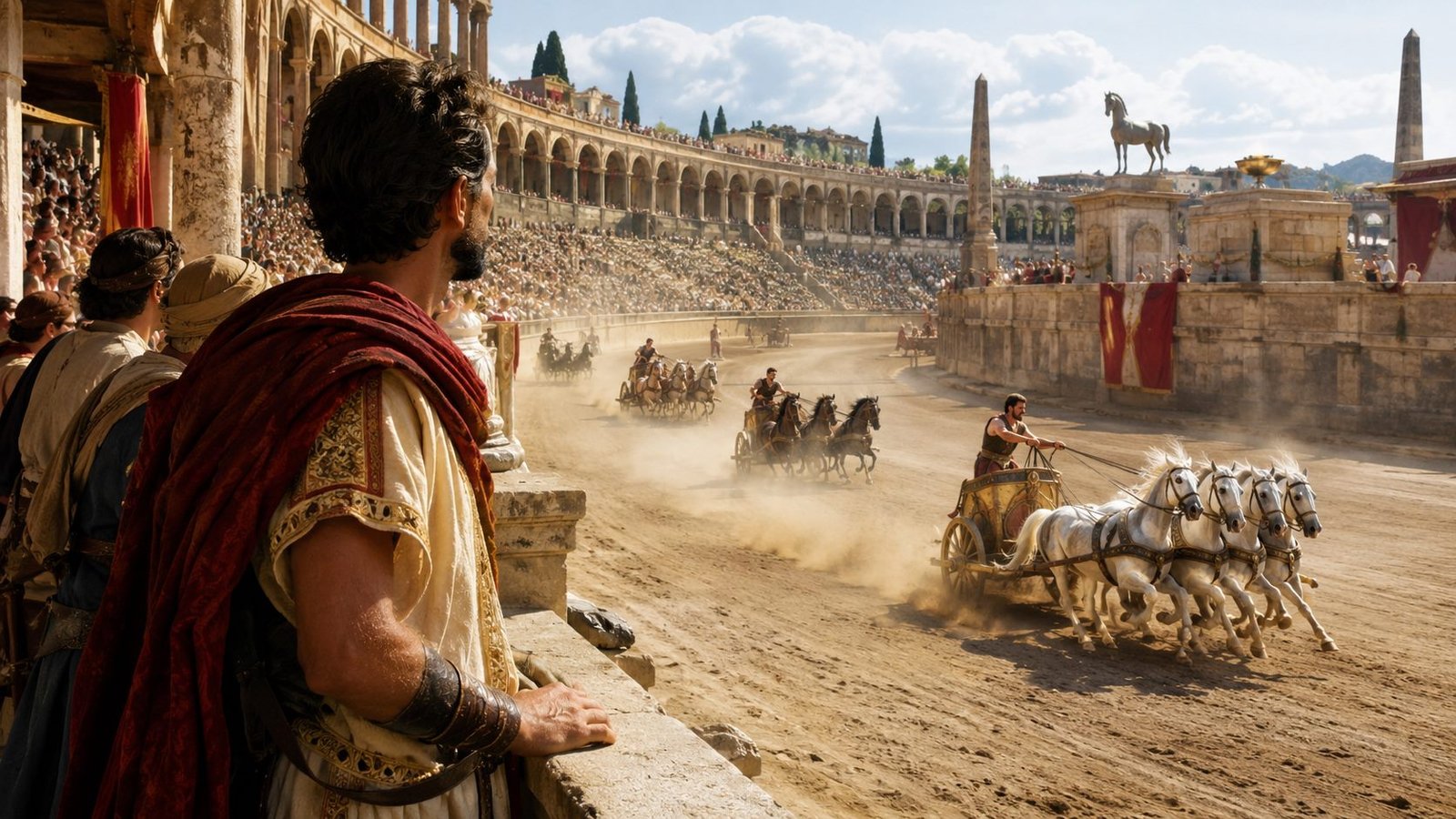
Watching the 1959 film Ben-Hur, it’s easy to believe you’re seeing a forgotten chapter of ancient history.
But was Ben-Hur a true story? Did Judah really live during the time of Jesus Christ? And did the Bible record any of his adventures?
The short answer is no. Ben-Hur is not based on a documented true story. Judah Ben-Hur is a fictional character created by American author Lew Wallace in his 1880 novel Ben-Hur: A Tale of the Christ. However, the story takes place during a real historical period and includes biblical events associated with the life of Jesus.
That mix of fiction, faith, and genuine history is what makes Ben-Hur so convincing.
And the real story behind its creation may surprise you.
What Is Ben-Hur Really About?
At its heart, Ben-Hur tells the story of a man who struggles to choose between revenge and forgiveness.
The 1959 film, directed by William Wyler, stars Charlton Heston as Judah Ben-Hur, a wealthy Jewish prince living in Jerusalem during the Roman Empire.
Judah seems to have everything. He has a loving family, a respected position in society, and a comfortable life.
Then his childhood friend Messala returns to Jerusalem as a Roman officer.
Their friendship falls apart because they have different loyalties. Judah cares about his Jewish people, while Messala believes in Rome’s power.
Things become worse when an accident involving Judah’s household injures a Roman official. Messala uses the incident to punish Judah and his family.
Judah is sent into slavery. His mother and sister are imprisoned, and his old life disappears.
Years later, he returns with one purpose: revenge.
That desire leads him toward the film’s most famous scene, a deadly chariot race against Messala.
Yet revenge is only part of the story. Judah’s encounters with Jesus gradually change the way he sees suffering, hatred, and forgiveness.
The film follows his journey from anger toward spiritual peace.
It’s a powerful story. But that does not make its central character historical.
Was Judah Ben-Hur a Real Person?
There is no reliable historical evidence that Judah Ben-Hur existed.
No accepted ancient record identifies a Jewish prince named Judah Ben-Hur who experienced the events described in the novel.
There is also no historical record of his famous chariot race against Messala.
Judah belongs to historical fiction. His life was invented to help readers imagine the world of first-century Judea.
This distinction matters because his story includes so many realistic details.
He lives under Roman rule. His people struggle with foreign authority. He encounters soldiers, slavery, political conflict, and religious belief.
These details create an authentic historical atmosphere, even though his personal experiences are fictional.
Was Messala a real Roman officer?
Messala, Judah’s former friend and enemy, is also fictional.
His character represents the conflict between personal loyalty and loyalty to the Roman Empire.
Their broken friendship gives the story its emotional weight.
Judah sees Messala as someone who betrayed him. Messala sees Judah as someone who refuses to accept Roman authority.
It’s a conflict that feels believable because the political tensions behind it were real.
However, the particular friendship and betrayal depicted in Ben-Hur are inventions.
Was Ben-Hur a True Story in the Bible?
No. Judah Ben-Hur is not mentioned in the Bible.
You will not find his chariot race, his imprisonment, or his conflict with Messala in the Old or New Testament.
But the movie does include events and people connected to biblical accounts.
The story unfolds during the life of Jesus Christ, and several scenes draw inspiration from the Gospels.
For example, the film includes Jesus’ birth, his ministry, and his crucifixion.
These are important events in Christian scripture.
The difference is that Lew Wallace places an imaginary character alongside those biblical events.
Judah’s meetings with Jesus are part of Wallace’s fictional narrative, not documented encounters.
Why does Jesus appear in Ben-Hur?
Jesus is central to the story’s message.
Early in the film, Judah suffers as a prisoner. During this difficult journey, Jesus gives him water.
The moment is quiet but meaningful.
Judah does not yet understand the importance of the man who helped him.
Later, their paths connect again as Jesus is led toward his crucifixion.
The scenes create a powerful emotional connection between the two stories.
Judah begins to understand that strength does not always come from defeating enemies. Sometimes, it comes from refusing to hate them.
This was also important to Lew Wallace.
According to the General Lew Wallace Study & Museum, Wallace wanted to treat the words and actions of Jesus with great care. He aimed to keep Christ’s spoken words in the novel tied to biblical accounts rather than inventing new teachings for him.
That choice helped make Ben-Hur feel both like an adventure and a religious story.
How Lew Wallace Created the Story
The real history of Ben-Hur begins almost 1,900 years after the time in which the novel is set.
Lew Wallace was an American Civil War general, lawyer, politician, and writer.
He was born in 1827 and later served as governor of the New Mexico Territory.
But his greatest literary success came from a story about ancient Judea.
Wallace published Ben-Hur: A Tale of the Christ on November 12, 1880, after spending approximately seven years researching and writing it.
The General Lew Wallace Study & Museum explains that he wrote much of the novel beneath a beech tree near his home in Crawfordsville, Indiana.
The book became enormously successful.
It inspired a stage production in 1899 and several film adaptations, including the famous versions released in 1925 and 1959.
But what inspired Wallace to begin writing about Jesus?

A conversation that changed his thinking
In 1876, Wallace had a conversation on a train with Robert G. Ingersoll, a well-known agnostic.
They discussed religion and Christianity.
Wallace later explained that the conversation made him realize how little he knew about his own religious beliefs.
Rather than dismissing the subject, he decided to study it.
He researched the Bible and the historical setting of early Christianity.
His earlier interest in the birth of Jesus gradually developed into the larger story of Judah Ben-Hur.
Wallace later described the writing process as important to the development of his Christian faith.
There is a common claim that Wallace wrote Ben-Hur on a bet or to disprove Christianity.
His own account does not support that version.
The museum’s research explains that his motivation came from personal curiosity and a desire to understand Christianity more deeply.
That is one of the most interesting details behind the novel.
The story of a fictional man discovering faith grew out of a real writer’s effort to examine his own beliefs.
Which Parts of Ben-Hur Reflect Real History?
Although Judah’s life is fictional, the world around him was not invented entirely.
The Roman Empire, Jewish life under Roman authority, and the popularity of chariot racing all belong to ancient history.
Here is how the major elements compare.
| Story element | Historical reality |
|---|---|
| Judah Ben-Hur | Fictional character |
| Messala and his rivalry with Judah | Fictional relationship |
| Roman control of Judea | Historically established |
| Jesus Christ | Historical religious figure described in biblical and other ancient sources |
| Roman chariot racing | Genuine ancient sport |
| Judah’s famous race against Messala | Fictional event |
| Judah’s personal meetings with Jesus | Created for the story |
| Jesus’ crucifixion | Widely accepted by historians as a historical event |
The most important lesson is that a film can contain real history without telling the true life story of its main character.
Roman rule was a real source of conflict
During the first century, Rome exercised political and military authority over Judea.
This was a period of tension between imperial power and local communities.
Jewish religious traditions, Roman political demands, and questions of independence often came into conflict.
Wallace used this historical background to build Judah’s personal struggle.
His fictional punishment reflects the broader theme of people living under powerful rulers.
However, the particular injustice done to Judah is not a documented event.
Chariot racing was a real Roman sport
The chariot race is not simply a Hollywood invention.
Ancient Romans loved chariot racing.
According to The Metropolitan Museum of Art, racing was one of Rome’s oldest forms of public entertainment.
Drivers often controlled teams of four horses. Racing around sharp turns was dangerous, especially when chariots collided or overturned.
Spectators followed competing teams with enormous enthusiasm.
Some drivers earned fame and rewards.
So when Ben-Hur shows horses racing around a crowded arena, it is recreating a genuine feature of ancient Roman culture.
What is fictional is Judah’s particular victory over Messala.
Did Charlton Heston Really Ride the Chariot in Ben-Hur?
Yes. Charlton Heston really drove a chariot during parts of the 1959 movie.
But he did not perform every dangerous stunt himself.
This is where the real filmmaking story becomes almost as exciting as the movie.
The chariot race was one of the most demanding sequences produced in Hollywood at the time.
It required enormous sets, trained horses, carefully planned movements, and many camera positions.
Heston underwent extensive training to learn how to control the horses.
The American Film Institute confirms that both Heston and Stephen Boyd, who played Messala, trained with their chariot teams.
By the time filming began, Heston had become skilled enough to drive during many shots.
However, the production also depended on experienced stunt performers.
The dangerous stunt that went wrong
One of the most memorable moments occurs when Judah’s chariot races over debris from a crash.
His chariot suddenly jumps into the air, throwing him forward.
It looks terrifying.
And part of that moment came from a real accident during filming.
Joe Canutt, the son of legendary stunt coordinator Yakima Canutt, was doubling for Heston.
During the stunt, the chariot landed harder than expected.
Joe was thrown from the vehicle.
Fortunately, he survived with relatively minor injuries.
The production later combined footage of the stunt with shots of Heston recovering his position.
The result became one of the film’s most unforgettable action moments.
The American Society of Cinematographers preserves a detailed account of the stunt and how the scene was completed.
How long did the chariot race take to film?
The finished sequence lasts less than ten minutes.
But the American Film Institute reports that it required about ten weeks of filming after months of preparation.
More than 80 horses were brought to Italy for the production, and the enormous arena set covered over 18 acres.
That scale is one reason the race still feels impressive.
The film was made long before digital effects became the normal way to create large action sequences.
The horses, chariots, arena, and many of the people were physically present.
The danger on screen was carefully staged, but some of the risks were genuine.
Did anyone die filming the chariot race?
There is a long-standing rumor that a stunt performer died while filming the 1959 chariot race.
The available production records do not support that claim.
The American Film Institute documents injuries during the sequence, including Joe Canutt’s accident, but reports no deaths from the filming of the race.
The difference between a dangerous stunt and a fatal accident is important.
The race was difficult and risky, but dramatic rumors should not be mistaken for verified production history.
How Accurate Was the 1959 Ben-Hur Movie?
The 1959 film is impressive as historical entertainment, but it should not be treated as a documentary.
Its costumes, large sets, Roman military presence, and ancient locations help create the appearance of a real historical world.
Yet filmmaking requires choices that go beyond the surviving evidence.
The movie also changes certain details from Wallace’s original novel.
For example, Messala dies following the chariot race in the 1959 adaptation.
In the novel, he survives but is permanently disabled.
That difference is confirmed in the American Film Institute’s production history.
It shows how a fictional story can change as it moves from a book to the screen.
The 1959 film was made to entertain, move audiences, and explore moral questions.
It was not designed to reconstruct every detail of first-century Judea with historical certainty.
Still, its emotional impact was remarkable.
At the 1960 Academy Awards ceremony, Ben-Hur won 11 Oscars, including Best Picture, Best Director for William Wyler, and Best Actor for Charlton Heston.
According to the Academy of Motion Picture Arts and Sciences, the film set a new Academy Awards record with those wins.
That recognition helped establish Ben-Hur as one of cinema’s most celebrated historical epics.
What Ben-Hur Gets Right About Faith and Forgiveness
The emotional truth of Ben-Hur may be more important than its fictional events.
Judah’s story begins with injustice.
He loses people he loves. He suffers under a political system he cannot control. His anger becomes the reason he keeps fighting.
For much of the movie, revenge seems like the only way to repair his broken life.
But winning the chariot race does not solve everything.
That is one of the story’s strongest ideas.
Defeating an enemy cannot automatically remove years of grief.
Judah’s change comes through his growing understanding of Jesus and the Christian message of forgiveness.
The story does not pretend that suffering is easy to forget.
Instead, it asks whether a person can stop allowing hatred to control the rest of their life.
You do not need to share every religious belief in the film to understand that question.
Many people have experienced betrayal, disappointment, or anger.
And most of us know how difficult forgiveness can be.
This is where Wallace’s fictional story reaches beyond its historical setting.
Questions Readers Still Ask
Does the bloodline of Jesus still exist?
There is no verified historical evidence establishing that Jesus had biological children or that a direct line of descendants survives today.
The New Testament does mention members of Jesus’ family, including his mother and brothers.
However, it does not identify any wife or biological children of Jesus.
Claims that Jesus married Mary Magdalene or left descendants have appeared in later writings and popular fiction, but historians have not established those claims as facts.
Harvard scholar Karen L. King also emphasized that the controversial text known as the Gospel of Jesus’ Wife did not prove the historical Jesus was married. The Harvard Gazette discussed that distinction in its reporting.
It is also important to distinguish between descendants of Jesus himself and descendants of his wider family.
They are not the same thing.
Without reliable evidence identifying a child of Jesus and a documented family line, claims about a surviving direct bloodline remain unproven.
Which woman in the Bible never married?
One example is Jephthah’s daughter, whose story appears in Judges 11.
The Bible does not give her personal name.
Judges 11:37–39 describes her mourning her virginity and says she had never known a man when her father fulfilled his vow.
Readers and religious traditions differ in how they interpret her fate, but the passage does not describe her marrying.
You can read the account in Judges 11:34–39.
She is not the only biblical woman whose marital history is unclear, so the question does not have one exclusive answer.
Did Jesus and Judah Ben-Hur actually meet?
No historical evidence records a meeting between Jesus and Judah Ben-Hur.
Since Judah is a fictional character, their encounters were created for the story.
Wallace used those meetings to connect Judah’s personal suffering with the religious events described in the Gospels.
Is Ben-Hur based on a true biblical character?
No. Judah Ben-Hur was invented by Lew Wallace.
His fictional story takes place during the life of Jesus, but he is not identified as a historical figure in the Bible.
The book’s subtitle, A Tale of the Christ, reflects its religious setting and message rather than a claim that Judah was a real biblical person.
Was Ben-Hur a success when it was released?
Yes. The 1959 film became one of Hollywood’s major achievements.
It received widespread recognition, won 11 Academy Awards, and became especially famous for its enormous production and chariot race.
Its success also helped introduce new generations to Lew Wallace’s novel.
Why Ben-Hur Still Feels Like a True Story
More than a century after Lew Wallace published his novel, Ben-Hur continues to invite the same question: could something like this really have happened?
The Roman Empire was real. Chariot racing was real. The world of first-century Judea was shaped by genuine political and religious struggles.
But Judah Ben-Hur himself was a creation of fiction.
Wallace placed him inside that historical world to explore something much more personal.
He wanted readers to follow a man who loses nearly everything, becomes consumed by revenge, and eventually discovers a different way to live.
The 1959 film brought that journey to life through unforgettable performances, enormous sets, and one of the most famous action sequences ever filmed.
And perhaps that is why the story still touches people.
Ben-Hur is not a true story in the historical sense. But its questions about loss, injustice, faith, and forgiveness remain deeply human.
Sometimes a fictional character can help us understand real emotions more clearly than a record of dates and events.
Judah Ben-Hur never needed to exist for his struggle to mean something.
His story reminds us that winning against someone who hurt us is not always the same as finding peace.
And that may be the most lasting truth behind Ben-Hur.

Jessica Savitch, with a deep passion for journalism, brings her expertise to istruestory.com as a dedicated author. MA in Arts & Journalism.