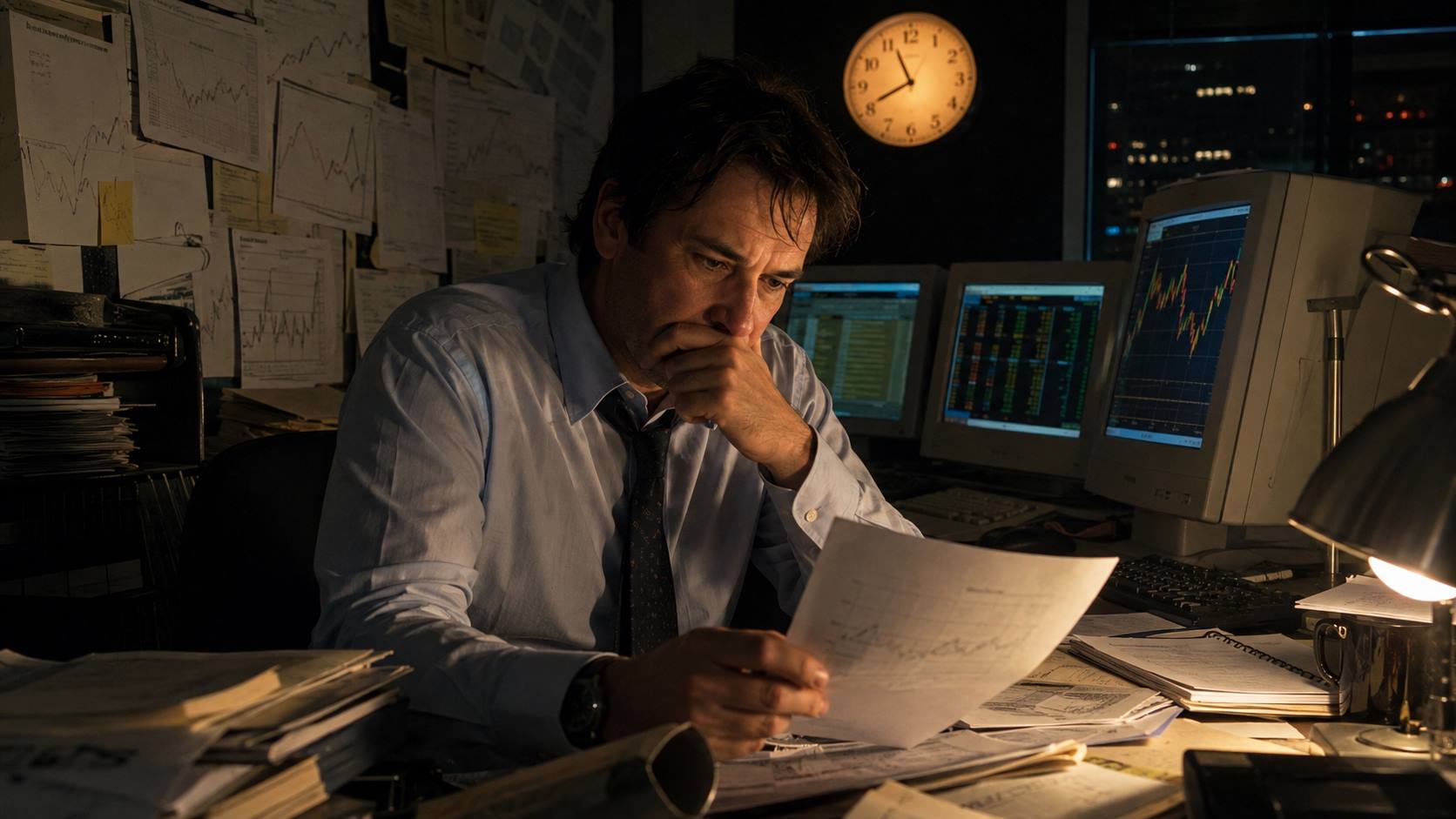
The Andrew Carlssin true story is one of them.
It has everything a viral mystery needs. A quiet stock trader. A tiny investment. A shocking fortune. The FBI. Wall Street. A confession that sounds like it came from a science fiction movie.
According to the famous claim, Andrew Carlssin turned $800 into $350 million in only two weeks. He made 126 perfect stock trades. Not lucky trades. Not smart trades. Perfect ones. Then, when investigators asked how he did it, he allegedly said he was a time traveler from the future.
That is the kind of story that grabs people by the collar.
But here’s what matters. The Andrew Carlssin story is not supported by real evidence. It is widely traced back to Weekly World News, a tabloid famous for fictional and satirical stories. Snopes investigated the claim and classified the report as fake news.
So, was Andrew Carlssin a real man from the future?
No credible evidence shows that he was. In fact, there is no solid public record proving the arrest, the trading case, or the time travel confession happened the way the viral story says.
Still, the story keeps coming back. And maybe that says something important about us.
We do not just love time travel because it bends science. We love it because it bends regret. It lets us ask: What if someone could know tomorrow before the rest of us did?
The Story People Still Share
The viral version usually goes like this.
In March 2003, a 44-year-old man named Andrew Carlssin was arrested for insider trading. He had allegedly started with $800 and used it to make $350 million in stock market profits.
That alone would sound impossible.
But the story gets stranger. Carlssin supposedly made 126 successful high-risk trades in a row. Investigators became suspicious because no normal trader could be that accurate. When questioned, he allegedly claimed he came from the year 2256.
He said he knew which stocks would rise because he had already seen history.
The story also claims he refused to reveal his time machine’s location or explain how it worked. Some versions say he offered to reveal the cure for AIDS or the location of Osama bin Laden in exchange for freedom.
It sounds dramatic. Almost cinematic.
But when we slow down, the problem becomes clear. There are no reliable official records from the SEC or FBI confirming this case. The main source of the claim was not a court filing, financial report, or government statement. It was a tabloid story. Snopes says the report about a man arrested for insider trading who blamed his success on time travel is fake.
That changes everything.
Where the Andrew Carlssin Story Came From
The Andrew Carlssin tale appears to have spread from Weekly World News, a supermarket tabloid known for wild fictional stories. This is the same kind of publication style that made strange headlines feel like secret truth.
That does not mean every reader understood it as fiction.
In the early internet era, stories often escaped their original context. A tabloid piece could be copied onto forums, blogs, and email chains. Once that happened, many readers saw the story without the satire label around it.
That is likely how Andrew Carlssin became an internet legend.
The story had the perfect shape for online sharing:
A simple setup.
A shocking number.
A secret explanation.
A government mystery.
A missing man.
And most important, it had just enough detail to sound believable at first glance.
Names like FBI, Wall Street, and insider trading make the story feel official. But official-sounding details are not the same as evidence.
A real insider trading case of this size would almost certainly leave a paper trail. There would be regulatory documents, court records, news coverage from serious financial outlets, or public statements. The Andrew Carlssin story does not have that foundation.
That is why the safest answer is clear: Andrew Carlssin is best understood as a fictional or hoax figure, not a proven time traveler.
Why People Believed It
The story worked because it touched a real fear.
Stock markets already feel mysterious to many people. We know some traders make huge money. We know insider trading exists. We know powerful people sometimes use hidden information before the public sees it.
So when a story claims a man made impossible profits, people do not immediately reject it. They think, maybe someone really knew something.
Then the time travel angle adds magic.
It turns financial suspicion into science fiction. Instead of asking whether Carlssin had illegal stock tips, the story asks whether he had future history.
That is a much more exciting question.
It also feels emotionally satisfying. Many people imagine that if they could go back in time, they would buy Apple stock, Bitcoin, Amazon, or some other winning investment before it exploded.
Andrew Carlssin becomes the fantasy version of that dream.
Not a criminal. Not a genius. Just a man with tomorrow’s newspaper.
Is There Any Evidence of Time Travel?
There is evidence for one kind of time travel, but not the Hollywood kind.
NASA explains that time travel is real under certain conditions, but not in the way most movies show it. Because of Einstein’s theory of relativity, time can pass differently depending on speed and gravity. This is called time dilation.
For example, astronauts moving very fast in space can experience time slightly differently than people on Earth. The difference is tiny, but real.
That is travel into the future in a scientific sense.
But Andrew Carlssin’s story is about something much bigger: traveling back from the future into the past, then using future knowledge to make money.
That is not supported by evidence.
A 2013 paper by Robert J. Nemiroff and Teresa Wilson searched the internet for signs of time travelers. They looked for prescient online mentions of information that should not have been known yet. Their search found no time travelers, though they also noted that a negative result does not fully disprove time travel.
That is an honest scientific answer.
We have real physics showing time can stretch.
We do not have real evidence that people are walking around from the future.
Is Time Travel to the Past Possible?
This is where the story moves from urban legend into physics.
Traveling to the future is allowed by relativity. It happens through time dilation, though not in a useful “jump into 2256” way for normal people. NASA’s explanation makes that distinction clear: time travel is real under certain conditions, but it is not like movie time travel.
Traveling to the past is much harder.
Some theories in physics discuss strange ideas like wormholes or closed timelike curves. These are mathematical possibilities in some models, but they are not working machines. They also create major problems, like paradoxes.
The classic example is simple: What if you travel back and stop your own birth? If you were never born, how did you travel back?
Some physicists explore these questions seriously. Others argue that backward time travel may be physically impossible, or at least impossible in any practical way. A 2022 paper on the pseudoscience of time travel argues that claims about changing the past often rest on flawed assumptions.
Bottom line: science does not support the idea that Andrew Carlssin came from the future and traded stocks in 2003.
How to Time Travel to the Past in Real Life?
There is no proven method to time travel to the past in real life.
That may sound disappointing, but it is important to say clearly.
No person has publicly demonstrated a working time machine. No scientific institution has verified backward time travel. No government record proves that someone came from the future and entered our timeline.
What we do have are theories, thought experiments, and science fiction.
Real science gives us time dilation. That means time can pass at different rates under extreme conditions. But it does not give ordinary people a way to step into yesterday, change history, or bring back stock tips from the future.
So if someone asks, “How can I time travel to the past in real life?” the honest answer is:
You cannot, based on any proven science available today.
You can study relativity.
You can read physics papers.
You can enjoy time travel movies.
But you cannot build a real device that sends you back to buy stocks in 2003.
Are There Time Travelers Among Us?
It is a fun question.
It is also one of the reasons Andrew Carlssin refuses to disappear from the internet.
People love looking for clues. A strange person in an old photo. A modern-looking object in a black-and-white film. A prediction that seems too accurate. A stock trader who becomes impossibly rich.
But most of these stories fall apart when checked carefully.
The 2013 internet search for time travelers found no solid evidence. The researchers looked for online information that should not have existed before certain events became public, but they found no confirmed time travelers.
That does not prove time travelers are impossible. It only means we do not have good evidence for them.
And that is the key difference.
A mystery can be interesting without being true.
Why the $350 Million Claim Sounds Suspicious
The Andrew Carlssin true story depends heavily on one number: $350 million.
That number makes the story feel huge. It also makes it harder to believe.
If someone really turned $800 into $350 million through suspicious trades in two weeks, that would be one of the most extreme trading cases in modern financial history. It would attract serious attention from regulators, financial journalists, courts, and trading firms.
A case like that would not remain hidden inside one tabloid-style story.
The claim also says he made 126 successful trades in a row. In real markets, that kind of perfect record is almost impossible without either false reporting, hidden information, or a fictional setup.
That is why the simpler explanation is stronger.
The story was written to entertain, shock, and spread.
It was not built like a documented legal case.
The Role of Weekly World News
To understand Andrew Carlssin, you have to understand the media world that created him.
Weekly World News was famous for bizarre stories. It published material about strange creatures, impossible events, supernatural claims, and wild celebrity-style rumors. Its stories were often treated as entertainment.
The Andrew Carlssin story fits that pattern.
It takes a normal public fear, insider trading, and blends it with an impossible twist, time travel. That mix makes the story memorable.
It is not boring fraud.
It is fraud from the future.
That is brilliant tabloid storytelling.
But tabloid storytelling is not the same as verified journalism.
Jessica Savitch’s lens matters here because this story asks for investigation, not just excitement. A journalist does not ask, “Is this cool?” first. A journalist asks, “What can we prove?”
And what can we prove?
We can prove the story became viral.
We can prove people still discuss it.
We can prove Snopes labels it fake.
We cannot prove Andrew Carlssin was arrested as described.
We cannot prove he made $350 million.
We cannot prove he came from 2256.
Why the Story Still Feels Alive
Even when a hoax is exposed, the emotion behind it can survive.
Andrew Carlssin still feels alive because the story touches three things people care about:
First, money. Everyone understands the dream of one perfect trade.
Second, time. Everyone has something they wish they could go back and change.
Third, secrecy. People love the idea that governments may know more than they reveal.
Put those three together and you get a legend that feels bigger than its source.
That is why the story keeps appearing on YouTube videos, Reddit threads, TikTok clips, and mystery blogs.
People are not always asking, “Is this documented?”
Often, they are asking, “What if?”
And “what if” is powerful.
The Difference Between Mystery and Evidence
There is nothing wrong with enjoying a mystery.
The problem begins when mystery is sold as fact.
A good true story article must separate the two.
The Andrew Carlssin case is interesting because it shows how a fictional or satirical claim can become internet folklore. People repeat the same details until they feel familiar. Then familiarity starts to feel like truth.
That happens all the time online.
A story gets shared.
A short video repeats it.
A blog rewrites it.
A social post adds dramatic music.
Someone says, “This really happened.”
But repetition is not proof.
For proof, we need records, documents, credible witnesses, and reliable reporting.
Andrew Carlssin does not pass that test.
What This Story Teaches About Time Travel Claims
The Andrew Carlssin true story is not really a story about time travel.
It is a story about belief.
It shows how easily people can be pulled toward an idea when the idea is exciting enough. It also shows why fact-checking matters, especially with stories that mix real-world institutions with impossible claims.
The FBI is real.
Insider trading is real.
Stock market fraud is real.
Time dilation is real.
But Andrew Carlssin as a proven future traveler is not real, based on available evidence.
That is the trick. The hoax borrows pieces of reality and uses them to make fiction feel heavier.
Andrew Carlssin and Pop Culture
One reason this story works so well is that movies trained us to understand it.
We have seen characters use future knowledge before. We have watched time travelers try to fix mistakes, get rich, warn people, or hide from authorities. The Andrew Carlssin legend feels like a missing scene from a science fiction thriller.
It has the energy of a movie pitch:
A man from the future gets caught because he is too good at the stock market.
That is a strong idea.
It would make a fascinating film or TV episode. But as a real-world event, it does not hold up.
That difference matters for IstrueStory readers. Some stories are “true” because they happened. Others are true because they reveal something about human imagination.
Andrew Carlssin belongs in the second group.
Common Claims About Andrew Carlssin
Claim: Andrew Carlssin made $350 million from $800
This is the central claim of the legend. It is not supported by verified financial or legal records. Snopes identifies the time-traveler insider trading story as fake.
Claim: The FBI arrested him
No reliable public FBI record confirms the viral version of the story. The claim appears inside the tabloid-style account, not in a confirmed legal file.
Claim: He said he came from the year 2256
This is part of the viral story, but it has no verified interview, court transcript, or official statement behind it.
Claim: He disappeared after bail
This detail helps the story feel mysterious, but it is also unsupported. In urban legends, a disappearance often works like a final magic trick. It stops people from asking for more proof.
Claim: His story proves time travel
It does not. Real science supports time dilation, not a proven case of backward time travel by a stock trader. NASA explains that time travel under relativity is not the same as movie-style time travel.
So, Was Andrew Carlssin Real?
There may or may not have been a person somewhere with that name. But the famous Andrew Carlssin story, the one about the time traveler who made $350 million, is not verified as real.
The better answer is:
Andrew Carlssin is an internet legend created from a fake or satirical report, not a confirmed true story.
That answer is less exciting than “he came from the future.”
But it is more honest.
And honestly, the real story is still fascinating.
Not because a man beat Wall Street with a time machine.
But because millions of people wanted to believe someone could.
Why We Want Time Travel to Be Real
Time travel stories are rarely just about science.
They are about regret. Hope. Curiosity. Fear. Second chances.
We think about the past because it still has emotional weight. We think about the future because it feels both exciting and dangerous.
Andrew Carlssin sits right between those feelings.
He is the fantasy of knowing what comes next. He is the person who does not have to guess. While everyone else risks money, time, and reputation, he already knows the ending.
That is why the story keeps working.
It gives us a character who beats uncertainty.
And uncertainty is one of the hardest things humans live with.
A Clear Answer for Readers
The Andrew Carlssin true story is not a proven true story.
It is a viral time travel hoax linked to a tabloid-style report. No solid evidence confirms that Carlssin made $350 million, was arrested by the FBI, or traveled from the future.
Science does allow small forms of forward time travel through time dilation, but it does not prove that people can travel back to the past and change events. NASA explains that real time travel is not like what we see in movies.
And when researchers searched online for evidence of time travelers, they found none.
So the final truth is simple:
Andrew Carlssin was not exposed as a real time traveler.
He was exposed as a great internet myth.
FAQs About Andrew Carlssin True Story
Is Andrew Carlssin a real time traveler?
No credible evidence proves Andrew Carlssin was a real time traveler. The story is widely treated as a hoax that came from tabloid-style reporting.
Did Andrew Carlssin really turn $800 into $350 million?
There is no reliable public evidence that he made $350 million through stock trading. Snopes labels the insider-trading time traveler story as fake.
Is there any evidence of time travel?
There is scientific evidence for time dilation, which means time can pass differently under certain conditions. But there is no confirmed evidence that humans can travel back into the past.
Is time travel to the past possible?
Backward time travel remains theoretical and highly disputed. No working method has been proven in real life.
How can someone time travel to the past in real life?
There is no proven way to time travel to the past in real life. Current science does not offer a practical method for doing it.
Are there time travelers among us?
There is no verified evidence that time travelers are living among us. A 2013 internet search for time travelers found no confirmed cases.

Jessica Savitch, with a deep passion for journalism, brings her expertise to istruestory.com as a dedicated author. MA in Arts & Journalism.