
At first glance, it looks simple. A poor man lives in a small Chinese village. He gets mocked, beaten, humiliated, and eventually executed. But beneath that surface is something much deeper. Lu Xun, the writer behind the story, used Ah Q to expose fear, weakness, false pride, and the emotional wounds inside a struggling society.
Even today, readers around the world still ask the same questions:
Was Ah Q based on a real person?
Why was Ah Q executed?
What does “the spirit of Ah Q” actually mean?
And why did Lu Xun write such a harsh story?
Here’s what matters most. Ah Q was not one single historical man. He was created as a symbol of millions of people living through confusion, poverty, and humiliation during a difficult period in Chinese history. That is why the story still feels alive today.
Fast Truths Hidden Inside The True Story of Ah Q
| Topic | Quick Fact |
|---|---|
| Full Title | The True Story of Ah Q |
| Author | Lu Xun |
| Published | 1921 |
| Country | China |
| Genre | Satirical novella / social criticism |
| Main Character | Ah Q, a poor villager and drifter |
| Is Ah Q Real? | No, Ah Q is fictional but represents real social behavior |
| What Is It About? | A man who hides failure behind false pride and self-delusion |
| Why Was Ah Q Executed? | He became a scapegoat during political unrest and was wrongly blamed |
| Meaning of “Ah Q Spirit” | Pretending defeat is actually victory to protect pride |
| Did Lu Xun Study Medicine? | Yes, in Japan before becoming a writer |
| Why Did Lu Xun Stop Medicine? | He believed China needed mental and cultural healing more than physical treatment |
| Historical Setting | Early 1900s China after the fall of the Qing Dynasty |
| Main Theme | Self-deception, social weakness, and national identity |
| Literary Importance | Considered one of the most influential works in modern Chinese literature |
| Writing Style | Simple language with sharp social criticism |
| Legacy | Still studied worldwide in literature and history courses |
A Story Born During China’s Time of Crisis
The True Story of Ah Q was written by Chinese author Lu Xun in 1921. It first appeared as a serialized story in a Beijing magazine during a period when China was going through political collapse, social unrest, and cultural change.
The Qing Dynasty had recently fallen. Revolution was spreading across the country. Many intellectuals believed China needed to completely rethink its future. Lu Xun became one of the strongest voices pushing for social awakening through literature instead of politics alone.
What made his writing different was its honesty.
He did not write heroic fantasy stories filled with perfect people. He wrote about weakness, denial, fear, and emotional suffering. He believed many people were trapped mentally long before they were trapped physically.
That belief became the foundation of Ah Q.
According to Britannica, Lu Xun originally studied medicine in Japan before turning to writing because he believed China needed spiritual and cultural healing more than medical treatment.
That decision changed modern Chinese literature forever.
Did Lu Xun Study Medicine?
Yes, he did.
This is one of the most important facts connected to the story because it explains why Lu Xun wrote with such emotional intensity.
Lu Xun traveled to Japan and studied medicine at the Sendai Medical Academy. At the time, he hoped to help sick people physically. But during his studies, he experienced something that deeply disturbed him.
He watched a classroom slide showing a Chinese prisoner being executed while nearby Chinese spectators watched passively without emotion. Lu Xun later explained that this moment shocked him more than illness itself.
He realized physical health alone could not save a society that had lost confidence, awareness, and self-respect.
So he left medicine and became a writer.
In many ways, The True Story of Ah Q became his attempt to diagnose the emotional sickness of society.
What Is The True Story of Ah Q About?
The story follows Ah Q, a poor drifter living in a village called Weizhuang. He has no stable home, little money, and almost no respect from others.
People insult him constantly. He gets beaten in public. He loses fights. He is mocked by villagers. Yet after every humiliation, Ah Q convinces himself that he somehow “won.”
This strange mental trick becomes the core of the story.
Instead of facing reality, Ah Q creates imaginary victories inside his own mind. If someone beats him, he tells himself the attacker was beneath him anyway. If he loses status, he pretends the loss was actually honorable.
Lu Xun called this kind of thinking “spiritual victory.”
At first, it sounds almost funny. But as the story continues, it becomes tragic.
Ah Q cannot grow because he refuses to honestly face his failures.
That is exactly what Lu Xun wanted readers to notice.
The story was not simply criticizing one poor villager. It was criticizing a society trapped in denial, fear, and emotional self-deception.
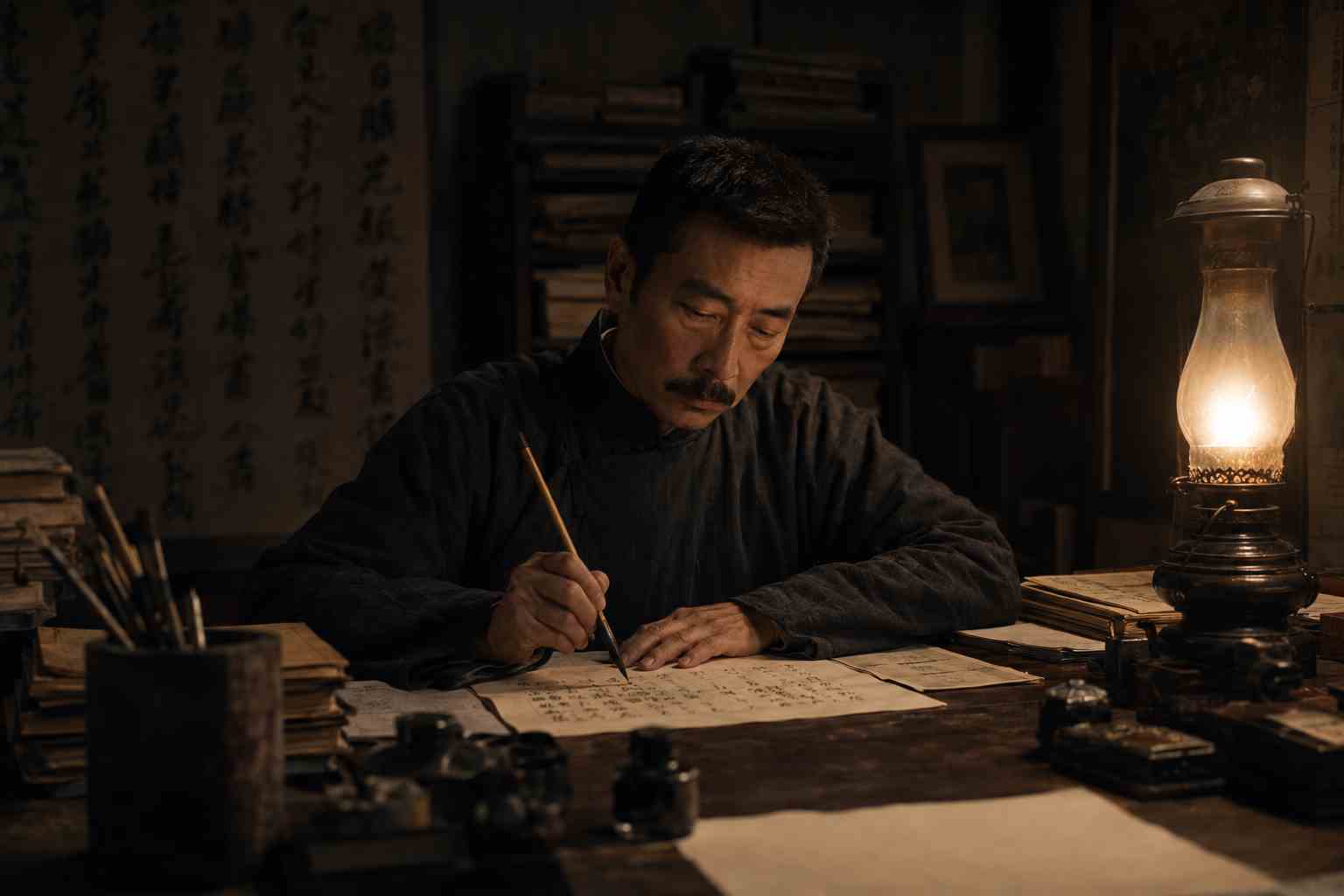
Understanding the “Ah Q Spirit”
The phrase “Ah Q spirit” became famous across China.
Even today, people still use it when talking about someone who pretends defeat is actually success.
The “Ah Q spirit” means using false emotional comfort to avoid painful truth.
For example:
- Losing badly but pretending it was intentional
- Being humiliated but acting superior afterward
- Avoiding responsibility through excuses
- Escaping reality instead of confronting it
Lu Xun believed this mindset was dangerous because it prevented real change.
If people refuse to admit problems exist, those problems never improve.
That message gave the story enormous cultural influence.
According to The China Project, the term “Ah Q spirit” remains part of modern Chinese discussions about psychology, nationalism, and social behavior even more than a century later.
That is rare for a fictional character.
Was Ah Q Based on a Real Person?
Not exactly.
There is no confirmed historical man named Ah Q who inspired the story directly. Most literary experts agree Ah Q was fictional.
But that does not mean the story lacked reality.
Lu Xun built Ah Q from real social conditions, real emotional struggles, and real behaviors he observed around him. In that sense, Ah Q represented ordinary people living during a painful period of Chinese history.
Many readers saw themselves in him.
Others saw neighbors, politicians, or entire social systems reflected through the character.
That is why the story felt dangerous and powerful at the time.
It exposed uncomfortable truths.
Why Was Ah Q Executed?
This is one of the darkest moments in the story.
Near the end, political unrest spreads through the village during the revolution. Ah Q wants to join revolutionary activity, partly because he thinks it may finally bring him respect and importance.
But instead of becoming powerful, he becomes a convenient target.
After a robbery occurs, local authorities arrest Ah Q despite weak evidence and confusion surrounding the crime. He barely understands what is happening. He is pushed through the legal process quickly and publicly executed.
The execution scene is intentionally disturbing.
Ah Q is confused, frightened, and emotionally disconnected even in his final moments. He worries more about appearances than about death itself.
Lu Xun used this moment to show how powerless ordinary people could become inside chaotic political systems.
Ah Q dies not as a hero, but as someone crushed by ignorance, manipulation, and social failure.
Why the Story Shocked Readers
Modern readers may wonder why the book became so famous. The answer is simple.
Few writers at the time were willing to criticize society this openly.
Lu Xun challenged:
- Blind nationalism
- Social cruelty
- Intellectual weakness
- Fake pride
- Cultural denial
- Empty revolutionary slogans
He showed how people sometimes become trapped emotionally and mentally without realizing it.
For many readers, the story felt like a mirror.
Some admired Lu Xun’s honesty. Others hated how brutally accurate the story felt.
Either way, people could not ignore it.
The Historical Background Behind Ah Q
To fully understand the story, it helps to understand China during the early 1900s.
The country faced:
- Foreign political pressure
- Military defeats
- Internal rebellion
- Economic instability
- Cultural identity struggles
Many Chinese intellectuals believed traditional systems were collapsing. The younger generation wanted reform, science, education, and modernization.
Lu Xun became connected to the New Culture Movement, which encouraged critical thinking and modern literature written in everyday language instead of older classical Chinese forms.
That mattered because ordinary readers could finally understand stories directly.
The True Story of Ah Q became one of the most important examples of this literary revolution.
Why Ah Q Still Feels Relevant Today
One reason the story continues to survive is because Ah Q’s behavior still exists everywhere.
People still:
- Avoid uncomfortable truth
- Pretend failure is success
- Protect pride instead of improving
- Follow crowds without understanding
- Seek quick emotional comfort
That makes Ah Q timeless.
The story may be rooted in early 20th-century China, but its emotional themes are universal.
Readers from completely different countries still recognize the psychology behind the character.
That is the mark of powerful literature.
Lu Xun’s Lasting Legacy
Lu Xun is now considered one of the most influential writers in modern Chinese history.
His work helped reshape Chinese literature by using simple language, psychological realism, and social criticism. He inspired generations of writers, intellectuals, and reformers.
According to Britannica – The True Story of Ah Q, the novella became one of the defining literary works of modern China because it captured the emotional condition of society during a transformative historical moment.
Even today, students across the world study the story in literature and history classes.
Not because Ah Q was heroic.
But because he felt real.
The Sad Truth Hidden Inside Ah Q
The most heartbreaking part of the story is that Ah Q never fully understands himself.
He spends his entire life escaping reality emotionally instead of confronting it honestly.
Lu Xun believed this kind of self-deception could destroy individuals and entire societies alike.
That is why the story still matters.
It is not simply about one poor villager from long ago. It is about human weakness, pride, fear, and survival. It asks readers a difficult question:
What happens when people become more comfortable with illusion than truth?
That question still feels uncomfortably modern.
And that is why The True Story of Ah Q remains one of the most important literary works ever written in China.

Jessica Savitch, with a deep passion for journalism, brings her expertise to istruestory.com as a dedicated author. MA in Arts & Journalism.