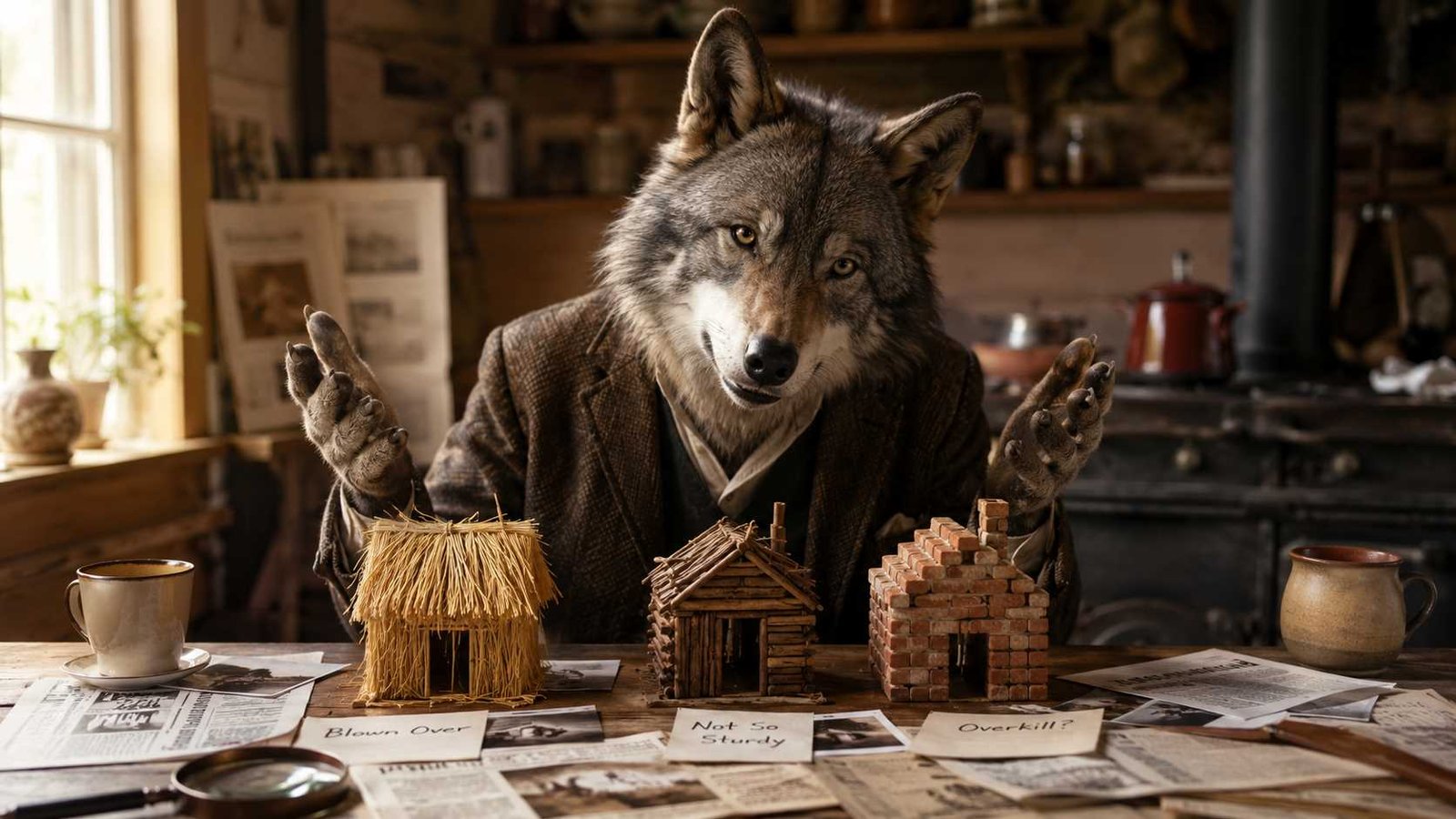
Three pigs build three houses. One uses straw, another uses sticks, and the smartest one chooses bricks. Then a hungry wolf arrives, huffs and puffs, and causes plenty of trouble.
But The True Story Of The Three Little Pigs asks a much more interesting question: What if we have been listening to only one side of the story?
That question is at the heart of Jon Scieszka’s children’s book The True Story of the 3 Little Pigs!, illustrated by Lane Smith. First published in 1989, the book turns the famous fairy tale upside down by allowing the wolf, Alexander T. Wolf, to tell his version of events.
Despite the title, however, this is not a true story in the historical sense.
There was no real Alexander T. Wolf. There was no criminal case involving three pigs. Instead, Scieszka created a clever fictional retelling of a much older English folktale.
And once we look at that older tale, things become surprisingly dark.
Is The True Story Of The Three Little Pigs Actually True?
No. The True Story Of The Three Little Pigs is a fictional picture book.
The word true is part of the joke.
Instead of telling the familiar story from the pigs’ point of view, Jon Scieszka lets the supposed villain defend himself. Alexander T. Wolf claims that people have misunderstood what happened.
According to the publisher’s description, his trouble begins with a birthday cake for his grandmother, a bad cold, and his already terrible reputation.
That changes the whole mood of the story.
Suddenly, the Big Bad Wolf is not simply a monster appearing outside a pig’s house. He is a narrator asking us to believe his explanation.
Is he innocent?
Is he lying?
Or is the truth somewhere between the two?
Scieszka never turns the book into a serious criminal investigation. It remains funny and exaggerated. But beneath the jokes is a surprisingly smart lesson: the person telling a story can change the way we understand it.
What Happened In The True Story Of The Three Little Pigs?
Alexander T. Wolf, usually called Al, says that the famous version of events is wrong.
In his account, he wants to make a birthday cake for his grandmother. He discovers that he is missing an ingredient, so he visits a neighbor to borrow some.
That neighbor happens to be a pig living in a straw house.
Al also has a terrible cold.
He sneezes.
The fragile house comes down.
From there, his problems get worse.
He visits another pig. Another sneeze follows. Another house collapses.
By the time he reaches the third pig and the brick house, the situation has turned into the story everyone thinks they know.
The difference is motivation.
The traditional wolf deliberately attacks the pigs. Scieszka’s wolf presents himself as the victim of unfortunate circumstances, bad publicity, and his own reputation.
Penguin Random House describes the book as a fractured fairy tale in which Alexander T. Wolf finally tells his side of the encounter with the pigs.
That is why the book’s title works so well.
It sounds like a promise to reveal hidden facts. In reality, it asks readers to decide how much they trust the person speaking.
So What Is The Original Three Little Pigs Story?
There is an important distinction here.
There is no confirmed historical event behind The Three Little Pigs. It belongs to the tradition of folklore and fairy tales.
Stories like this were passed down and changed over time, which means looking for one single original version can be misleading.
One of the most influential printed versions appears in Joseph Jacobs’ English Fairy Tales. The Library of Congress records that collection as having been published in London in 1890.
And the Jacobs version is much harsher than many versions children hear today.
The first pig does not escape
The first pig builds a house from straw.
The wolf arrives and demands to enter.
When the pig refuses, the wolf blows down the house.
Then the wolf eats the pig.
There is no rescue.
There is no reunion later.
The first pig is simply gone.
The second pig suffers the same fate
The second pig builds with furze, a type of woody shrub.
Once again the wolf arrives.
Once again he destroys the house.
And once again, he eats the pig.
Only the third pig survives.
The brick house is only part of the third pig’s victory
Modern retellings often make the lesson very simple:
Build a strong house and the wolf cannot get you.
But the older story continues much longer.
After failing to blow down the brick house, the wolf repeatedly tries to lure the third pig outside.
He suggests visiting a turnip field.
The pig outsmarts him.
He suggests collecting apples.
The pig tricks him again.
They even become involved in an episode surrounding a fair and a butter churn.
The third pig survives not only because his house is stronger.
He survives because he is smarter than the wolf.
That changes the meaning of the tale.
It is not simply a story about construction materials. It is also a battle of patience, planning, and intelligence.
Is There A Dark Story Behind The Three Little Pigs?
Yes, although calling it a secret dark story would be misleading.
The darker material is not a hidden conspiracy. It is right there in older published versions of the folktale.
The wolf eats the first two pigs.
Then the third pig eventually turns the tables.
When the wolf tries to enter the brick house through the chimney, the pig prepares a pot of boiling water below.
The wolf falls into it.
The pig then cooks the wolf and eats him for supper.
That ending can be shocking if you grew up with a softer version.
Modern adaptations often remove the deaths altogether. Sometimes all three pigs survive. Sometimes the first two simply run to their brother’s brick house. The wolf may run away, get burned, or learn a lesson.
The older story is less gentle.
The wolf eats pigs.
Then a pig eats the wolf.
Fairy tales were not always designed to protect young readers from frightening consequences. Danger was often part of the lesson.
Why Were Old Fairy Tales So Much Darker?
It is tempting to think that people in the past simply enjoyed frightening children.
The reality is more complicated.
Traditional folktales often placed characters in extreme situations because those situations made lessons easier to remember.
A weak house does not merely become inconvenient. It gets destroyed.
Ignoring danger does not lead to a mild problem. It can lead to death.
Being clever does not earn the hero a certificate. It saves his life.
The violence gives the story clear stakes.
For a child hearing the tale, the message is easy to understand:
Preparation matters.
Carelessness has consequences.
Danger may return.
And clever thinking can sometimes succeed where strength cannot.
That may help explain why The Three Little Pigs survived for generations even while details changed.
The Real Difference Between The Old Tale And Scieszka’s Version
This is where The True Story Of The Three Little Pigs becomes more than a funny rewrite.
The traditional story tells us exactly how to feel.
The pigs are victims.
The wolf is dangerous.
The third pig defeats him.
Case closed.
Scieszka creates doubt.
Alexander T. Wolf knows that everyone already thinks he is guilty. So he tries to explain how ordinary events were transformed into the legend of the Big Bad Wolf.
The clever part is that readers do not have to believe him.
His version teaches a different lesson from the traditional fairy tale:
Always ask who is telling the story.
Two people can describe the same event in completely different ways.
That idea appears everywhere in real life, from playground arguments to courtrooms, newspapers, documentaries, and history books.
The facts matter.
But perspective matters too.
Is Alexander T. Wolf Innocent?
That is deliberately difficult to answer.
Al certainly wants us to believe he has been treated unfairly.
But he is also defending himself.
That makes him what literary readers often call an unreliable narrator: someone whose version of events may not be completely trustworthy.
Children do not need to know that technical term to understand the idea.
They naturally start asking questions.
Why should we believe the wolf?
Why did the pigs tell a different story?
Could Al be changing details to make himself look better?
Those questions are part of what made the book so memorable.
Penguin Random House even frames the story as something readers should judge for themselves rather than providing a simple declaration that the wolf is innocent.
What Is The Dark Meaning Behind This Little Piggy?
This question often gets mixed together with The Three Little Pigs, but they are different works.
This Little Piggy is the nursery rhyme traditionally played using a child’s toes.
It includes the familiar sequence about one pig going to market, another staying home, one eating roast beef, another having none, and the final pig crying on the way home.
The rhyme has a long history.
Research cited by the Library of Congress notes that its first line can be traced to an English song from 1728, while a fuller form was recorded later in the eighteenth century.
Does going to market mean the pig was killed?
You may have seen a darker explanation online.
According to that theory, the first pig did not go to the market to shop. It was being taken to market to be sold or slaughtered.
It sounds believable because livestock really are taken to market.
But there is an important problem:
There is no solid historical evidence proving that this was the rhyme’s intended meaning.
A fact-check examining the viral interpretation found that the slaughter explanation has circulated widely but has not been confirmed. (
So it is better to describe this as a modern interpretation rather than a discovered secret meaning.
It may be possible.
It is not established fact.
And it has no direct connection to Jon Scieszka’s The True Story of the 3 Little Pigs!.
Is There A Play Based On The True Story Of The Three Little Pigs?
Yes.
There is an official musical adaptation based on the book by Jon Scieszka and Lane Smith.
The stage version has book and lyrics by Robert Kauzlaric, with music by Paul Gilvary and William Rush. Concord Theatricals lists it as a short musical comedy designed for young audiences.
The musical takes the book’s idea in a clever new direction.
Instead of merely listening to Al explain himself, audiences enter something resembling a courtroom drama.
Alexander T. Wolf is involved in Piggsylvania’s Trial of the Century, where the question becomes whether the famous Big Bad Wolf can receive a fair hearing.
The official production history says the musical received its world premiere at Lifeline Theatre in Chicago on February 25, 2007.
So if someone asks whether there is a True Story of the Three Little Pigs play, the answer is definitely yes.
More precisely, it is a musical stage adaptation.
Why The Wolf’s Version Still Feels Fresh
A fairy tale with pigs, straw houses, and a sneezing wolf may sound simple.
But the reason Scieszka’s version works is surprisingly grown-up.
We live surrounded by competing versions of events.
One person says something happened one way.
Another insists it happened differently.
Then everyone has to decide which details are facts and which details are interpretation.
Alexander T. Wolf turns that problem into comedy.
He does not change the basic pieces of the fairy tale. There are still pigs. There are still houses. Houses still come down.
What changes is the explanation.
That small shift makes readers reconsider a story they thought they already understood.
Questions Readers Still Ask
What happened in the true story of The Three Little Pigs?
In Jon Scieszka’s fictional retelling, Alexander T. Wolf claims the destruction of the pigs’ houses began because he had a cold and needed an ingredient for his grandmother’s birthday cake. The story is told from his point of view rather than the pigs’.
Is The True Story Of The Three Little Pigs based on real events?
No. It is a fictional fractured fairy tale based on the traditional Three Little Pigs folktale. The word true is part of the book’s playful attempt to make readers question which narrator they believe.
Is there a dark story behind The Three Little Pigs?
Older versions are considerably darker than many modern adaptations. In Joseph Jacobs’ 1890 collection, the wolf eats the first two pigs, while the surviving third pig eventually cooks and eats the wolf.
What is the dark meaning behind This Little Piggy?
Some people interpret the pig that goes to market as an animal being taken for sale or slaughter. That interpretation is possible but not proven as the rhyme’s original intended meaning. This Little Piggy is also separate from The Three Little Pigs.
Is there a play based on The True Story Of The Three Little Pigs?
Yes. Robert Kauzlaric adapted the book into a musical, with music by Paul Gilvary and William Rush. Its world premiere took place at Lifeline Theatre in Chicago in 2007.
Why This Old Story Still Works
There is no hidden real-world crime behind The True Story Of The Three Little Pigs.
Its real cleverness lies somewhere else.
The traditional tale teaches us about preparation, danger, and cleverness. Its older versions can be surprisingly brutal, with two pigs eaten and the wolf ultimately meeting the same fate.
Jon Scieszka’s 1989 book takes that familiar story and asks us to look at it again.
Maybe the wolf is guilty.
Maybe he is making excuses.
Maybe the pigs’ version is closer to the truth.
The book never needs to settle the argument completely.
That uncertainty is the point.
The True Story Of The Three Little Pigs is ultimately a story about perspective: who gets to speak, who gets believed, and how differently the same events can sound when the supposed villain finally gets a chance to tell his side.

Jessica Savitch, with a deep passion for journalism, brings her expertise to istruestory.com as a dedicated author. MA in Arts & Journalism.