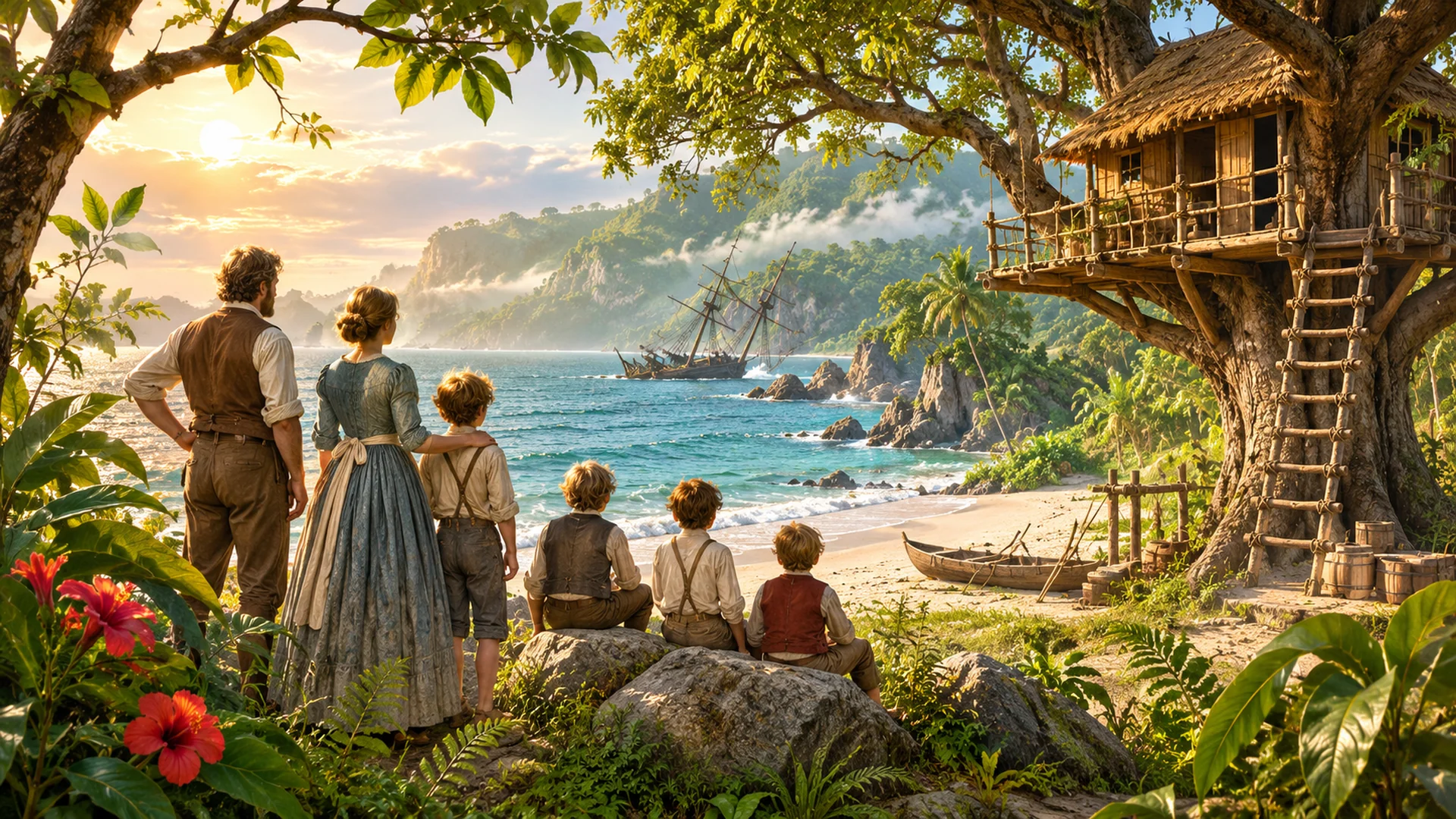
A family survives a terrible shipwreck. They rescue supplies, build a home in the trees, and turn an unfamiliar island into a place to live. It sounds like the kind of adventure that might have come from a sailor’s diary. But is The Swiss Family Robinson a true story?
No. The Swiss Family Robinson is a work of fiction, not the record of a real shipwrecked family. Its author, Johann David Wyss, drew on his own family life and an earlier survival novel. The island, the family’s extraordinary discoveries, and their long adventure were created for a story.
The real history is still worth exploring. It explains why the book feels personal, why its island seems almost too wonderful to be true, and why two readers can remember different endings.
Is Swiss Family Robinson Based on a True Story?
The short answer is no. The novel follows a Swiss couple and their four sons after a storm wrecks their ship near a tropical island. They salvage food, tools, animals, and other supplies, then use what they find to build shelters and establish a new life. The plot is imaginative rather than a documented account of six people who actually lived through those events. The Harvard Gazette describes the novel as fiction and notes its unusual mix of animals.
Some parts feel believable: a shipwreck would create urgent problems, clean water would matter, and working together could improve a family’s chances. Those everyday concerns are different from saying the specific Robinson family or island existed.
That distinction also matters with other survival stories. For example, the question of whether Cast Away is true is about another fictional island adventure whose realism can make it feel like history.
Who Wrote The Swiss Family Robinson?
Johann David Wyss (1743–1818), a Swiss clergyman from Bern, is the writer most closely associated with the book. He had four sons of his own. According to the Swiss National Museum’s literary history, he originally shared the adventure with his children, rather than planning a commercial bestseller.
The project became a family effort. Johann Rudolf Wyss, one of his sons, prepared and published his father’s material. Accounts of the manuscript and its later editions differ on how much each family member shaped the writing, so it is safest to credit Johann David with the story while recognizing Johann Rudolf’s editorial role.
The German work began appearing in 1812, and an English translation followed in 1814. Publisher Penguin Classics confirms these dates and describes the many changes later translators made to the text.
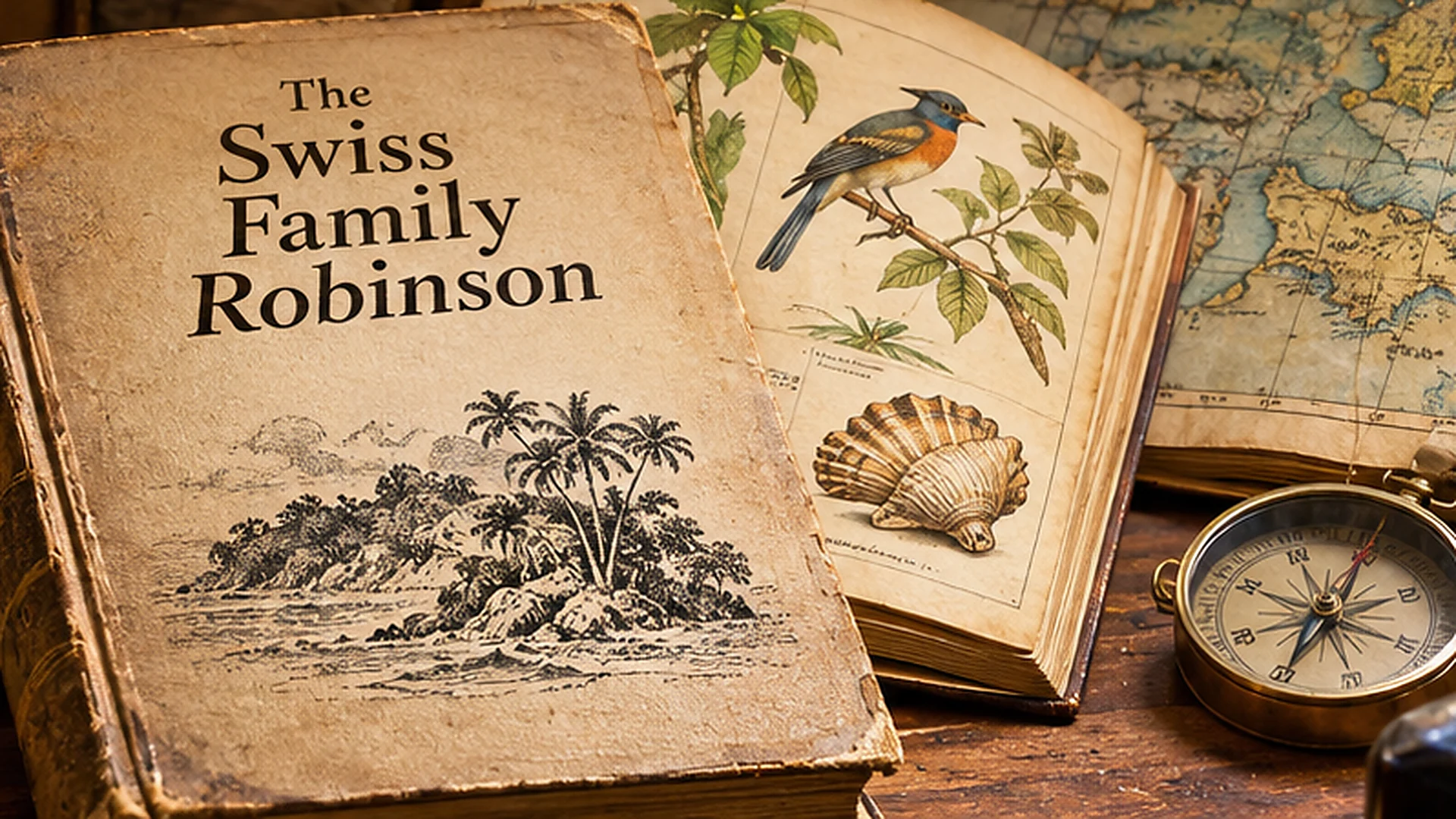
What Inspired the Swiss Family Robinson Novel?
There were two major sources of inspiration: Wyss’s children and Daniel Defoe’s Robinson Crusoe. Neither makes the Swiss family’s shipwreck a historical event, but together they explain the book’s unusual blend of adventure and teaching.
A Father Writing for His Children
Wyss imagined what a family might do if it had to survive far from home. The father in the story uses everyday challenges to teach the boys practical skills, observation, cooperation, and moral judgment. A biographical study from EBSCO explains that Wyss’s own household helped shape the fictional family, and that his son later brought the manuscript to readers.
That is the closest the novel comes to a true family story. The relationships and lessons have roots in Wyss’s real home life; the wreck and the adventures do not.
The Influence of Robinson Crusoe
Daniel Defoe published Robinson Crusoe in 1719, more than ninety years before The Swiss Family Robinson. Its success inspired many other stories about people stranded far from society. Literary historians call these stories robinsonades. The Swiss National Museum places Wyss’s book in that tradition.
Wyss changed the central idea. Instead of watching one man face isolation, readers watch a whole family solve problems together. It makes survival less about loneliness and more about learning from one another.
Was the Robinson Family Real?
No historical evidence identifies the novel’s Robinsons as a real family who were marooned together. The parents and four boys are fictional characters, even though Wyss’s own family provided a model for their relationships. Different editions may name or describe characters differently, another reason not to confuse the imagined household with an actual set of survivors.
The family’s achievements also fit the author’s educational purpose. A problem appears, a parent or child recalls a useful idea, and the lesson becomes part of the next step toward a safer home. The result is satisfying storytelling, not a verified day-by-day survival report.
Readers who enjoy this difference between a convincing narrative and a true account may also like our look at the competing stories in Life of Pi. That book raises a different question: how the stories we tell affect what others believe.
Is the Island in Swiss Family Robinson a Real Place?
The family’s island is imaginary. The adventure points toward the East Indies, a historical name used for parts of South and Southeast Asia, but readers cannot match the island’s plants, animals, and landscape to one confirmed real location.
One clue is its wildlife. The family encounters creatures that would not normally share a single island habitat. In a Harvard Gazette reflection on the book, a biologist notes how the island brings together animals from very different parts of the world. This is an inventive setting for lessons about nature, not a reliable ecological description.
The remarkable abundance is also part of the novel’s appeal. The family seems to discover just the right materials, foods, and animals for each new challenge. A real castaway would face much more uncertainty, while the story is arranged to keep the lessons and adventures moving.
For a sharp contrast, the true survival ordeal behind Alive comes from a documented disaster. Its setting and people can be checked against real events, unlike Wyss’s invented island.
Swiss Family Robinson vs. Robinson Crusoe
The titles sound closely related, and that is deliberate in a literary sense. But they are separate books, written by different authors, about different characters.
| Question | The Swiss Family Robinson | Robinson Crusoe |
|---|---|---|
| Who wrote it? | Johann David Wyss | Daniel Defoe |
| When did it first appear? | 1812 | 1719 |
| Who is stranded? | Parents and four sons | Primarily one castaway |
| Main focus | Family teamwork, practical lessons, exploration | Solitude, resourcefulness, belief, and survival |
| Is it a factual account? | No | No; it is also a novel |
Robinson Crusoe has connections to the wider history of real castaways, but it should not be treated as an exact transcript of one sailor’s life. The Swiss Family Robinson goes a step further into family-centered invention.
If the true-story question is what interests you most, our collection of novels with real-life inspirations helps separate books built around documented events from stories that borrow only a theme or setting.
How the Original Novel Changed Through Translations
There is another reason readers sometimes disagree about The Swiss Family Robinson: not every edition contains the same material. Over the centuries, translators and editors shortened passages, expanded scenes, and changed parts of the ending.
According to EBSCO’s account of the publication history, the French writer and translator Isabelle de Montolieu reshaped and extended the narrative. Later revisions helped produce multiple versions in circulation. Penguin Classics likewise explains that significant scenes were cut or added in editions of the novel.
So if you remember a particular rescue, a new character, or a different ending, you may have read another adaptation. That difference does not uncover a hidden true story. It shows how a popular fictional adventure was rewritten for new readers.
You can explore one historical English-language text through Project Gutenberg’s free edition. Keep in mind that this is a published edition, not a scan of Wyss’s original handwritten manuscript.
What the Story Teaches About Family and Survival
Wyss does not need a real shipwreck for his central ideas to work. The family learns to use resources carefully, combine different strengths, and keep trying when plans fail. Children are encouraged to be curious, while adults guide them through unfamiliar problems.
Modern readers can also look more critically at the book. Its view of exploration reflects the European ideas and assumptions of its time. The fantasy of finding an island full of useful resources leaves out many real questions about ecosystems, other people, and the effects of settlement. Those limitations are part of reading a nineteenth-century adventure with twenty-first-century eyes.
It can be helpful to compare its imagined hardships with books about historical danger, such as the historical background of The Book Thief. Both kinds of literature can teach empathy, but they make different promises about what really happened.
So, is The Swiss Family Robinson a true story? No. Its famous shipwreck, remarkable island, and resourceful Robinson family belong to fiction. The authentic part lies behind the pages: a Swiss father, his children, and an earlier adventure novel helped inspire a story about finding courage and purpose together.

I am Jeremy Jahns – Your Cinematic Explorer
Immerse in movie reviews, Hollywood insights, and behind-the-scenes stories.