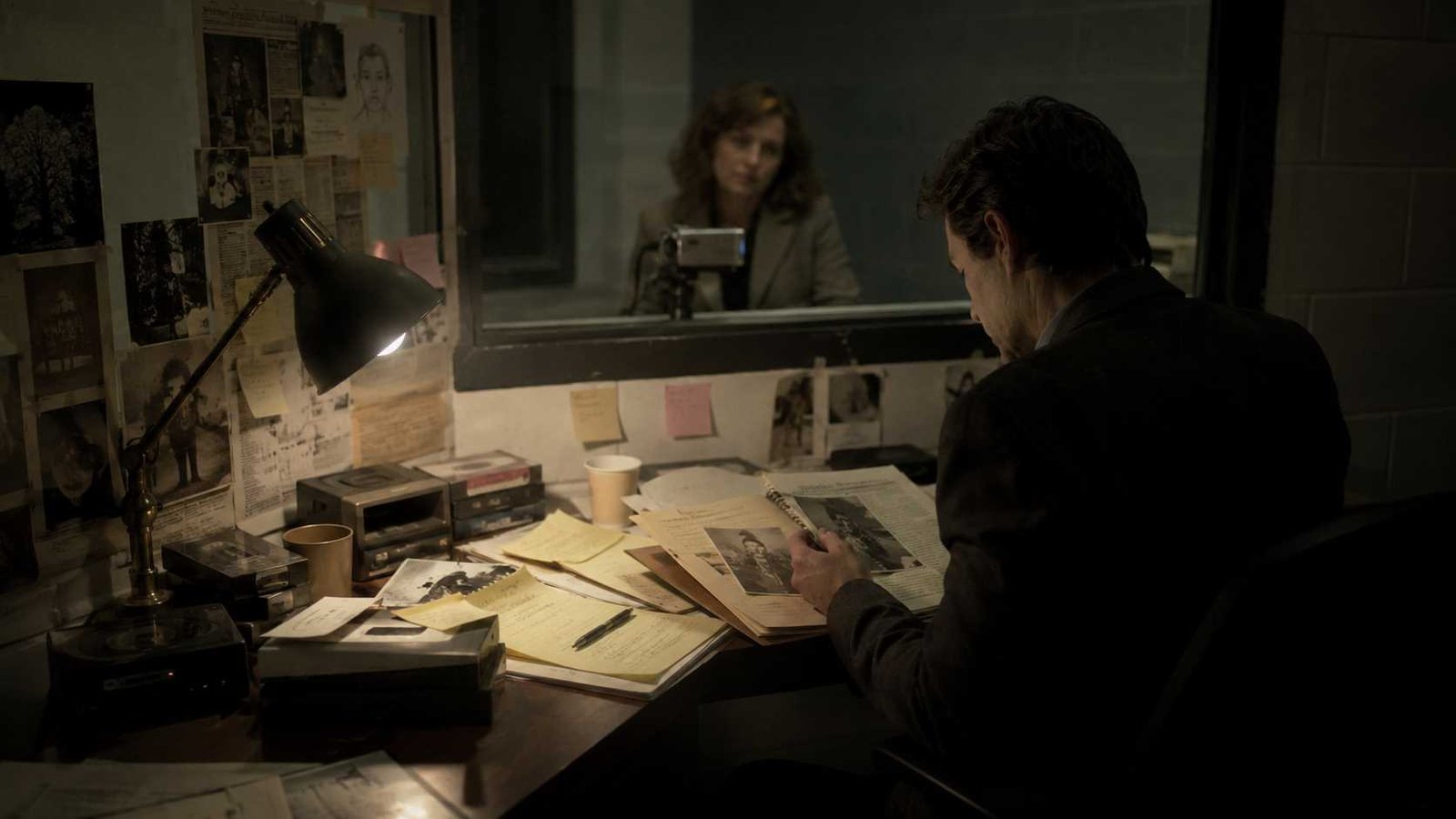
Then we meet Detective Bruce Kenner, played by Ethan Hawke. A teenage girl named Angela Gray, played by Emma Watson, accuses her father of a terrible crime. Her father admits guilt even though he says he cannot remember committing it. Soon, psychologists, police officers, hidden memories, and frightening stories of satanic rituals become part of the investigation.
It feels like the setup for an unbelievable true-crime case.
But the Regression movie true story is more complicated.
There was no real Angela Gray case that the movie simply recreated. Bruce Kenner was not a detective whose famous investigation was turned into a screenplay. Instead, writer and director Alejandro Amenábar built his fictional story around a very real period of fear involving satanic ritual-abuse allegations, controversial memory-recovery techniques, and what became known as the Satanic Panic.
So yes, reality is behind Regression. Just not in the way the movie initially makes you think.
Spoilers ahead: The sections below explain the entire story and ending of Regression.
Is Regression based on a true story?
Regression is inspired by real events and historical controversies, but it is not based on one specific true story.
That distinction matters.
The movie itself tells viewers that it was inspired by real events. However, critics and historical accounts of the production have found no single real-life Angela Gray or Bruce Kenner case that matches the plot.
Amenábar has explained where the idea actually came from.
While developing a movie about Satanism, he began researching the subject. He said he eventually discovered the phenomenon of satanic ritual abuse and its connection with psychology. That gave him a way to make a realistic thriller about fear while also exploring the human mind.
That is the real foundation of Regression.
The police case is fiction.
The atmosphere surrounding it has roots in history.
What is the movie Regression based on?
Regression is mainly based on three connected subjects:
- The Satanic Panic of the 1980s and early 1990s
- Allegations of satanic ritual abuse
- Controversies surrounding recovered memories and regression-style therapy
The official story places the action in Minnesota in 1990, where Detective Bruce Kenner investigates Angela’s allegations against her father, John Gray. A psychologist, Professor Kenneth Raines, is brought in to help John recover memories he supposedly cannot access.
The year 1990 is important.
America had spent much of the previous decade hearing frightening claims about secret cults, ritual abuse, hidden symbols, sacrifices, and conspiracies involving children.
Some allegations involved genuine concerns about abuse. Others grew into extraordinary stories for which investigators could find little or no supporting evidence.
That mixture of genuine fear, uncertain evidence, media attention, and psychological suggestion is exactly the world Regression enters.
The real Satanic Panic behind Regression
To understand the Regression movie true story, you have to understand the Satanic Panic.
During the 1980s, fear of secret satanic groups spread through parts of the United States and other countries. Day-care workers, teachers, parents, musicians, and others sometimes became targets of accusations involving occult activity.
Stories could include hidden tunnels, secret ceremonies, human sacrifice, organized cult networks, and ritual sexual abuse.
The allegations were horrifying.
They were also extremely difficult to prove.
By 1992, FBI Supervisory Special Agent Kenneth V. Lanning had examined the subject in a detailed guide published through the U.S. Department of Justice.
His conclusion was cautious but important. Investigators had been unable to document the widespread organized satanic ritual-abuse conspiracy that many people feared. He advised police to concentrate on evidence and consider other explanations rather than automatically accepting a ritual or satanic explanation.
That real historical problem sits at the heart of Regression.
Bruce believes he is uncovering something enormous.
Each new statement seems to support the last one.
Fear starts filling the spaces where evidence is missing.
Before long, even a trained detective cannot clearly separate what he knows from what he has begun to imagine.
Regression therapy is the movie’s real key
The title Regression is not just there because it sounds mysterious.
The investigation relies heavily on attempts to recover supposedly buried memories.
John Gray says he cannot remember abusing Angela. Professor Raines therefore tries to help him revisit forgotten experiences. Similar techniques are later used with other characters.
At first, those recovered images appear to make the case stronger.
Then the film asks an uncomfortable question:
What if the method used to uncover the truth is actually helping create the story?
Recovered-memory therapy has been controversial for decades. The American Psychological Association describes it as an approach intended to bring forgotten or repressed traumatic childhood memories to the surface, sometimes through techniques such as hypnosis and guided imagery. The APA notes that the practice has been controversial because of questions about both the reliability of recovered memories and the clinical validity of the methods.
Modern research still shows why caution is necessary.
A 2025 scientific review found that hypnosis did not improve accurate recall in the studies examined and, in some experiments, increased memories of events that never happened. Participants could also feel confident about those inaccurate memories.
That does not mean every recovered memory is automatically false.
It means memory is not a perfect video recording stored inside the brain.
Suggestion matters.
Questions matter.
Expectations matter.
And Regression turns that uncertainty into its real monster.
Bruce Kenner slowly becomes part of the experiment
One of the smartest ideas in the movie is that Bruce does not simply investigate other people’s memories.
He becomes influenced himself.
As Angela’s story grows, Bruce starts having terrifying dreams. Hooded figures and satanic imagery enter his mind. Strange encounters seem connected to the conspiracy.
For a while, it appears that Angela was right.
Then Bruce notices something ordinary.
A woman appearing in his frightening mental images resembles a woman he has seen in an advertisement.
That small realization changes everything.
If his mind can take an everyday image and place it inside a terrifying nightmare, perhaps other people have been doing something similar.
Bruce finally begins to question not just Angela’s claims but the entire process used to support them.
This is where Regression stops acting like a supernatural horror movie and reveals what it has really been investigating: suggestion, fear, memory, and belief.
Did the FBI really investigate cases like this?
Yes, although not the fictional case shown in Regression.
Law-enforcement agencies did investigate allegations involving supposed satanic and ritual abuse during this period.
Lanning’s 1992 guide came from years of concern about exactly these kinds of reports. It discussed claims involving multiple offenders, strange ceremonies, secret organizations, and extreme forms of abuse.
But the guide also warned that investigators needed evidence.
Possible alternative explanations included distorted memories, childhood fears, fantasy, suggestion from overly enthusiastic interviewers, confusion, and spreading urban legends.
Importantly, this did not mean investigators should simply dismiss people reporting abuse.
The guide specifically emphasized listening to alleged victims, carefully evaluating statements, communicating with families, and using an interdisciplinary approach.
That distinction is important when discussing Regression.
Real abuse exists.
Real victims deserve serious investigation.
The historical problem examined by the movie was what happened when extraordinary claims about huge satanic conspiracies were accepted without enough independent evidence.
Was Angela Gray a real person?
There is no reliable evidence that Angela Gray was a real person whose life became the basis of the film.
She is a fictional character created for Amenábar’s screenplay.
The same is true of Detective Bruce Kenner and the Gray family story presented in the movie.
Amenábar’s own description of his inspiration points toward a phenomenon, rather than a particular victim or criminal investigation. He became interested in satanic ritual-abuse allegations because they allowed him to connect Satanism with psychology and the exploration of the mind.
That is why saying Regression is based on the Angela Gray true story would be misleading.
A better description is:
Regression is a fictional thriller inspired by real psychological controversies and the Satanic Panic era.
How old was Emma Watson in Regression?
Emma Watson was 24 years old when she began filming Regression.
There is unusually clear evidence for this because filming began on a memorable date for her.
Watson turned 24 on April 15, 2014, and spent her birthday working on Regression in Toronto. She even described it at the time as her first day shooting the movie.
She plays Angela Gray, who is presented as a teenage girl.
That age difference helps explain why some viewers who discover the film years later are surprised to learn Watson was already in her mid-20s during production.
The movie itself was produced in 2015 and stars Watson alongside Ethan Hawke, David Thewlis, David Dencik, Dale Dickey, and Devon Bostick. Official Spanish film records classify it as a thriller directed and written by Alejandro Amenábar.
What happened at the end of Regression?
The ending completely changes how we understand the previous hour and a half.
Bruce finally realizes that there is no evidence of the enormous satanic conspiracy he has been chasing.
The frightening memories produced during regression sessions cannot be trusted simply because they feel vivid.
His own nightmares have shown him how easily the mind can take suggestions, images, fears, and outside information and turn them into something that feels real.
Then comes the bigger revelation.
Angela made up the central story
Bruce learns that Angela’s account was fabricated.
She hated her home life and wanted to escape her family. She blamed them for the miserable life she believed she had been given and carried anger connected to her mother’s death.
Angela had also been involved with Detective George Nesbitt and wanted to leave with him.
When that did not happen, her accusations against her father developed into something much larger.
The regression sessions then gave the story room to grow.
People began supplying details.
Others remembered similar images.
Bruce became frightened.
A supposed satanic conspiracy started to look real even though independent evidence was missing.
Angela even uses Bruce’s mistake against him
Earlier, Angela kisses Bruce in the cemetery.
Bruce immediately understands that the situation has crossed a serious line.
But near the end, the moment becomes something more sinister.
When Bruce confronts Angela, she points out that people may not believe his version of events if she tells them that he kissed her.
Suddenly, Bruce understands how effectively she has manipulated the people around her.
The person he spent most of the movie trying to protect has also learned how to use his fear against him.
Why does John Gray still plead guilty?
This is one of the strangest and saddest parts of the ending.
Bruce tells John that Angela’s accusations were fabricated and encourages him to tell the truth.
But John still wants to accept punishment.
Why?
Because he believes he failed his daughter in other ways.
He knows he was not the father she needed. He feels responsible for the broken family environment that helped shape Angela’s anger.
John therefore sees punishment as a kind of personal atonement.
He is not confessing because Bruce proves the alleged ritual abuse happened.
Quite the opposite.
Bruce has concluded that it did not happen as Angela described it.
John accepts blame because he feels guilty for the damage he believes he caused as a parent.
It is a bleak ending because almost everyone has lost something even after the mystery is solved.
So was there actually a satanic cult?
The film ultimately gives us no solid proof of the massive satanic cult described throughout the investigation.
That is the point.
For much of Regression, the audience sees the case through Bruce’s frightened perspective.
We hear disturbing testimony.
We watch apparent memories.
We see masks, rituals, nightmares, and suspicious behavior.
The pieces seem to fit.
But once the power of suggestion is removed, those pieces begin falling apart.
Amenábar deliberately uses horror-film language before pulling it away. He has said that he wanted to explore fear and the mind through a realistic approach to the satanic ritual-abuse phenomenon.
The devil we expect never needs to appear.
Human fear has already done enough damage.
How much of Regression is actually true?
Here is the simplest way to separate fact from fiction:
| Part of Regression | True or Fictional? |
|---|---|
| Angela Gray and her family’s case | Fictional |
| Detective Bruce Kenner | Fictional |
| Professor Kenneth Raines | Fictional |
| A nationwide secret cult in the movie | Not established as real |
| Satanic Panic during the 1980s and 1990s | Real historical phenomenon |
| Police investigations into ritual-abuse allegations | Real |
| Controversy over recovered-memory techniques | Real |
| Concern that suggestion can affect memory | Supported by psychological research |
| Emma Watson being 24 during filming | True |
That is why the phrase inspired by real events fits Regression better than the true story of Angela Gray.
The screenplay creates fictional people and a fictional mystery to explore genuine historical fears.
Why Regression feels like a true story even when it isn’t one
Amenábar does something clever with the audience.
At the start, we are placed in roughly the same position as Bruce.
We know terrible crimes can happen.
We want to believe someone who appears frightened.
We see a confession.
Then another person’s memory seems to confirm part of the story.
After enough pieces line up, doubt starts feeling almost irresponsible.
That emotional pressure is what makes the film interesting.
The U.S. Justice Department’s historical material on ritual-abuse investigations repeatedly stressed the need to separate evidence from assumptions. Investigators were warned that dramatic allegations could spread and reinforce one another even when physical evidence did not support a vast organized conspiracy.
Regression turns that investigative problem into suspense.
We are not simply watching Bruce become scared.
We are watching him become certain.
And certainty without enough evidence is ultimately what traps him.
The uncomfortable truth behind the Regression movie true story
The Regression movie true story is not really about discovering that Angela Gray existed.
She didn’t, at least not as the documented real-life person behind this screenplay.
The truth is broader and, in some ways, more unsettling.
People really did fear hidden satanic networks.
Investigators really did confront extraordinary ritual-abuse allegations.
Recovered memories really did become part of serious psychological and legal debates.
Authorities eventually warned that widespread organized satanic abuse could not simply be accepted as fact without evidence. Modern research continues to show that hypnosis, suggestion, and guided memory techniques require great care because vivid memories can sometimes be inaccurate.
That makes Regression less of a traditional true-crime movie and more of a story about what happens when fear begins writing the evidence for us.
There is no single real Bruce Kenner case waiting to be uncovered.
There is something bigger behind the film: a real chapter of cultural panic in which frightening stories, uncertain memories, genuine concern for victims, media attention, and the search for hidden evil became dangerously tangled together.
And that is why the movie’s final revelation works.
For most of Regression, everyone is searching for monsters hiding in the dark.
By the end, the film suggests that the more frightening force was much closer all along: the human mind’s ability to believe a story once fear makes it feel true.

Jessica Savitch, with a deep passion for journalism, brings her expertise to istruestory.com as a dedicated author. MA in Arts & Journalism.