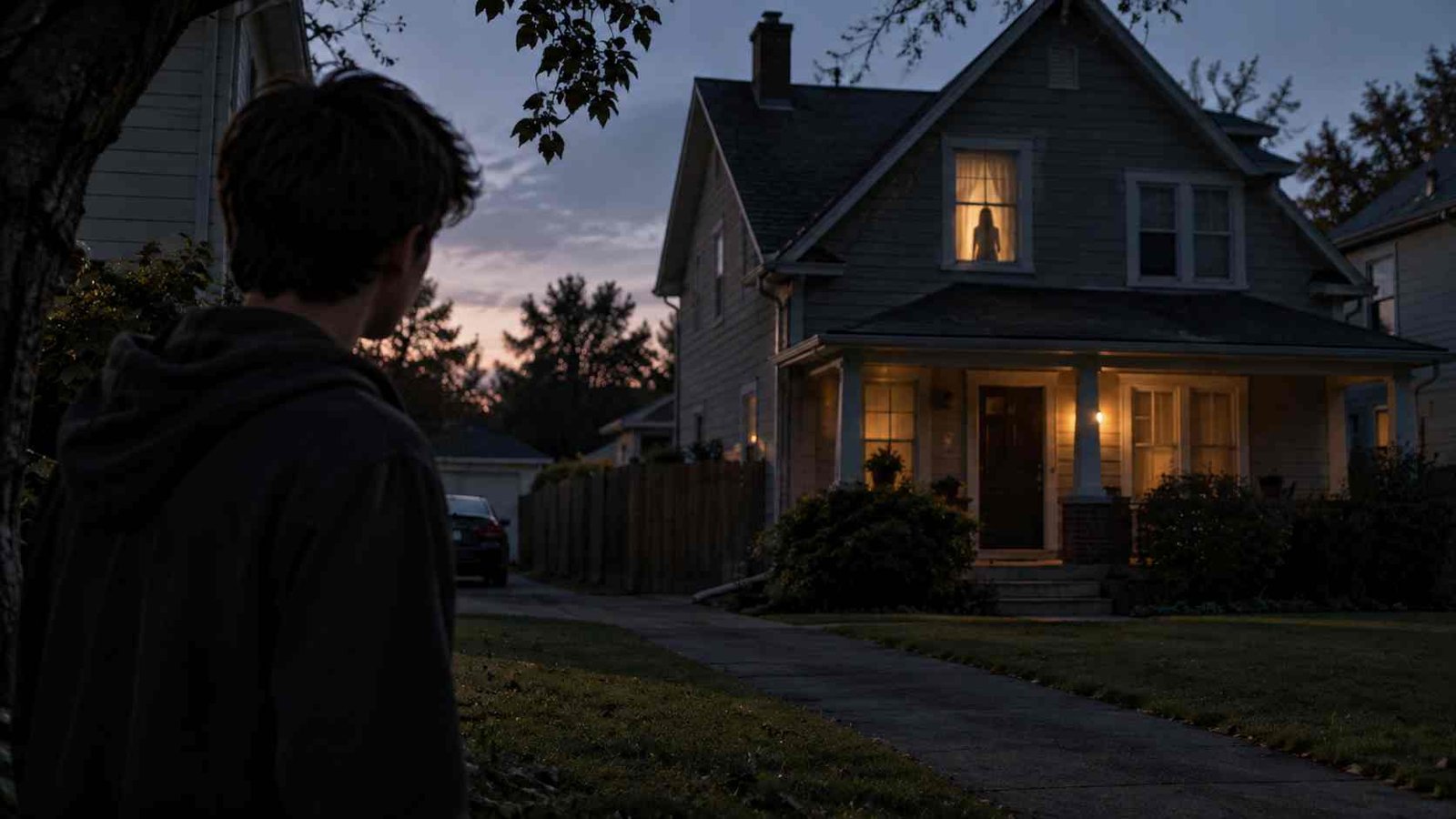
That unsettling idea drives House Next Door, the third episode of John Carpenter’s Suburban Screams, which premiered on Peacock on October 13, 2023.
The episode follows a teenage boy who becomes caught up in a frightening situation involving his girlfriend and alleged dark spirits. But the question that stays with viewers is simple: Did the John Carpenter’s Suburban Screams House Next Door true story really happen?
The short answer is that Suburban Screams presents stories drawn from real people’s accounts. John Carpenter has confirmed that researchers found the stories featured in the series. However, there is an important difference between someone reporting a haunting and independent evidence proving that ghosts were responsible.
For House Next Door, the alleged supernatural events have not been independently verified by the reliable sources reviewed for this article.
Did the House Next Door Haunting Really Happen?
House Next Door is presented as part of a true-horror anthology, but that description needs some explanation.
In an October 10, 2023 interview with the Los Angeles Times, Carpenter discussed how the series was developed. He explained that researchers had located the stories and that the production recreated accounts using actors.
This is significant because it confirms that the show was not simply marketed as a collection of fictional ghost stories. Its creators intended to bring reported experiences to television.
Still, an experience can be sincerely reported without every detail being independently established.
Consider what a viewer would need to confirm the haunting behind House Next Door. Ideally, investigators would have access to contemporary records, independently verified witness statements, property information, or other evidence supporting the alleged events.
The publicly available sources reviewed here do not establish that level of proof.
That leaves us with three different things:
-
The television production: A real episode released by Peacock in October 2023.
-
The underlying testimony: A reported experience presented through the show’s true-horror format.
-
The supernatural explanation: The claim that spirits caused the frightening events, which has not been independently demonstrated.
So, calling the episode entirely fictional would go beyond the available evidence. But presenting the haunting as a proven paranormal incident would go too far in the other direction.
What Happens in the House Next Door Episode?
The official Peacock description introduces a teenage boy who faces a terrifying situation after dark spirits apparently threaten his girlfriend.
The story begins with a familiar horror setting: an ordinary suburban neighborhood where people expect to feel safe.
Rather than taking viewers to a distant haunted castle, the episode places its danger close to home. That choice matters. A neighboring house is something we might walk past every day without giving it a second thought.
As the story develops, the teenage boy finds himself facing what the episode presents as a supernatural threat. His concern for his girlfriend becomes the emotional center of the story.
He cannot simply ignore what appears to be happening. According to Peacock’s synopsis, he eventually takes action himself to protect her.
The episode combines fear of an unknown presence with something much easier to understand: the desire to help someone you love.
That is what makes the premise work even for viewers who do not believe in ghosts.
Why the teenage relationship matters
Many ghost stories focus on the haunted property. Here, the relationship between the teenagers gives the supernatural threat personal meaning.
The boy is not investigating strange events purely out of curiosity. He believes someone important to him is in danger.
This creates a difficult choice. Should he stay away from a place that frightens him, or try to protect someone who might need help?
The episode uses that conflict to build tension.
It also makes the story more emotionally believable. We may question whether spirits exist, but most people understand the fear of being unable to protect someone they care about.
Who Are Torrence and Lisa Kennedy?
The episode’s cast listings identify Ryan Dean as Torrence and Josephine Jewers as Lisa Kennedy. Crispian Belfrage is also credited as Dr. Kennedy.
These character and cast details help viewers identify the people portrayed in the dramatization.
However, their appearance in the program should not be confused with independent confirmation of the alleged haunting.
Television reenactments use performers, scripted dialogue, editing, and carefully arranged scenes to communicate a story.
Those scenes may be based on testimony, but they are still part of a production.
The distinction is especially important for an article about a true story. The characters viewers see on screen are not, by themselves, evidence that every event occurred exactly as depicted.
Without independent records connecting the narrative to a documented case, it would be misleading to claim that the actors’ characters establish the identities or experiences of real witnesses.
What Does the Show Actually Prove?
The most useful way to understand House Next Door is to separate confirmed information from claims that remain uncertain.
| Question | What we can establish |
|---|---|
| Is House Next Door a real episode? | Yes. It is Season 1, Episode 3. |
| Was it released in 2023? | Yes, on October 13. |
| Is the series based on reported real experiences? | Yes, according to John Carpenter. |
| Was the haunting independently proven? | No independent proof was established in the sources reviewed. |
| Was the episode dramatized? | Yes. The series uses cinematic reenactments. |
| Are all depicted conversations and details verified? | Not through the available production information. |
Peacock confirms the episode’s place in the series, while Carpenter’s interview explains the broader research and reenactment approach.
Why a real account is not the same as a proven haunting
Imagine hearing unexplained footsteps late at night.
You might sincerely believe someone is walking through an empty hallway. That feeling of fear would be real. The sound might also be real.
But identifying the cause is a separate question.
Old flooring, household equipment, animals, or other ordinary sources can sometimes produce unexpected noises.
This does not establish what happened in House Next Door. It simply shows why an unexplained experience is not automatically proof of paranormal activity.
There is also no need to accuse witnesses of inventing their experiences. People can interpret frightening events differently, especially when they cannot immediately identify a cause.
The responsible conclusion is that the episode reflects a reported haunting narrative, while the supernatural explanation remains unconfirmed.
How John Carpenter Turned Real Accounts Into Horror
Carpenter is famous for films such as Halloween (1978) and The Thing (1982). With Suburban Screams, he brought that unsettling style to stories presented as real experiences.
But there is a production detail worth clearing up: John Carpenter did not personally direct every episode.
For House Next Door, the credited director is Michelle Latimer, while Zack Kahn is listed as the writer. Carpenter served as an executive producer of the overall series and contributed music. He personally directed the sixth episode, Phone Stalker.
Why the reenactments feel like horror movies
Executive producer Jordan Roberts explained that the show combines firsthand accounts with dramatic recreations.
That gives the creators two ways to tell a story.
The interviews provide a connection to people describing experiences. The reenactments use lighting, sound, camera movement, and performances to turn those accounts into suspenseful television.
It is an effective combination, but it also makes careful viewing important.
A frightening shadow in a reenactment does not independently prove a witness saw that exact shadow. Dramatic dialogue may help explain a scene without being a verified recording of an actual conversation.
The show’s purpose is partly to tell stories and partly to frighten its audience. Those goals can exist together, but they are not the same as conducting an independent paranormal investigation.
What Is John Carpenter’s Suburban Screams About?
John Carpenter’s Suburban Screams is a six-part horror anthology released on Peacock on October 13, 2023.
Each episode tells a different disturbing story set around seemingly ordinary communities. Some involve violent criminals or stalking. Others explore supernatural claims and strange encounters.
Here is how the first season is organized, according to Peacock’s episode guide.
| Episode | Title | Central premise |
|---|---|---|
| 1 | Kelly | A gathering takes a disturbing turn after an alleged ghostly encounter. |
| 2 | A Killer Comes Home | A killer brings fear to his hometown. |
| 3 | House Next Door | A teenager fears that spirits threaten his girlfriend. |
| 4 | Bunny Man | Residents describe encounters linked to a frightening local legend. |
| 5 | Cursed Neighborhood | A family reports a threatening presence in its new home. |
| 6 | Phone Stalker | A woman recounts years of terrifying stalking. |
What connects these episodes is not one particular monster, criminal, or unexplained event.
It is the setting.
The suburbs are often pictured as peaceful places where families live, neighbors recognize one another, and children feel safe playing outside.
Suburban Screams challenges that picture.
It asks what happens when the place you trust most becomes the place you fear.
That idea is especially powerful in House Next Door, where the apparent danger is not far away. It is close enough to see from home.
Is The Haunted House Based on a True Story?
That depends on which film or television production called The Haunted House you mean. Several works use that title or similar names.
If you are referring to the haunted property in House Next Door, the answer is more specific.
The episode belongs to a series developed around reported real experiences. However, its portrayal of a haunted home does not establish that the property was genuinely occupied by supernatural beings.
We also could not independently confirm an exact real-world house address, a documented property investigation, or physical evidence supporting the haunting from the sources reviewed.
This matters because a real location and a real ghost are two separate claims.
A house can exist. People can have frightening experiences there. Someone can sincerely believe that a spirit caused those experiences.
None of those facts, on its own, demonstrates that a ghost was present.
Viewers can appreciate the story without treating its supernatural interpretation as a confirmed historical event.
Is The Real Murders on Elm Street a True Story?
Yes. The Real Murders on Elm Street is an Investigation Discovery true-crime series about actual homicide investigations connected to streets named Elm Street across the United States.
It premiered on September 9, 2024, and was originally announced as a six-part documentary series.
Unlike House Next Door, which deals with an alleged haunting, The Real Murders on Elm Street focuses on criminal investigations. Its episodes explore cases involving killings, detectives, suspects, and the consequences for affected communities.
There are two important distinctions.
First, the title may remind viewers of A Nightmare on Elm Street, but the Investigation Discovery program is not a documentary about Freddy Krueger or the fictional murders in that film.
Second, the program covers different homicide cases rather than one single incident known as the Elm Street murders.
The cases are presented as real crimes, although individual dramatized details should still be checked against official investigative or court records when accuracy matters.
Why the House Next Door Story Still Feels So Disturbing
You do not have to believe in ghosts to understand why House Next Door can be frightening.
Think about the last time you heard an unusual sound outside at night. Maybe it was footsteps, a door closing, or something moving near a window.
For a moment, you probably wanted to know what caused it.
Now imagine believing the danger was coming from a neighboring house, with someone you cared about inside.
That is the emotional situation at the center of this episode.
The story uses three familiar fears.
One is the fear of the unknown. Something appears wrong, but the characters cannot easily explain it.
Another is the fear of not being believed. The teenage boy suspects a haunting, yet the episode synopsis makes clear that other people initially doubt his concerns.
The third is the fear of losing someone important. His desire to protect his girlfriend turns uncertainty into urgent action.
These fears do not depend on supernatural proof. They work because they reflect real human emotions.
That may be the most interesting part of House Next Door. Whether viewers accept the paranormal explanation or question it, the experience of feeling helpless when someone is threatened remains recognizable.
The Truth Behind the House Next Door
The John Carpenter’s Suburban Screams House Next Door true story is best understood as a reported experience presented through documentary-style horror storytelling, not as a scientifically or historically verified ghost encounter.
The evidence supports the existence of the episode, its creative team, its October 2023 release, and Carpenter’s explanation that researchers gathered real people’s stories for the series.
What remains unconfirmed is whether supernatural forces actually caused the events depicted.
And perhaps that uncertainty is why the episode stays with viewers.
A strange house in a fictional horror movie can be forgotten when the credits roll. A story presented as someone’s real experience raises a harder question: what would you do if a person you trusted told you something impossible was happening next door?
You might believe them. You might look for another explanation. You might never find an answer.
House Next Door lives in that uneasy space between a frightening personal account and what we can independently establish as true.
The haunting remains unproven, but the uncertainty is real.

Jessica Savitch, with a deep passion for journalism, brings her expertise to istruestory.com as a dedicated author. MA in Arts & Journalism.