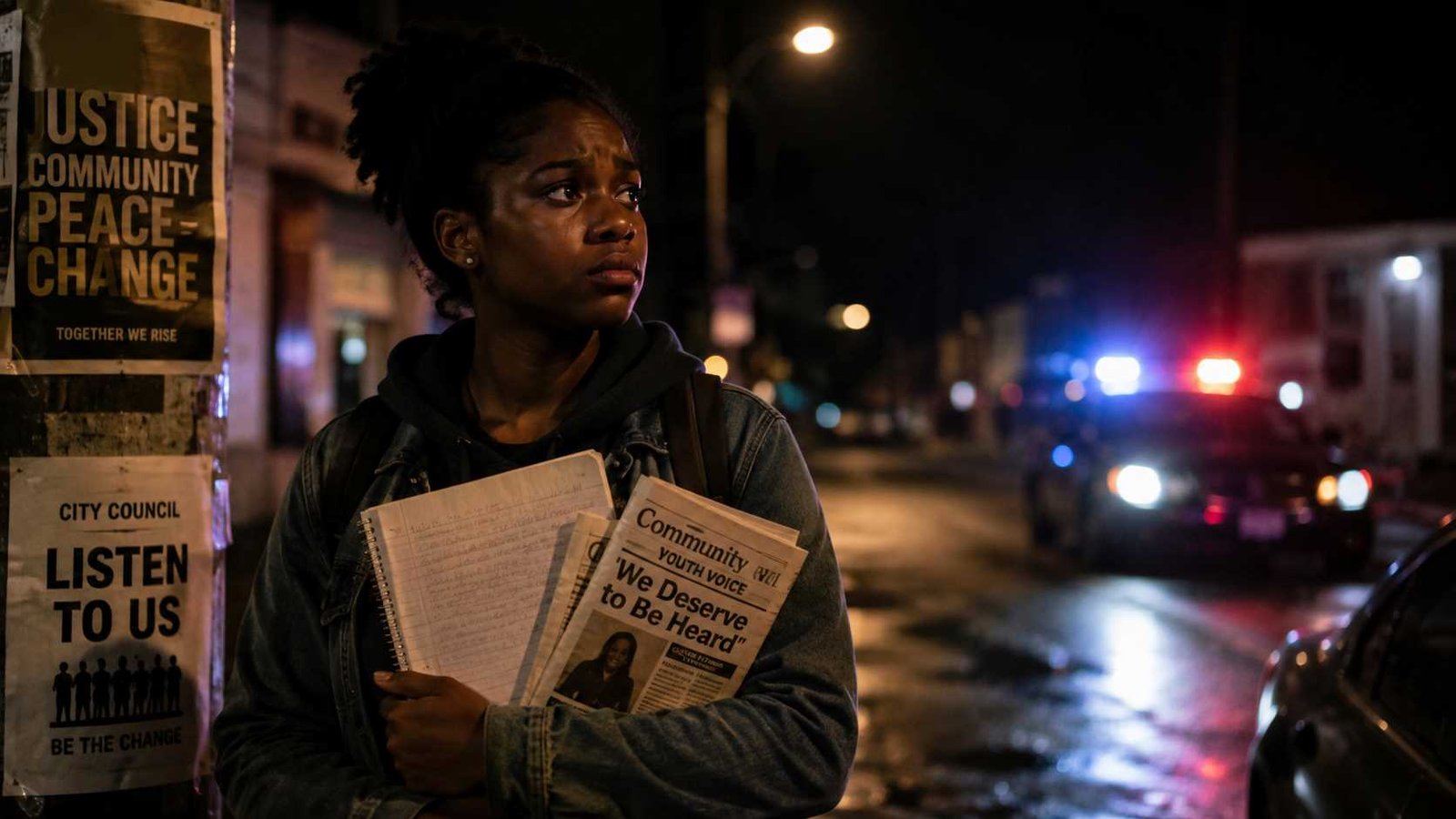
Starr Carter watches her childhood friend Khalil die after a police traffic stop. She then has to live with the trauma, public arguments about Khalil’s character, pressure from her community, and fear about speaking openly.
It is easy to watch the 2018 movie and wonder whether Starr and Khalil were real people.
So, is The Hate You Give a true story?
No. The Hate U Give is not based on one true story, and Starr Carter and Khalil Harris are fictional characters. But author Angie Thomas built the story from real experiences, real police shootings, and emotions she felt after the 2009 killing of Oscar Grant.
That real-world foundation is one reason the story can feel more like a dramatization than fiction.
The Hate U Give Is Fiction, But Its Roots Are Real
Angie Thomas first developed Starr’s story while she was in college.
At that time, she was studying at a mostly white private college while living in a predominantly Black neighborhood in Jackson, Mississippi. Thomas has explained that moving between those two environments made her very aware of how she presented herself around different people.
That experience later became an important part of Starr Carter.
Starr behaves one way at home in Garden Heights and another way at Williamson Prep. She watches her language and reactions because she worries about being judged through racial stereotypes.
Thomas has described experiencing a similar form of code-switching herself.
But another event gave her the emotional reason to start writing the story.
Oscar Grant Was a Major Inspiration
On January 1, 2009, Oscar Grant, a 22-year-old Black man, was fatally shot by a transit police officer at Fruitvale station in Oakland, California.
Thomas was in college when Grant was killed.
What stayed with her was not only his death. She was also disturbed by the conversations surrounding him.
Thomas heard people in her own community identify with Grant, while some classmates focused on his criminal history and questioned why people were upset about his death.
She later explained that the anger, frustration, and pain she felt pushed her to write the short story that eventually became The Hate U Give.
This distinction matters.
Khalil is not Oscar Grant under another name.
The circumstances, characters, family relationships, neighborhood, investigation, and many other details in The Hate U Give are fictional.
Instead, Grant’s death helped Thomas ask a larger question: What happens when a young Black person is killed, and the public begins judging the victim instead of simply seeing the person who died?
That question sits at the heart of Khalil’s story.
Other Real Cases Also Shaped the Novel
Thomas originally wrote Starr’s story as a short piece. Years later, she returned to it as cases involving Trayvon Martin, Michael Brown, Tamir Rice, and other young Black Americans became part of a much larger national discussion about race and violence.
Thomas has said seeing young people affected by these deaths encouraged her to expand the story into a full novel.
That is why it would be misleading to say The Hate U Give is simply the Oscar Grant story.
Oscar Grant was a major starting point.
But the completed book draws from a much broader American reality involving racism, policing, public perception, poverty, activism, identity, and the Black Lives Matter era.
Thomas then placed those issues inside the life of one fictional teenager.
That choice makes the subject personal.
Instead of watching the debate from a distance, we experience it through Starr.
Was the Movie The Hate You Give Based on a True Story?
The movie is not directly based on a true story either.
The 2018 film The Hate U Give, directed by George Tillman Jr., is based on Angie Thomas’s bestselling novel.
The official 20th Century Studios description identifies it as an adaptation of the book and follows Starr after she witnesses the fatal police shooting of her childhood friend.
So the chain looks like this:
Real experiences and events → Angie Thomas’s fictional novel → 2018 movie adaptation
That makes the movie different from films such as Fruitvale Station, which directly dramatizes Oscar Grant’s final hours.
The Hate U Give uses fictional people to explore issues seen in many real cases.
Starr Carter Also Contains Pieces of Angie Thomas
The police-shooting storyline attracts most of the attention, but Starr’s identity struggle is just as important to understanding what the book is based on.
Thomas grew up in a poorer, predominantly Black neighborhood while attending a mostly white, wealthier school environment.
She has described changing the way she spoke and behaved depending on where she was.
Starr does much the same thing.
At Williamson Prep, she worries about appearing angry, loud, confrontational, or too closely connected to stereotypes her classmates may hold about Black teenagers.
At home, she worries that her private-school life has separated her from Garden Heights.
Thomas told NPR that her own experiences strongly informed this part of Starr’s character.
That personal connection helps explain why Starr often feels so believable.
She is fictional, but some of her emotional conflicts came from experiences her creator understood firsthand.
What Does Tupac Have to Do With The Hate U Give?
Even the title has a real cultural origin.
The Hate U Give comes from rapper Tupac Shakur’s explanation of THUG LIFE.
Thomas was interested in Tupac’s idea that what society gives to children eventually affects society as a whole. The words forming THUG appear inside the title The Hate U Give.
Thomas told NPR that she also wanted readers to reconsider the word “thug,” particularly the way it is often applied to young Black men after something happens to them.
That concept becomes central to Khalil.
After his death, people begin discussing his possible connection to drugs and gangs.
Starr knows there was more to him.
The tension between those two versions of Khalil is exactly the kind of problem Thomas wanted readers to examine.
Did Starr and Khalil Kiss in the Book?
Yes. Starr and Khalil did kiss in the book, but not in exactly the same way shown in the movie.
In the novel, Starr remembers that Khalil was her first kiss when they were about ten years old. The kiss happened in the basement of Christ Temple Church during Vacation Bible School.
This establishes that they had a close childhood history and that Starr once had feelings for him.
The movie makes their romantic connection more immediate.
In the film, Khalil and Starr talk about their childhood kiss, and Khalil kisses Starr again while they are sitting in his car shortly before the police stop. Starr then reminds him that she has a boyfriend.
That second kiss is part of the film’s adaptation of their relationship.
So if you remember Khalil kissing Starr shortly before his death, you are probably remembering the movie version, not that exact sequence from the novel.
Why Was The Hate U Give Banned?
There is another common misunderstanding around the book.
The Hate U Give has not been universally banned.
It has been challenged, restricted, removed, or banned in particular schools and libraries.
Those words have different meanings.
The American Library Association explains that a challenge is an attempt to remove or restrict a book, while a ban occurs when the material is actually removed.
The Hate U Give has repeatedly appeared on the ALA’s lists of frequently challenged books.
In 2017, objections included drug use, profanity, and claims that the book was excessively vulgar.
Later challenges included concerns about violence, profanity, sexual references, drug use, and claims that the novel promoted an anti-police message or social agenda.
Supporters of keeping the book available argue that those difficult subjects are part of what makes the novel valuable for discussions about race, policing, grief, family, inequality, and civic responsibility.
Whether students should read it at a particular age remains a decision debated by parents, educators, libraries, and school systems.
But saying simply that The Hate U Give was “banned” everywhere leaves out that important context.
How Much of Khalil’s Story Actually Happened?
There was no real teenager named Khalil Harris whose complete story unfolded exactly as it does in the novel.
There was no real Starr Carter who experienced all of these events.
Garden Heights is part of Thomas’s fictional world.
Yet Khalil represents something larger than one invented character.
Thomas took emotions and questions connected to real deaths and placed them into a fictional situation where readers could spend time with the person behind the headlines.
Before Khalil becomes a national story inside the novel, he is Starr’s friend.
He has memories.
He has family problems.
He makes mistakes.
He has reasons for choices other people quickly judge.
And someone loves him enough to remember the person he was before strangers began arguing about what kind of person he had been.
That is where the fictional story and its real inspiration meet.
Why The Hate U Give Feels So Real
The answer to “Is The Hate You Give a true story?” is technically simple:
No. The Hate U Give is a fictional story.
But stopping there misses what Angie Thomas was trying to do.
Oscar Grant’s death helped inspire the original story. Thomas’s own experience moving between Black and white social spaces helped shape Starr. Later deaths of young Black Americans added urgency to the novel. The Black Lives Matter era gave the story a larger cultural setting, while Tupac Shakur’s THUG LIFE concept helped give it a name.
None of that makes Starr or Khalil real people.
It makes their story fiction built from real pain, real conversations, and real questions.
And perhaps that is why The Hate U Give stays with so many readers and viewers.
You may know Starr is fictional.
You may know Khalil never existed exactly as written.
But the world that made their story possible is very real.

Jessica Savitch, with a deep passion for journalism, brings her expertise to istruestory.com as a dedicated author. MA in Arts & Journalism.