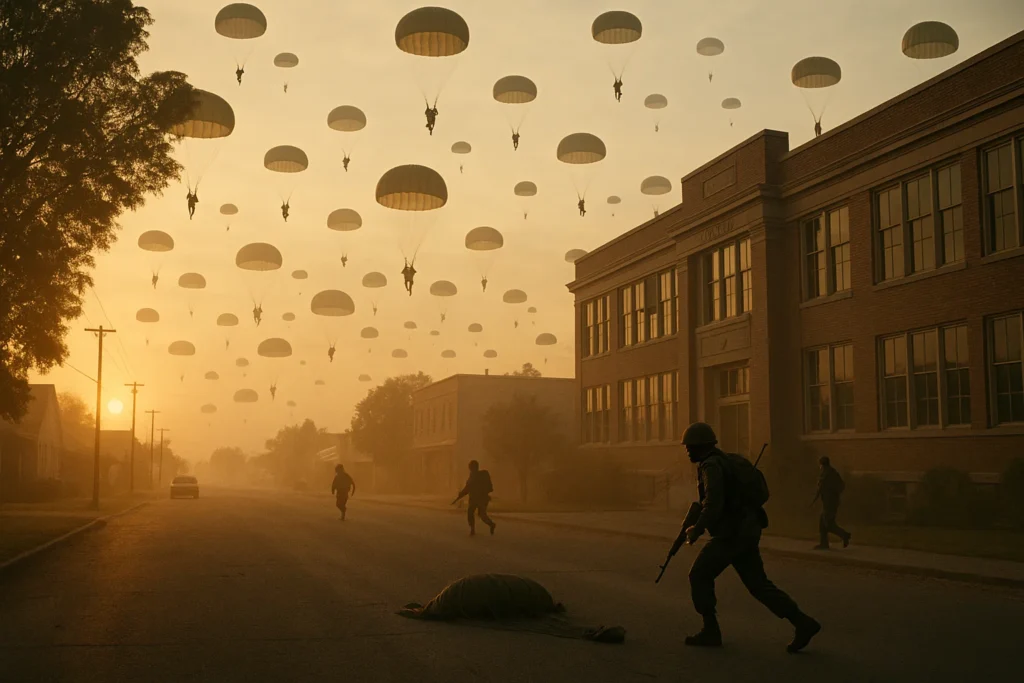
Here’s what matters. The movie isn’t a retelling of a real invasion, but it was absolutely shaped by real-world politics, military theories, and the anxieties of its time. When you peel back the action and drama, you find a story deeply rooted in what America feared most: the idea that the unthinkable could happen right at home.
Let me walk you through the truth behind the film, the inspirations that shaped it, and why it remains one of the most controversial war movies ever made.
How Red Dawn Became the “What If” Story of the Cold War
Red Dawn wasn’t born from a real attack. It was born from fear fear of a world that felt one misstep away from nuclear disaster. According to historical accounts and analysis, the early 1980s were a peak moment in Cold War tension, when both the United States and the Soviet Union questioned each other’s intentions and military strategies.
The film’s original script imagined a scenario where the U.S. becomes vulnerable after global alliances shift and enemy forces take advantage. While it didn’t replicate any documented invasion, it used real military theories and possible geopolitical paths suggested by experts of the era.
Many of the unsettling details paratroopers landing in a quiet town, sudden communication breakdowns, rapid occupation were inspired by real-world war simulations and defense reports that asked a simple but chilling question: Could the United States be caught off guard?
The film’s answer was a loud, dramatic yes.
So, Is Red Dawn Based on a True Story?
No at least not in the literal sense. There was never a Soviet or Cuban invasion of the United States. But the story reflects real fears, real political tensions, and scenarios that military analysts genuinely debated.
Think of it this way: the events never happened, but the mindset that shaped them did.
What Was Red Dawn Based Off Of?
When you look closely, you can see its building blocks:
1. Cold War escalation
The early ’80s saw an intense arms race, mistrust between superpowers, and widespread anxiety. This climate influenced everything from news reports to pop culture. Red Dawn captured that emotional temperature.
2. The “Fulda Gap” invasion theories
Defense analysts often modeled Soviet invasion strategies in Europe. Some of those theories inspired the film’s depiction of a rapid, airborne assault.
3. Central American conflict
Cuba’s alignment with the Soviet Union and military involvement in the region influenced the movie’s choice of Cuban paratroopers as part of the invading force.
4. American concerns about internal vulnerability
The film reflects a quiet fear many Americans carried: What if our sense of security is just an illusion?
None of these influences are fictional. The movie simply threads them together into a dramatic narrative.
What Town Was Red Dawn Based On?
The story takes place in the fictional town of Calumet, Colorado, but the location wasn’t random. It was chosen to represent small-town America isolated enough to be overwhelmed, yet proud enough to fight back.
Even though Calumet doesn’t exist, the setting feels familiar to anyone who grew up in the Midwest or mountain states. And that familiarity was intentional. It made the invasion feel personal.
Why Was Red Dawn Controversial?
Red Dawn stirred controversy from the moment it premiered, and the debate hasn’t stopped.
Here’s why:
1. It was the most violent film of its time
According to the MPAA, Red Dawn held the record for the highest number of violent acts in a single movie when it was released. That alone shook audiences.
2. It portrayed a foreign invasion in explicitly political terms
Critics argued that the story amplified fear of communism at a time when public nerves were already frayed. Supporters said it simply explored a realistic “what if” scenario.
3. It created stark moral boundaries
The film paints clear heroes and villains. For some viewers, that felt honest. For others, overly simplistic.
4. It fed into Cold War propaganda narratives
Scholars and think-tank analysts have both praised and criticized the film for reinforcing geopolitical anxiety rather than analyzing it.
As one commentary put it, “Red Dawn is a misunderstood masterpiece.” It’s a film that meant different things to different people and that’s partly why it still sparks discussion decades later.
Is The Dawn Based on a True Story?
Some people mix up Red Dawn with other titles like The Dawn. To be clear, they are unrelated. Red Dawn’s premise stands on its own and was crafted for its specific historical moment.
What Red Dawn Got Right And What It Didn’t
Here’s the bottom line:
What the film reflects accurately
- Cold War tension and mistrust
- Real military theories and war-game outcomes
- The emotional climate of the early 1980s
- The fear of sudden conflict
What the film exaggerates or invents
- The invasion itself
- The scale and speed of enemy success
- The complete collapse of national defense
- The level of local resistance
That balance between realism and imagination is what makes the movie so gripping and so debated.
Why People Still Ask if Red Dawn Is True
Because at its core, the film isn’t just about war. It’s about ordinary people being dropped into extraordinary circumstances. It’s about teenagers becoming soldiers overnight. It’s about how quickly the world can change.
And those themes aren’t tied to any specific decade. They feel timeless.
Red Dawn turned national anxiety into a story people could watch, argue about, and remember. It wasn’t real, but the emotions behind it certainly were.
Final Thoughts
Red Dawn isn’t based on a true story, but it is built on true fears fears that shaped an entire era of American life. That’s what gives the movie its weight. That’s why it resonates. And that’s why people still search for the truth inside its fiction.
If you’ve ever wondered how much of Red Dawn could happen in the real world, the answer is simple: not the events, but the mindset. And sometimes, that’s more revealing than a documentary.
Let me know if you want a shorter version, social media captions, or an FAQ section for your post.

Jessica Savitch, with a deep passion for journalism, brings her expertise to istruestory.com as a dedicated author. MA in Arts & Journalism.