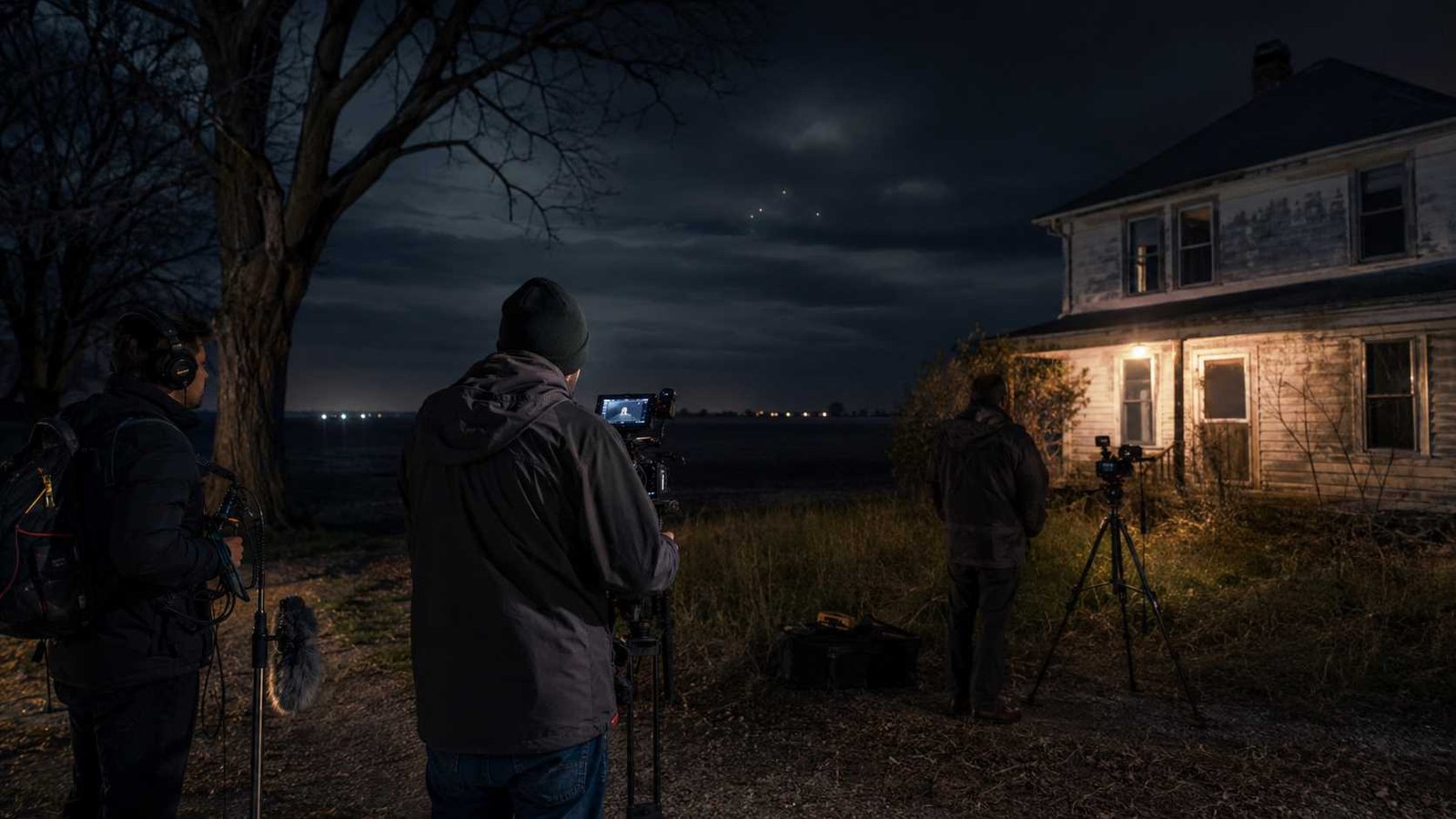
The shaky cameras feel natural. The interviews seem ordinary. The people often use their real names. There are no glossy Hollywood sets warning you that everything is fictional.
So, is Holes In The Sky a true story?
No. Holes in the Sky: The Sean Miller Story is not a documentary about a verified alien abduction. It is a fictional horror mockumentary created by writer and director Ash Hamilton. Sean Miller is a character played by actor Sean Ed.
There is one interesting twist, though. Hamilton has discussed the movie in an interview promoted as being based, at least partly, on a reported real alien encounter. That may have influenced the idea behind the film, but it does not make Sean Miller’s disappearance a documented real event.
That thin line between reality and fiction is exactly where the movie wants you to stand.
What Is Holes in the Sky About?
Holes in the Sky: The Sean Miller Story follows a documentary crew investigating an alleged alien abduction.
According to the film’s story, Illinois resident Sean Miller disappeared in 2013. He was gone for four days before suddenly returning.
Years later, filmmaker Ash Hamilton becomes interested in Miller’s case. Hamilton and his team travel to Miller’s rural home hoping to document what supposedly happened to him.
At first, it feels like a normal paranormal documentary.
There are interviews. There are cameras around the house. There are discussions about Miller’s disappearance and his strange experiences.
Then things begin to change.
The crew experiences events that suggest whatever happened to Sean may not have ended when he returned home. Strange disturbances and unexplained incidents begin affecting the filmmakers themselves.
Rotten Tomatoes describes the story as a documentary crew attempting to investigate Miller’s supposed 2013 alien abduction before the production turns into a life-changing experience for everyone involved.
That premise is clever because the filmmakers do not simply tell us an alien story.
They ask us to watch people who believe they are investigating one.
Is Holes in the Sky Based on a True Story?
Not in the way the movie initially makes you think.
There is no good evidence that a real Illinois man named Sean Miller disappeared for four days in 2013 under the circumstances shown in the film and later became the subject of this documentary investigation.
Sean Miller is played by Sean Ed, while Ash Hamilton is credited as the film’s writer and director.
Independent reviews have also identified the production as a mockumentary, meaning a fictional movie presented using the style and language of a documentary.
One contemporary review described it as a realistic documentary-style production while making clear that the story itself is fictional.
Another review called it a mockumentary with found-footage elements built around a supposed alien abduction.
So why are so many viewers fooled?
Because the movie works hard to remove the normal signs of fiction.
Why Holes in the Sky Feels So Real
This is where the movie becomes more interesting than its basic alien-abduction plot.
Ash Hamilton appears in the film as a version of himself.
Other people involved in the production also appear under their real names. The cameras look like documentary cameras rather than traditional cinema cameras. Conversations can feel casual and imperfect.
The result is something closer to footage you might find while browsing a paranormal documentary channel than a polished studio horror movie.
One reviewer even wrote that the movie’s presentation made him stop watching temporarily and search online to determine whether the story was real.
That reaction tells you what Hamilton was trying to achieve.
The film does not depend only on monsters or jump scares.
Its biggest trick is credibility.
If actors behave like actors, you relax because you know you are watching fiction.
If people behave like ordinary documentary subjects, your brain starts asking a different question:
What if this really happened?
That uncertainty becomes part of the horror.
But Was Holes in the Sky Inspired by Something Real?
Possibly, at least in a loose sense.
This part needs careful wording.
A December 2021 podcast episode featuring Ash Hamilton described Holes in the Sky: The Sean Miller Story as an alien movie based in part on a true encounter. The episode specifically discussed Hamilton and the making of the film.
That tells us Hamilton may have drawn inspiration from a reported encounter or existing UFO stories.
It does not, however, prove that Sean Miller was a real abductee or that the events shown in the film happened.
There is an important difference between:
inspired by a reported experience
and
recreating a documented person’s true story.
Holes in the Sky belongs much closer to the first category.
The Sean Miller narrative is the fictional framework that turns those paranormal ideas into a horror story.
Is Sean Miller a Real Person?
The Sean Miller presented in the film should be understood as a fictional character, not as the subject of a verified true-crime or UFO documentary.
Actor Sean Ed plays Sean Miller.
This is one of the movie’s smartest choices.
Instead of surrounding the character with obviously fictional scenes, Hamilton builds a fake documentary around him.
Realistic interviews make Sean feel like someone whose name you should be able to search online.
The effect is similar to the best found-footage horror films. They create fear not by proving that something supernatural exists, but by making fictional evidence look almost believable.
What Kind of Movie Is Holes in the Sky?
The easiest description is:
alien-abduction horror + mockumentary + found footage.
Those three elements overlap throughout the movie.
The mockumentary format gives us interviews and documentary-style investigation.
Found footage gives us imperfect cameras and recordings that seem captured during events rather than professionally staged.
The alien story gives the film its central mystery.
But the movie gradually mixes other paranormal ideas into the experience as well.
A PopHorror review noted that the story combines alien-abduction material with poltergeist-like disturbances, including strange movements, digital interference and other unexplained events.
That combination helps the movie avoid becoming only a story about someone describing something that happened years ago.
Eventually, the documentary crew becomes part of the mystery.
The Cleverest Part Is the Documentary Inside a Documentary
There is another layer that can be easy to miss.
You are not simply watching Ash Hamilton investigate Sean Miller.
The movie is structured as though another production is examining Hamilton’s documentary and what happened during its creation.
That gives Holes in the Sky an unusual story-within-a-story quality.
A review from Nerdly described it as a documentary becoming the subject of another documentary, with Hamilton’s unfinished investigation effectively becoming evidence inside the larger story.
It sounds complicated on paper.
On screen, though, it serves a useful purpose.
Every new layer makes you slightly less certain about what is supposed to be real.
That is the point.
Is Holes in the Sky Connected to Fire in the Sky?
No.
The similar titles and alien-abduction themes can easily create confusion, but Holes in the Sky and Fire in the Sky tell different stories.
And here is the important difference:
Fire in the Sky really is based on a reported real-world incident.
That does not mean an alien abduction was scientifically proven. It means that an identifiable person, Travis Walton, really disappeared and later publicly claimed that he had encountered a UFO.
Holes in the Sky, by contrast, builds its main Sean Miller case as fictional mockumentary horror.
What Is the True Story Behind Fire in the Sky?
The story behind Fire in the Sky began on November 5, 1975, in Arizona.
Travis Walton was working with a logging crew in northeastern Arizona when the men reported seeing a strange bright object.
Walton said he approached it and was struck by a powerful beam or energy. The other workers fled.
Walton then disappeared.
A major search followed.
He returned five days later and eventually said he had experienced an encounter involving a spacecraft and non-human beings.
Walton later published his account, originally titled The Walton Experience. His story eventually became the basis for the 1993 Paramount film Fire in the Sky.
The safest description is therefore that Fire in the Sky is based on Travis Walton’s reported alien-abduction experience.
The disappearance and resulting investigation are part of the historical record.
The extraterrestrial explanation remains a claim rather than an established fact.
That distinction matters whenever we talk about a “true story.”
Did Fire in the Sky Show Exactly What Travis Walton Claimed Happened?
No.
Hollywood changed important parts of Walton’s account.
Even Walton’s own website says the movie did not stick closely to what he describes as the real story.
Paramount credits the film as being based on Walton’s book, but the movie was designed as dramatic science-fiction entertainment.
That means the frightening spacecraft sequences many people remember from Fire in the Sky should not automatically be treated as a literal reconstruction of Walton’s testimony.
This gives us an interesting contrast.
Fire in the Sky: a fictionalized movie based on a real person’s disputed claim.
Holes in the Sky: a fictional mockumentary designed to resemble the investigation of a real person’s claim.
They arrive at similar territory from opposite directions.
Is Holes in the Sky a Good Movie?
That depends heavily on what scares you.
If you want fast pacing, expensive visual effects, frequent creatures and large action scenes, Holes in the Sky may feel slow.
The film spends considerable time on conversations, interviews and seemingly ordinary documentary footage.
Some reviewers have criticized exactly that.
One review argued that the movie contains too much dialogue and takes too long to build its tension.
Another critic found its documentary approach too uneventful and gave it a strongly negative review.
But other viewers and critics reacted very differently.
CineDump described the film as a mockumentary that rises above its tiny-budget appearance and becomes surprisingly absorbing.
Nerdly praised how convincingly Hamilton makes the production resemble a genuine documentary.
It also won the Audience Favorite vote at the 2021 Route 66 Film Festival, showing that the film connected strongly with at least some festival viewers.
So is Holes in the Sky good?
For fans of slow-burn found footage and paranormal mockumentaries, I think it is worth trying.
For viewers expecting conventional Hollywood horror, probably not.
Its strongest special effect is not an alien.
It is doubt.
What Makes the Movie Work
There are three things I think explain the film’s cult appeal.
It does not look too polished
Normally, filmmakers want every shot to look beautiful.
Here, perfection would hurt the story.
Slightly awkward camera work, ordinary rooms and casual conversations make the footage seem less produced.
That helps sell the documentary illusion.
Real names blur the boundary
Ash Hamilton playing Ash Hamilton is especially effective.
When a filmmaker appears to be documenting his own investigation, your normal separation between actor and character becomes weaker.
You know you are watching a movie.
But part of your brain keeps looking for evidence that maybe something underneath it is real.
The horror develops slowly
The movie does not immediately announce what you should fear.
It allows uncertainty to grow first.
For some viewers, that will feel boring.
For others, that is exactly why it works.
Slow-burn horror depends on patience.
Why People Keep Asking Whether Holes in the Sky Is Real
The question itself may be the movie’s greatest success.
Many horror films want you to say, “That was scary.”
A mockumentary like Holes in the Sky wants something slightly different.
It wants you to finish the movie and type:
Was that actually real?
The film borrows the visual language we associate with truth: interviews, timestamps, handheld recordings, imperfect conversations and supposedly recovered footage.
We have learned to trust those signals from actual documentaries.
Hamilton turns that trust into a storytelling device.
That does not make the movie dishonest.
It makes the illusion the central part of the experience.
Holes in the Sky vs. Fire in the Sky
Here is the simplest way to separate the two:
| Question | Holes in the Sky | Fire in the Sky |
|---|---|---|
| Is the central story documented as real? | No | Based on a real reported incident |
| Main subject | Sean Miller | Travis Walton |
| Is the subject portrayed as an alien abductee? | Yes | Yes |
| Is the alien explanation proven? | No | No |
| Style | Mockumentary/found footage | Hollywood drama |
| Main purpose | Make fiction resemble documentary reality | Dramatically adapt Walton’s reported experience |
| Director | Ash Hamilton | Robert Lieberman |
Holes in the Sky asks you to believe in a fictional case for the length of a movie.
Fire in the Sky asks you to consider what might have happened during a real man’s unexplained disappearance and disputed account.
That difference is small on the surface but enormous when judging what qualifies as a true story.
So, Is Holes In The Sky A True Story?
No. Holes in the Sky: The Sean Miller Story is a fictional horror mockumentary, not a documentary recording a verified Sean Miller alien-abduction case.
Sean Miller is played by Sean Ed, and Ash Hamilton wrote and directed the film. Multiple reviews identify its approach as mockumentary or fictional documentary-style horror.
There may be some real-world paranormal inspiration behind the concept. Hamilton has appeared in an interview describing the film in connection with a supposedly true alien encounter. But that should not be confused with proof that Sean Miller’s disappearance happened.
And maybe that explains why the film sticks with some viewers.
The most unsettling moment may not happen while you are watching it.
It may happen afterward, when you reach for your phone to check whether Sean Miller was real.
For a low-budget mockumentary built around uncertainty, getting you to make that search is a pretty effective final scare.

Jessica Savitch, with a deep passion for journalism, brings her expertise to istruestory.com as a dedicated author. MA in Arts & Journalism.