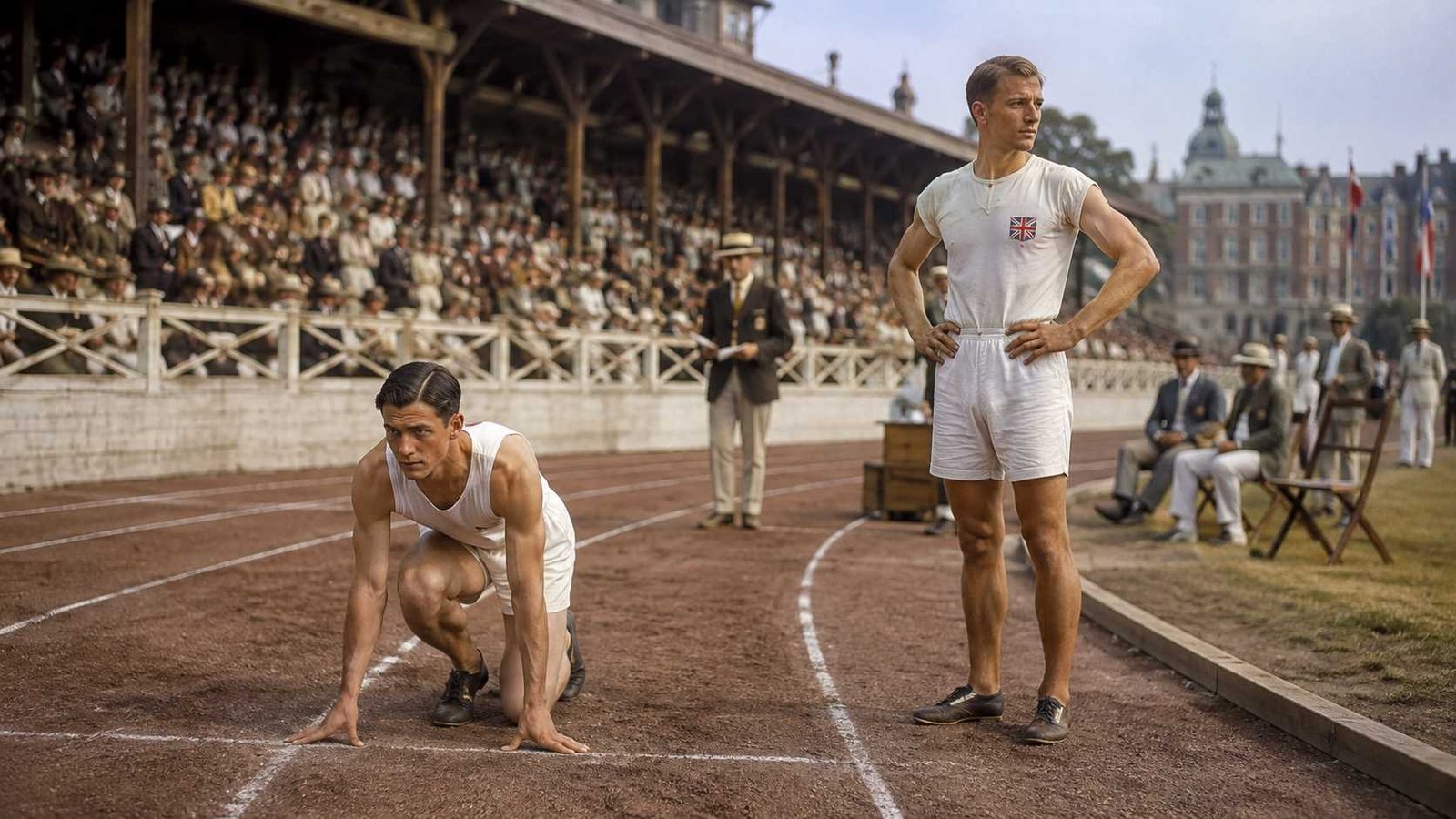
But the movie is not a scene-by-scene history lesson.
Some of its most memorable moments were invented, moved to different dates, or given to the wrong person. The filmmakers were trying to capture what these men stood for rather than recreate every event exactly as it happened.
That distinction matters because the real story is, in several ways, even more remarkable than the film.
The short answer
| Question | Real answer |
|---|---|
| Is Chariots of Fire based on a true story? | Yes |
| Were Harold Abrahams and Eric Liddell real? | Yes |
| Did Abrahams win Olympic gold? | Yes, in the 100m in 1924 |
| Did Liddell refuse to run on Sunday? | Yes |
| Did Liddell win the Olympic 400m? | Yes, in a world-record 47.6 seconds |
| Did Abrahams beat Liddell? | Not in their two documented head-to-head races |
| Is every scene historically accurate? | No |
| How many Oscars did the movie win? | Four |
The film’s basic story comes directly from the lives of Abrahams and Liddell. Producer David Puttnam discovered their stories while reading an Olympic history book in the late 1970s. Screenwriter Colin Welland then researched the two runners, interviewed people who had known them and studied surviving film of the athletes.
The two real men behind Chariots of Fire
At first glance, Harold Abrahams and Eric Liddell seem like two versions of the same story. Both were gifted runners representing Great Britain.
Their motivations, however, were very different.
That difference became the emotional heart of Chariots of Fire.
Harold Abrahams ran because winning meant something personal
Harold Maurice Abrahams was born in Bedford, England, in 1899. He became an outstanding athlete while studying at Cambridge and competed at the 1920 Antwerp Olympics before reaching his peak four years later.
Abrahams was Jewish, and the film connects his intense desire to succeed with the antisemitism he faced within British society.
There is real history behind that part of his story. HISTORY reports that Abrahams encountered antisemitism while at school and that the experience helped fuel his determination to prove himself through sport.
He also made a decision that raised eyebrows in the amateur sporting world.
Abrahams hired professional coach Sam Mussabini.
Mussabini was real. Their working relationship was real too. During the winter of 1923–24, Mussabini helped Abrahams sharpen his technique as he prepared for Paris.
It is one part of Chariots of Fire where the movie’s drama rests on a solid historical foundation.
Eric Liddell really refused to run on Sunday
This is probably the best-known part of the movie.
And yes, it really happened.
Eric Liddell was born in China in 1902 to Scottish missionary parents. He became a talented rugby player as well as one of Britain’s fastest sprinters. He was deeply religious and regarded Sunday as the Sabbath, a day when he would not compete.
Liddell was considered a major British hope in the Olympic 100 metres.
Then came the problem.
The heats were scheduled for a Sunday.
Liddell refused to participate.
He would not make an exception simply because it was the Olympics.
That decision is one of the strongest pieces of truth inside Chariots of Fire. The movie did not invent his religious stand.
But it did change when he discovered the problem.
The movie makes Liddell’s discovery much more dramatic
In the film, Liddell learns while travelling toward Paris that his 100m heat will take place on Sunday.
It’s a great cinematic moment.
It just did not happen that way.
The real Liddell learned in the autumn of 1923, months before the Paris Games, that the 100m heats were scheduled for Sunday. That gave him time to shift his preparation toward the 200m and 400m.
This change tells us something important about the movie.
The filmmakers generally preserve the meaning of major events while adjusting their timing to make them more dramatic.
Liddell really sacrificed his chance in the 100m because of his beliefs.
He simply did not make that decision at the last minute.
What happened when Harold Abrahams reached Paris?
Abrahams entered the 1924 Olympics facing powerful American sprinters.
He responded with the performance of his life.
In the 100m final, Abrahams defeated American Jackson Scholz and won in an official time of 10.6 seconds. He became Olympic champion and later added a silver medal as part of Britain’s 4x100m relay team.
That Olympic victory is not Hollywood fiction.
It is the central historical fact around which Abrahams’ half of Chariots of Fire is built.
The surviving records also show that Abrahams finished sixth in the Olympic 200m.
Eric Liddell’s 400m victory was just as extraordinary as the movie suggests
Giving up the 100m did not end Liddell’s Olympics.
He competed in the 200m and won bronze.
Then came the 400m.
The distance was not originally his main specialty, and Liddell faced strong competition. Yet in the final he attacked the race at an extraordinary pace.
Instead of fading, he kept going.
Liddell crossed the line in 47.6 seconds, winning Olympic gold and setting a world record. World Athletics records the same 47.6-second performance from July 11, 1924.
It is one of those cases where filmmakers barely needed to exaggerate.
The real result was dramatic enough.
Is Chariots of Fire historically accurate?
It is accurate about the biggest achievements, but inaccurate about several details.
That is probably the fairest way to judge it.
The real Abrahams won the 100m.
The real Liddell refused to compete on Sunday.
The real Liddell won the 400m.
Sam Mussabini really coached Abrahams.
Those are not small details. They are the foundation of the story.
But the filmmakers also changed people, dates and events.
Fact vs. film
| In Chariots of Fire | What happened in real life |
|---|---|
| Liddell discovers the Sunday conflict while travelling to Paris | He knew about it months earlier |
| Abrahams takes part in the famous Great Court Run | Abrahams never attempted it |
| Lord Andrew Lindsay appears as a fellow athlete | Lindsay is a fictional character |
| Abrahams and Liddell are presented as closely connected rivals | They respected each other but were not close friends |
| Sam Mussabini trains Abrahams | This is based on fact |
| Abrahams wins the 1924 Olympic 100m | True |
| Liddell refuses to race on Sunday | True |
| Liddell wins the Olympic 400m | True |
So when someone asks, Is Chariots of Fire historically accurate?, the answer is best expressed this way:
Historically authentic, yes. Completely historically accurate, no.
PBS uses essentially that distinction when discussing the film. Its central athletes and achievements are real, while some of the surrounding drama was created for storytelling.
Harold Abrahams did not run around Trinity Great Court
One of the movie’s most charming sequences shows Abrahams attempting to run around the Great Court at Trinity College before the college clock finishes striking noon.
It looks like a wonderful piece of Cambridge history.
There is just one problem.
Harold Abrahams never did it.
The real athlete associated with that feat was David Burghley, later the 6th Marquess of Exeter, who completed the Great Court Run in 1927.
That was three years after the Paris Olympics.
PBS confirms that Abrahams never attempted the run.
The filmmakers transferred the achievement into their story because Burghley was not represented directly.
Was Lord Andrew Lindsay a real person?
Not exactly.
Nigel Havers plays aristocratic runner Lord Andrew Lindsay, but there was no Olympic athlete by that name behind the events shown in the film.
Lindsay was a fictional creation influenced partly by real athletes David Burghley and Douglas Lowe.
Screenwriter Colin Welland had hoped to include Lowe, Britain’s Olympic 800m champion, but Lowe did not want to be represented in the movie. Burghley also objected to the film’s historical changes and did not allow his name to be used.
The result was Andrew Lindsay, a character who allowed the filmmakers to combine elements from different real athletes.
That makes Lindsay one of the clearest examples of Chariots of Fire blending history with fiction.
Did Abrahams ever beat Liddell?
This question is especially interesting because the film encourages us to see the two men as sporting rivals.
According to World Athletics, Harold Abrahams raced Eric Liddell twice and lost to him both times.
The first was in the 220-yard semifinal at the 1923 AAA Championships.
The second was the 200m final at the 1924 Paris Olympics.
World Athletics says Abrahams finished 0.4 seconds behind Liddell on both occasions.
At Paris, Liddell took bronze in the 200m while Abrahams finished sixth.
So if the question is simply Did Abrahams ever beat Liddell?, the available record of their two head-to-head races says no.
That does not make Abrahams the lesser athlete.
They simply had different Olympic triumphs.
Abrahams became the 100m champion.
Liddell became the 400m champion.
Were Harold Abrahams and Eric Liddell really close friends?
The film binds their stories so tightly that it is easy to imagine them as close companions.
Reality appears to have been less intimate.
They knew each other and clearly respected each other’s talent, but HISTORY notes that they were not close friends. Each reportedly admired the other’s determination and competitive spirit.
This is another subtle example of filmmaking at work.
Putting their lives side by side creates a stronger story because their motivations contrast so beautifully.
Abrahams runs against exclusion and prejudice.
Liddell runs according to faith.
One is driven to prove something.
The other believes his talent itself carries a responsibility.
The movie makes those paths feel almost destined to intersect.
History was messier.
What happened to Harold Abrahams after the Olympics?
Abrahams’ Olympic glory did not lead to a long competitive career.
In May 1925, less than a year after winning gold, he suffered a serious leg injury that ended his active athletics career.
But he did not leave sport behind.
In many ways, he simply moved from the track to the microphone and writing desk.
Abrahams became:
- an athletics journalist
- a BBC radio commentator
- a sports administrator
- a historian and statistician
- athletics correspondent for The Sunday Times from 1925 to 1967
He also held important administrative positions within British athletics.
Abrahams died on January 14, 1978, aged 78.
There is a poignant twist here.
He died shortly before screenwriter Colin Welland began developing the screenplay that would turn his Olympic achievement into one of Britain’s most famous films.
What happened to Eric Liddell?
Liddell’s life after Paris moved in a very different direction.
He continued competing for a time, but athletics was never going to be the final destination for him.
In 1925, he travelled to China as a missionary, following the path of his parents.
He married Florence Mackenzie in 1934, and they had three daughters.
Then war changed everything.
As fighting intensified in China during World War II, Liddell’s wife and children left for Canada. Liddell remained in China.
In 1943 he was interned by Japanese forces.
He died in the internment camp on February 21, 1945, aged just 43. World Athletics says his death came after he remained behind to continue his missionary work.
Knowing this gives Chariots of Fire a different emotional weight.
The Olympic victory was extraordinary.
But for Liddell, it was only one chapter of his life.
How many Oscars did Chariots of Fire get?
Chariots of Fire received seven Academy Award nominations and won four Oscars at the 54th Academy Awards, honoring films released in 1981.
It won:
- Best Picture
- Best Original Score for Vangelis
- Best Costume Design for Milena Canonero
- Best Original Screenplay for Colin Welland
It was also nominated for supporting actor Ian Holm, director Hugh Hudson and film editor Terry Rawlings.
The Best Picture victory turned a relatively modest British production into an international cinema landmark.
And Vangelis’s electronic score did something even stranger: it made a film set in the 1920s sound unmistakably modern.
Decades later, hearing those opening notes is often enough to make people picture runners moving in slow motion along a beach.
Why did the filmmakers change the true story?
Because history rarely arrives in a perfect two-hour structure.
Real lives overlap awkwardly. Important decisions happen months before their consequences. People who matter to history may refuse to appear in a movie about it.
Chariots of Fire compresses that reality.
Liddell discovering the Sunday conflict on his journey to Paris gives the audience an immediate crisis.
Putting the Great Court Run into Abrahams’ story tells us something about his competitive nature in a few memorable minutes.
Creating Andrew Lindsay avoids introducing several additional athletes.
And linking Abrahams and Liddell more closely gives the movie a clear emotional spine.
That does not make the changes factual.
But it helps explain them.
BFI records show that Welland carried out extensive research, including interviews with people who had known the athletes and study of archival footage. The screenplay was built from history, then reshaped into drama.
What Chariots of Fire gets most right
The strongest truth in the movie may not be a date, race result or stopwatch reading.
It is the idea that these men ran for reasons larger than medals.
Abrahams’ Olympic record proves that his victory was real. His long relationship with Mussabini was real. So was the difficult social background that helped shape his competitive drive.
Liddell’s refusal to compete on Sunday was real. His Olympic 400m victory was real. So was the faith that later carried him away from sporting fame and into missionary work in China.
The movie rearranges pieces around those truths.
It does not invent the men at its center.
So, is Chariots of Fire a true story?
Yes. Chariots of Fire is based on the true stories of Harold Abrahams and Eric Liddell and their journeys to the 1924 Paris Olympics.
Abrahams truly won Olympic gold in the 100m.
Liddell truly refused to compete in the 100m because its heats fell on Sunday.
Liddell then really won the 400m in a world-record 47.6 seconds.
Where the movie moves away from history is in the path connecting those events. Liddell knew about the Sunday schedule months earlier. Abrahams never completed the Great Court Run. Lord Andrew Lindsay was fictional. And the two champions were not the close rivals the film sometimes makes them appear to be. (HISTORY TV Denmark)
Yet the deeper story survives those changes.
Two men reached the same Olympic stage while carrying very different ideas about identity, faith, ambition and success.
More than a century after their races in Paris, that is still the part of Chariots of Fire that feels true.

Jessica Savitch, with a deep passion for journalism, brings her expertise to istruestory.com as a dedicated author. MA in Arts & Journalism.