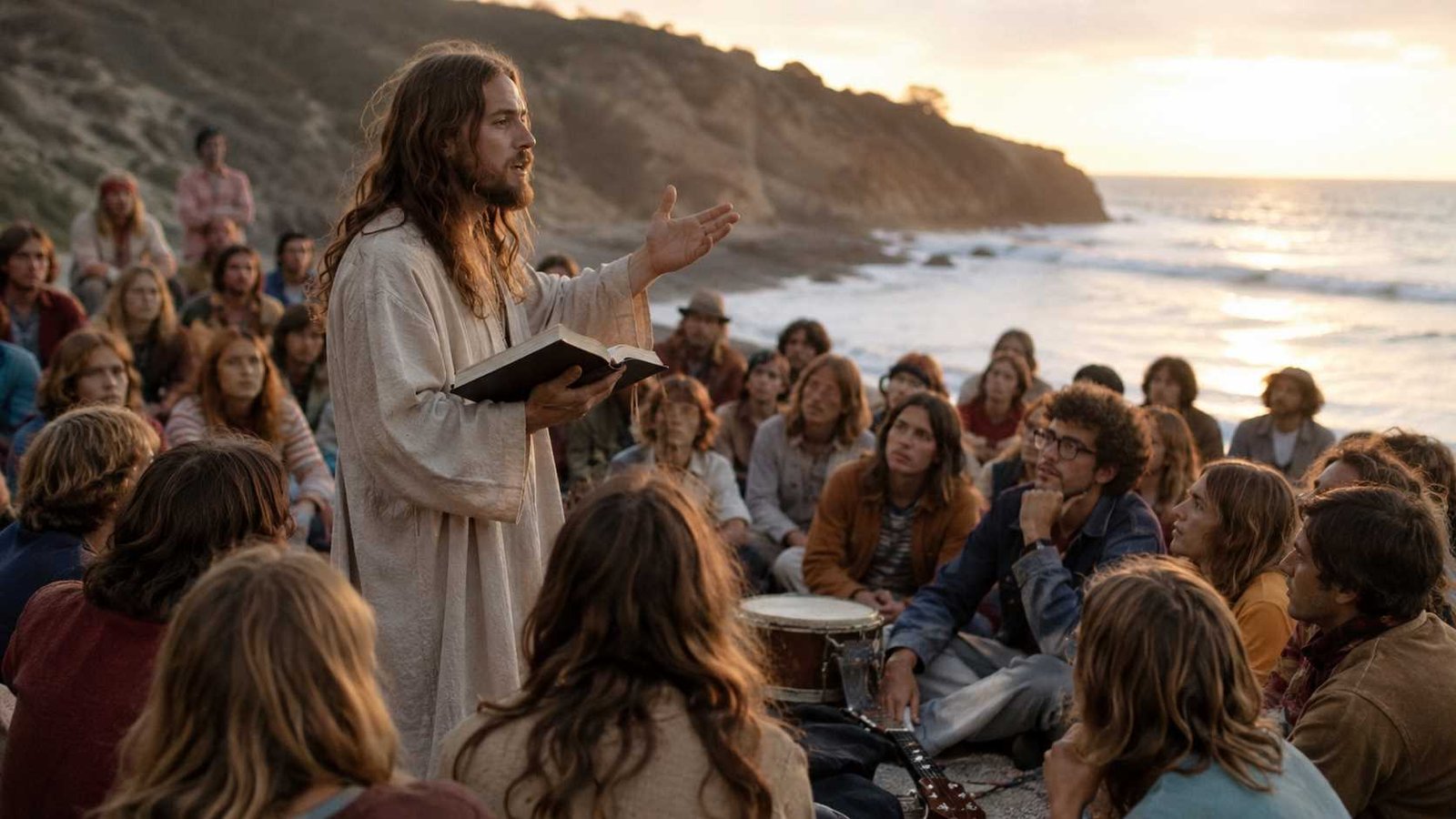
He had long hair, a beard, sandals, and the look of a California hippie. Yet instead of simply joining the counterculture around him, Frisbee became one of the most memorable preachers of the Jesus Movement.
Thousands heard him preach. Young people followed him to church. His work became connected with the early growth of Calvary Chapel and later the Vineyard movement. Greg Laurie was among the teenagers influenced by him.
But Frisbee’s story did not end like an uplifting movie.
Lonnie Frisbee died on March 12, 1993, at age 43. Later accounts from Greg Laurie, KQED, and the Los Angeles Times describe him as dying from AIDS or an AIDS-related illness. However, a Los Angeles Times funeral report published days after his death said his relatives identified a brain tumor as the cause.
That difference matters. Frisbee’s life has been surrounded by admiration, controversy, religious interpretation, and sometimes conflicting versions of events.
Here is what the available record actually tells us.
What happened to Lonnie Frisbee in real life?
Lonnie Frisbee became famous during the religious awakening known as the Jesus Movement in Southern California.
He was unusual even by the standards of the late 1960s.
He came out of hippie culture rather than traditional religious training. His informal appearance and speaking style made him especially effective at reaching young people who might never have entered a conventional church.
Frisbee eventually became closely connected with Pastor Chuck Smith and Calvary Chapel in Costa Mesa.
Greg Laurie remembers the combination clearly. Laurie wrote that Frisbee attracted young people while Smith provided the steady Bible teaching that helped keep many of them in the church. According to Laurie, crowds became so large that Calvary Chapel struggled to contain them.
Frisbee’s influence later reached another major Christian movement.
During the 1980s he worked around the Vineyard movement, where charismatic Christian practices such as prayer for healing, speaking in tongues, and what believers called signs and wonders received much greater attention. KQED’s documentary description places Frisbee at the center of this period from roughly 1980 to 1983.
A Vineyard USA historical interview also confirms that Frisbee traveled with John Wimber’s ministry team to South Africa during this era, when expectation of signs and wonders was becoming an important part of Vineyard identity.
Yet Frisbee’s personal life was becoming far more complicated.
His marriage ended. His relationships with churches changed. He struggled with drugs and sexuality, according to accounts from people who knew him and from Frisbee’s own later story as reported by Greg Laurie.
By the beginning of the 1990s, his health had seriously declined.
How did Lonnie Frisbee die?
The simple answer needs one important qualification.
Lonnie Frisbee died at his Newport Beach home on March 12, 1993, after a serious illness. He was 43.
Greg Laurie later wrote that he and pastor Mike MacIntosh visited Frisbee while Frisbee was in hospice care and dying from AIDS. Laurie remembered seeing him very thin and in pain. Frisbee still hoped he would recover and return to international preaching.
KQED’s description of David Di Sabatino’s documentary Frisbee: The Life and Death of a Hippie Preacher also says Frisbee died from AIDS in 1993. A later Los Angeles Times feature about the Jesus Movement likewise described him as having died of AIDS.
Why do some sources say he died of a brain tumor?
This is where the historical record becomes less tidy.
On March 18, 1993, only days after Frisbee’s death, the Los Angeles Times reported on his funeral at the Crystal Cathedral.
The newspaper said Frisbee had died after a lengthy illness and reported that his relatives said he died of a brain tumor.
That contemporary report cannot simply be ignored.
At the same time, several later sources, including people familiar with Frisbee’s life, identify AIDS as the illness associated with his death. Greg Laurie specifically describes visiting him while he was dying from AIDS, while KQED’s documentary page states that Frisbee died from AIDS.
The sources reviewed here do not provide Frisbee’s complete medical records. Because of that, the fairest way to state the answer is:
Later biographical and firsthand accounts identify AIDS as the central illness behind Lonnie Frisbee’s death, while his family publicly reported a brain tumor at the time of his funeral.
Trying to erase either part of the record would make the story less accurate, not more.
What does Greg Laurie say about Lonnie Frisbee?
Greg Laurie’s memories give us one of the clearest personal pictures of Frisbee.
Laurie does not describe him as a perfect religious hero.
He describes a gifted but complicated man.
Laurie wrote that Frisbee had a profound impact on his life and was briefly his spiritual mentor. He remembered Frisbee as authentic, gentle, funny, charismatic, and exceptionally well suited to the cultural moment of the Jesus Movement. Laurie also acknowledged that Frisbee could be theatrical.
More personally, Frisbee played a direct role in Laurie’s own Christian conversion.
Laurie recalls Frisbee visiting his high school and teaching from the New Testament. Frisbee challenged the students to decide where they stood concerning Jesus.
Laurie says he went forward with other students, prayed with Frisbee, and accepted Christ.
That helps explain why Laurie’s view of Frisbee remains emotional.
This was not simply a famous preacher Laurie read about years later.
It was someone who had been present at a defining moment in his youth.
Laurie also remembers Frisbee’s decline
Laurie’s account becomes much sadder when he reaches Frisbee’s final years.
He describes visiting him in hospice with Mike MacIntosh. Frisbee was very ill but remained convinced that he might be healed and resume his ministry.
According to Laurie, Frisbee also spoke about regrets and choices he wished had gone differently.
Laurie says they hugged him, told him they loved him, and prayed with him.
He never saw Frisbee again.
Laurie’s final assessment is neither complete condemnation nor hero worship. He sees Frisbee as a deeply flawed man through whom, in Laurie’s Christian understanding, God nevertheless influenced many people.
What happened to Lonnie Frisbee’s wife?
Lonnie Frisbee married Connie Bremer, who later became known as Connie Bremer-Murray.
Their relationship began when both were very young.
In a later interview, Connie said she was 19 and Lonnie was 18 when they married. Their marriage became closely tied to their religious work and the rapidly growing Jesus Movement.
But the marriage did not last.
Connie said they separated in 1973.
She explained that she initially filed for divorce but did not complete the process. According to her recollection, Lonnie later finished it, and she believed the divorce became official around 1975.
Connie later remarried. Years afterward, she spoke publicly about Lonnie, their marriage, their difficult personal histories, and how she believed later portrayals simplified what actually happened between them.
Her testimony is important because it shows something that a two-hour film or a brief church history can easily miss.
The Jesus Movement may have looked exciting from the outside, but the people living inside it still had marriages, wounds, conflicts, money problems, ambitions, and personal failures.
Lonnie and Connie were not simply supporting characters in a religious success story.
They were two very young people trying to manage a marriage while an enormous movement formed around them.
Did Lonnie Frisbee actually heal people?
This question requires a clear line between religious testimony and independently verified fact.
There are many accounts linking Frisbee with healing, prophecy, spiritual experiences, and other events that charismatic Christians considered supernatural.
KQED’s documentary description says Frisbee became closely associated with the 1980s signs-and-wonders movement, which emphasized divine healing, speaking in tongues, and other charismatic practices. It also notes the many miraculous stories connected with his life.
Vineyard’s own history confirms the environment in which he ministered. A Vineyard USA account describes Frisbee traveling with John Wimber’s team during a period when the movement emphasized an expectation of signs and wonders.
So, did people claim that healing occurred around Lonnie Frisbee’s ministry? Yes.
That is well established as part of the historical religious record.
But that is different from proving that Frisbee had supernatural healing powers.
The sources reviewed for this article do not provide independent clinical studies, medical documentation, or controlled investigations proving that a specific disease disappeared because Frisbee prayed for someone.
For that reason, it would be misleading to write simply, “Lonnie Frisbee healed people,” as though this were a medically demonstrated fact.
A more accurate statement is:
People who participated in Frisbee’s ministry reported healings and other miraculous experiences, and those testimonies became an important part of his reputation. Whether those events were supernatural is a matter of faith rather than something established by the evidence examined here.
Interestingly, Frisbee himself continued to believe in healing even when he became gravely ill.
Greg Laurie remembers that while Frisbee was in hospice, he still hoped he would be miraculously healed and return to preaching.
That healing never came.
Why Lonnie Frisbee’s story remains controversial
Part of the difficulty in telling Frisbee’s story is that several different versions of him exist at once.
To some Christians, he was a gifted evangelist who helped transform American evangelical culture.
To others, he became an example of the dangers of charismatic excess.
Some remember his personal failures most strongly.
Others believe churches benefited from his gifts and then pushed him to the edge when his life became uncomfortable or difficult to explain.
Even major sources use noticeably different language.
Greg Laurie remembers a mentor who changed his life but also describes serious flaws and regrets. KQED’s documentary presentation places greater emphasis on Frisbee’s marginalization and the tension between his sexuality and the conservative churches he helped build.
Those perspectives do not have to cancel one another out.
Real people are often more complicated than the stories later told about them.
His influence was larger than his fame
Frisbee never became a household name on the level of Billy Graham.
Yet his fingerprints can be found near two religious movements that became much larger than the young hippie preacher who helped energize them.
At Calvary Chapel, he was particularly effective at drawing counterculture young people into a Christian community. Greg Laurie calls him the magnet that attracted many of them.
Later, he became part of the charismatic period that helped shape the early Vineyard movement.
That makes the end of his life especially striking.
The man once surrounded by crowds spent his final days seriously ill.
The preacher associated with stories of healing hoped for healing himself.
And the evangelist who helped bring thousands of young people into churches became a person whose own place in church history would later be debated.
The clearest answer to how Lonnie Frisbee died
So, how did Lonnie Frisbee die?
Lonnie Frisbee died on March 12, 1993, at age 43, following a serious illness. Greg Laurie and later documentary and newspaper accounts identify AIDS as the illness connected with his death. A contemporary Los Angeles Times funeral report, however, said his relatives gave the cause as a brain tumor.
That discrepancy should remain part of any careful account of his death.
What is much less disputed is the scale of the life that came before it.
Frisbee helped introduce a generation of young Americans to a form of Christianity that looked and sounded radically different from the churches their parents knew. He influenced Greg Laurie personally, contributed to the explosive growth surrounding Calvary Chapel, and later became connected with the charismatic revival within the Vineyard movement.
He also lived through broken relationships, personal struggles, illness, and rejection.
That combination may be the reason people are still asking about him decades later.
Lonnie Frisbee’s story is difficult to reduce to saint, sinner, healer, hippie, or fallen preacher.
He was a human being whose gifts and struggles were both unusually visible.
And understanding how Lonnie Frisbee died means acknowledging the same thing his entire life seems to demand: the real story is more complicated than the simplified version.

Jessica Savitch, with a deep passion for journalism, brings her expertise to istruestory.com as a dedicated author. MA in Arts & Journalism.