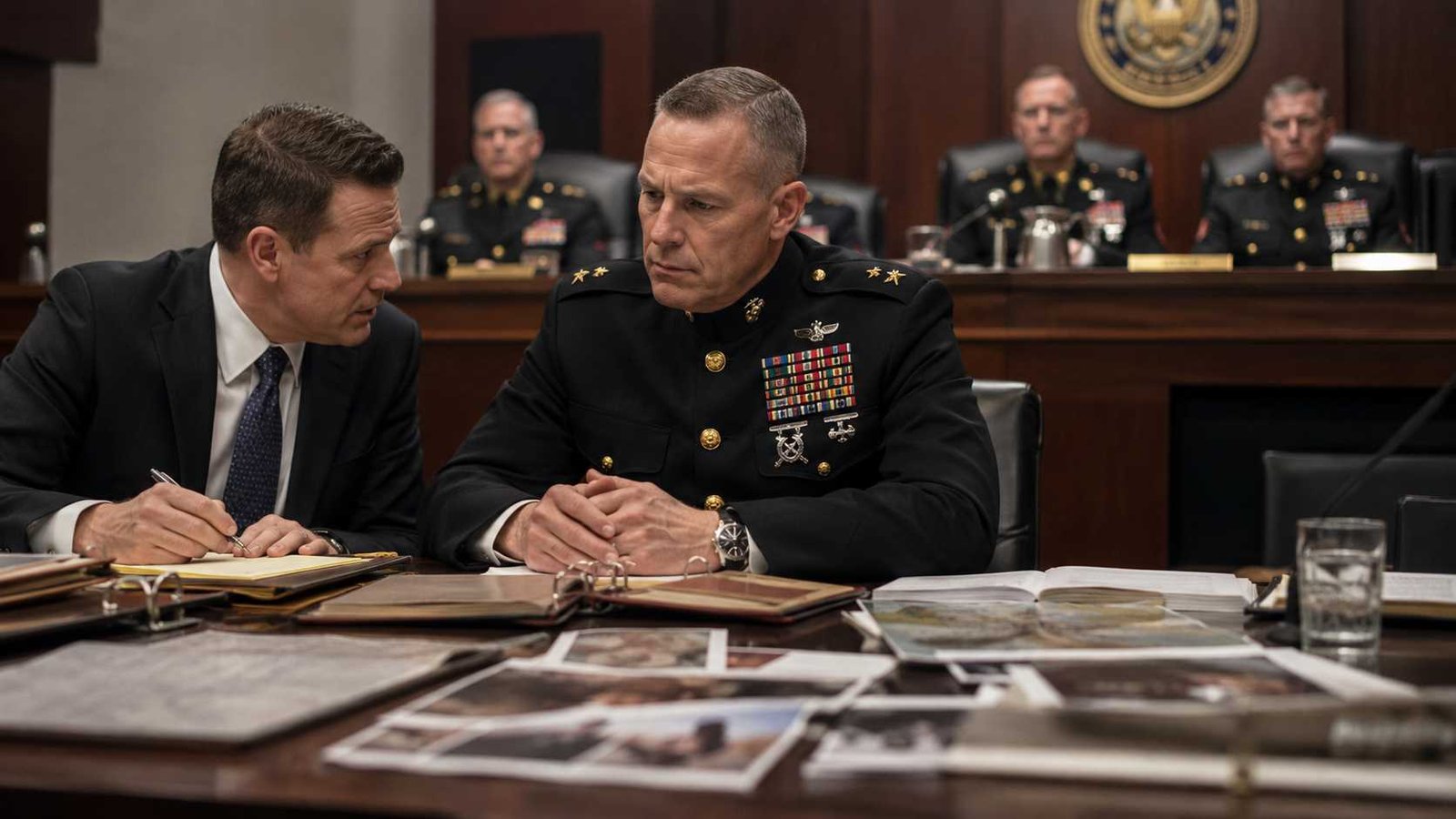
But there is an important fact to know from the start.
Colonel Terry L. Childers was not a real U.S. Marine officer. He is a fictional character played by Samuel L. Jackson in the 2000 movie Rules of Engagement.
The movie itself is also not based on one specific true story.
What makes things more interesting is where the story came from. Its creator, James Webb, really was a decorated Marine combat veteran and later served as U.S. Secretary of the Navy. He drew on his experiences with war, military law, loyalty, and difficult rules of engagement when developing the film.
So Childers is fictional, but some of the fears, decisions, and moral questions surrounding him are very real.
Was Colonel Terry Childers a real person?
No. There was no real Colonel Terry Childers behind Rules of Engagement.
Paramount Pictures identifies Terry L. Childers as the character played by Samuel L. Jackson. The official film synopsis describes him as a decorated Marine colonel who leads an operation in Yemen and later faces a court-martial after civilians are killed.
That entire storyline belongs to the fictional world of the movie.
There is no evidence that Samuel L. Jackson’s character was a renamed version of a specific Marine officer or that a real Colonel Childers went through the Yemen embassy incident shown on screen.
Still, the character works because he was written from a world James Webb understood personally.
Webb served as a Marine officer in Vietnam. Years later, when explaining how Rules of Engagement was created, he said the subject of military rules of engagement had stayed with him through several different parts of his life.
That background gave a fictional character like Childers a believable foundation.
Is The Rules of Engagement a true story?
No, Rules of Engagement is not a true story in the traditional sense.
The movie does not recreate a documented embassy massacre, court-martial, or case involving Colonel Terry Childers.
James Webb explained that he conceived the basic idea for the movie in 1989. The starting point was not a newspaper story about one Marine officer. It grew from a discussion about military loyalty and the meaning of standing beside another Marine under extreme circumstances.
Webb then built a fictional situation around that idea.
A Marine Expeditionary Unit would be sent to rescue people from an American embassy under siege. During the mission, Marines would come under fire. Their commander would order his men to fire into a crowd. He would then return home not simply as a hero, but as a man accused of murder.
That commander eventually became Terry Childers.
His old Marine friend, whose life he had once saved, would become the lawyer trying to defend him.
It is fiction. But Webb deliberately placed that fiction inside problems that real military officers can face.
The real experiences behind Terry Childers
This is where the Col Terry Childers true story becomes more complicated.
There may not be a real Childers, but Webb named several real experiences that shaped his interest in rules of engagement.
James Webb’s Vietnam experience
Webb served as a Marine officer during the Vietnam War.
In his U.S. Naval Institute interview, he said his own combat experience was one reason the rules-of-engagement issue weighed heavily on him.
That connection matters because Rules of Engagement begins by establishing a long bond between Childers and Colonel Hays Hodges.
Hodges, played by Tommy Lee Jones, owes his life to Childers after their service in Vietnam.
The movie uses that shared history to ask a difficult question: How far does loyalty go when the man you trust is accused of doing something terrible?
A military legal case also influenced Webb
Webb also pointed to his experience representing a man accused of being a war criminal.
He said that experience contributed to his long interest in the difficult line between what happens during combat and how those actions are judged afterward.
That idea sits at the center of the movie.
Childers makes his decision in seconds.
Lawyers later get weeks or months to examine it.
The courtroom can replay statements, study documents, question witnesses, and debate what should have happened.
The Marine commander standing under fire had none of those luxuries.
That tension gives Rules of Engagement much of its emotional power.
Beirut also helped shape the idea
Webb worked as a journalist in Beirut while U.S. Marines were deployed there.
He later described the rules under which Marines operated there as another major influence on his thinking about the film.
Rules of engagement tell military personnel when and how force may be used.
On paper, that sounds straightforward.
In a chaotic situation involving civilians, protesters, hidden weapons, unclear threats, and political pressure, it can become much harder.
The movie takes that problem and pushes it to an extreme.
Was the Yemen embassy attack real?
No. The embassy incident involving Terry Childers was created for the film.
There is an interesting detail behind it.
Director William Friedkin later explained that Webb’s original screenplay did not even place the embassy crisis in Yemen. The early version used a fictional Central American country.
During development, filmmakers changed the location to Yemen because they believed it made the scenario feel more plausible.
That is strong evidence against the idea that Rules of Engagement was secretly recreating a particular real Yemen incident.
The location itself evolved while the screenplay was being developed.
In other words, the filmmakers were constructing a believable political and military situation rather than reproducing a historical event.
What happens to Terry Childers in Rules of Engagement?
Childers is sent to Yemen after a protest outside the American embassy becomes dangerous.
His mission is to protect and evacuate the U.S. ambassador and his family.
The evacuation succeeds, but the Marines begin taking fire and suffering casualties.
Childers eventually orders his troops to fire toward the crowd below.
The consequences are devastating.
The film says 83 people are killed, including women and children. Childers soon finds himself blamed for ordering his Marines to fire on what authorities claim was an unarmed crowd.
He is brought back to the United States and court-martialed.
The government argues that Childers lost control and violated the rules.
Childers insists that people within the crowd were firing weapons at his Marines.
There is another problem.
Video evidence that could have supported his version of events disappears.
That missing evidence turns the trial into something larger than a simple question of whether Childers gave the order.
The movie begins asking whether military leaders can become convenient political sacrifices when an operation goes badly.
Why does Childers choose Hays Hodges?
Childers could have looked for an impressive courtroom specialist.
Instead, he asks Colonel Hays Hodges to defend him.
Hodges is not presented as the greatest lawyer in the military. He knows that himself.
But Childers trusts him.
Their relationship goes back to Vietnam, where Childers saved Hodges’ life.
James Webb said that this bond was central to the original idea. He wanted to explore a Marine concept of loyalty in which one person may stand beside another even when their relationship is difficult.
This is why Rules of Engagement is not simply a courtroom mystery.
Underneath the shooting, politics, and legal arguments is a story about trust.
Childers needs someone who understands what a battlefield decision feels like.
Hodges does.
What happened in the end of the movie Rules of Engagement?
The ending gives Childers a partial victory.
The military court finds Colonel Terry Childers not guilty of murder.
He is also found not guilty of conduct unbecoming an officer.
However, he is found guilty of the lesser charge of breach of the peace. The film’s final information indicates that Childers later retires honorably from the Marine Corps.
The movie also gives consequences to the officials involved in hiding the truth.
National Security Adviser William Sokal is held responsible for destroying evidence, while Ambassador Mourain faces consequences for giving false testimony.
Childers therefore does not walk away completely untouched.
His career as a commander is effectively over.
That detail is important because Webb specifically wanted audiences to understand what command meant to someone like Childers.
He explained that even if the character survived the court-martial, losing the ability to command troops meant losing something central to his professional identity.
What does Colonel Cao’s final salute mean?
One of the quieter moments near the end involves Colonel Cao.
Cao is connected to Childers’ actions during the Vietnam War and appears during the trial.
His testimony could seriously damage Childers.
Yet under questioning, Cao acknowledges the brutal reality of the battlefield situation and indicates that he might have made a similar choice had their positions been reversed.
After the court-martial, Cao and Childers salute one another.
The salute does not magically declare everything Childers ever did morally correct.
It represents something more complicated.
Two former enemies recognize that each understands the kind of decisions the other had to make during war.
Neither needs the other to explain it.
For a film built around military loyalty and judgment, it is a fitting final image.
How much of the movie reflects real military life?
The broad themes have real foundations, but viewers should not treat the movie as a documentary.
Director William Friedkin said the filmmakers sought help from the Marine Corps while preparing the production. The Marine Corps provided comments on the script, and the production was able to film aboard the USS Tarawa. Friedkin also said actual off-duty Marines appeared as Marines in the movie.
At the same time, Friedkin openly acknowledged that technical inaccuracies remained.
That distinction matters.
A movie can work hard to make uniforms, ships, commands, attitudes, and military procedures feel authentic while still telling a completely invented story.
That is essentially what happened with Rules of Engagement.
Why Rules of Engagement feels like a true story
Some fictional movies announce themselves as fiction immediately.
Rules of Engagement does the opposite.
It gives us dates, ranks, government officials, military procedures, courtroom charges, an overseas embassy, and closing notes explaining what happens to the characters afterward.
Those details create the rhythm of a historical drama.
The performances add another layer.
Samuel L. Jackson plays Childers not as an invincible action hero but as a career Marine who knows that one command may erase decades of service.
Tommy Lee Jones gives Hodges the weariness of someone who has lived with war long after leaving the battlefield.
Even the story’s central question feels like something pulled from an investigation:
What if the person who gave the order was telling the truth, but the evidence that could prove it disappeared?
That is why people continue asking whether Terry Childers was real.
The film was designed to make his dilemma believable.
So, who was the real Terry Childers?
There wasn’t one.
Searching for a real Marine colonel whose life exactly matches the character leads us in the wrong direction.
The better place to look is James Webb.
Not because Webb was secretly Terry Childers, but because Webb supplied the experience behind many of the story’s questions.
He knew combat.
He understood Marine culture.
He had dealt with accusations involving wartime conduct.
He had observed Marines operating under difficult rules of engagement in Beirut.
He had served at the highest levels of civilian Navy leadership.
Those experiences were combined, changed, dramatized, and turned into fiction.
Terry Childers emerged from that process.
The truth behind the Col Terry Childers story
The Col Terry Childers true story is therefore not the story of a forgotten Marine officer whose real court-martial became a Hollywood movie.
It is something subtler.
Terry Childers is fictional. The Yemen embassy massacre is fictional. His court-martial is fictional.
But the world that created him was informed by real combat experience and real questions about military command.
James Webb wanted audiences to think about what happens when soldiers are placed in politically complicated situations and then forced to make decisions in seconds that others may judge for years afterward.
That is probably why Rules of Engagement continues to feel like a true story more than two decades after its release.
Childers never existed.
The dilemma he represents certainly does.
Frequently Asked Questions
Is Terry Childers a real person?
No. Colonel Terry L. Childers is a fictional U.S. Marine character played by Samuel L. Jackson in Rules of Engagement. Paramount’s official film information lists Childers as Jackson’s character.
Is The Rules of Engagement a true story?
No. Rules of Engagement is a fictional story created by James Webb. Webb did, however, draw inspiration from his Vietnam combat experience, military legal work, time in Beirut, and service as Secretary of the Navy.
Was the Yemen incident in Rules of Engagement real?
No. The embassy attack shown in the film is fictional. Director William Friedkin said an earlier version of the screenplay actually placed the incident in a fictional Central American country before filmmakers moved the story to Yemen.
What happened in the end of Rules of Engagement?
Childers is acquitted of murder and conduct unbecoming an officer but found guilty of breach of the peace. The closing information says he later retired honorably from the Marine Corps.
Who played Colonel Terry Childers?
Samuel L. Jackson played Colonel Terry L. Childers. Tommy Lee Jones played Colonel Hays Hodges, the Marine lawyer who defends him during the court-martial.

Jessica Savitch, with a deep passion for journalism, brings her expertise to istruestory.com as a dedicated author. MA in Arts & Journalism.