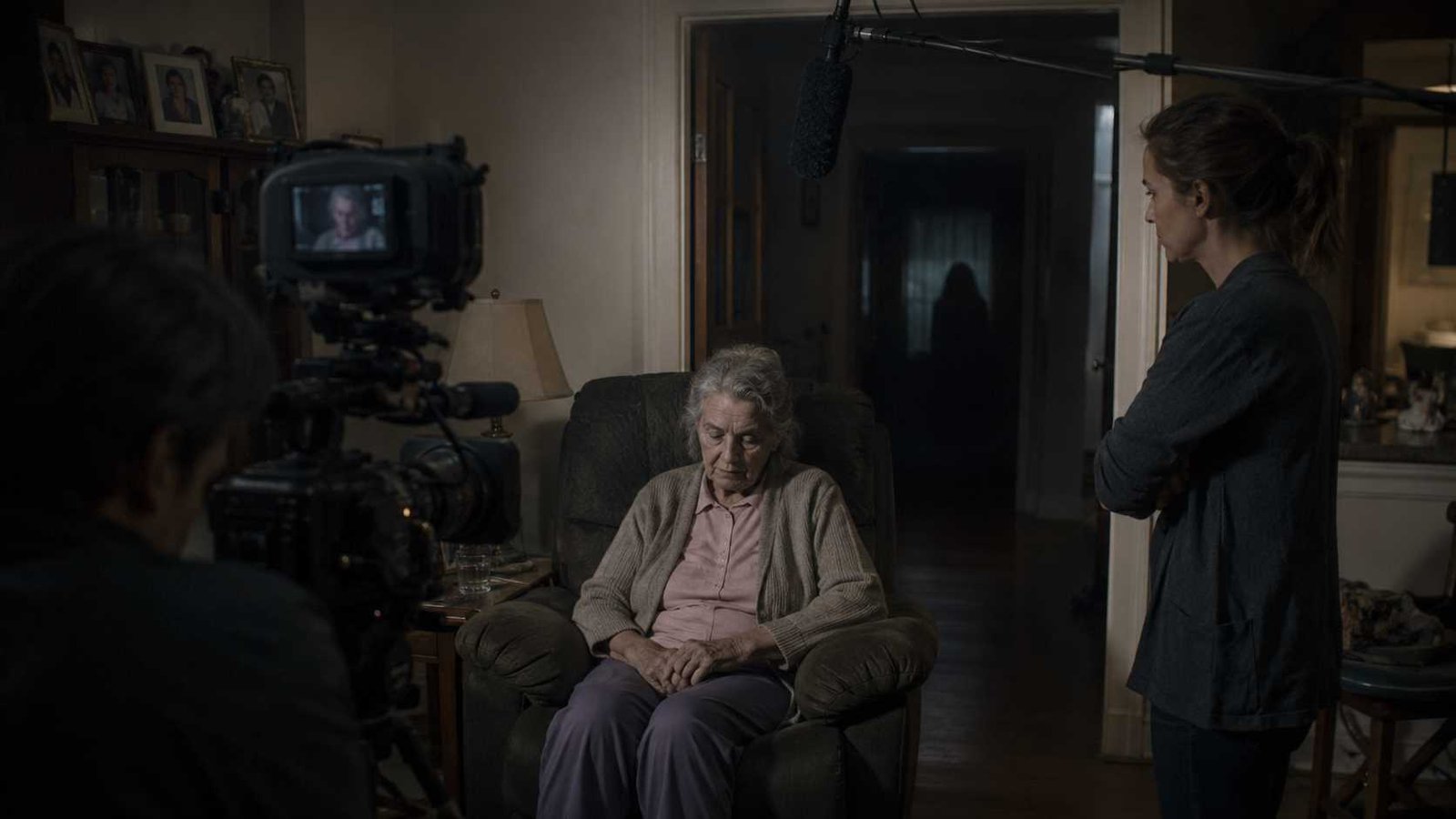
There is no haunted mansion. No obvious demon. No group of teenagers walking into a place they should have avoided.
Instead, a documentary crew enters the home of an elderly woman named Deborah Logan. She has Alzheimer’s disease. Her daughter, Sarah, is trying to care for her while dealing with money problems, exhaustion, and the painful reality of watching her mother change.
It feels uncomfortable because it feels possible.
Then Deborah starts doing things that Alzheimer’s cannot explain.
That realism has made many viewers wonder about The Taking Of Deborah Logan True Story. Was Deborah a real woman? Did a real documentary crew record her decline? Was Henri Desjardins an actual murderer?
The answer is much less mysterious than the movie makes it seem.
No, The Taking of Deborah Logan is not based on a true story. Deborah Logan, Henri Desjardins, the murders, possession, and supernatural ritual are fictional.
What is real is the fear at the center of the story. Director Adam Robitel has explained that Alzheimer’s disease personally frightened him and helped inspire the film. That mix of a real human fear with a fake documentary format is a big reason the movie can feel disturbingly authentic.
Is The Taking of Deborah Logan Based on a Real Story?
No.
The Taking of Deborah Logan is a fictional supernatural horror movie released in 2014. Adam Robitel directed the film and co-wrote the screenplay with Gavin Heffernan. Jill Larson plays Deborah Logan, while Anne Ramsay plays her daughter Sarah and Michelle Ang plays documentary filmmaker Mia.
There is no known real Deborah Logan case behind the movie.
There was also no real series of murders committed by a pediatrician named Henri Desjardins that inspired the central mystery presented in the film.
The movie is designed to look like evidence from a real case. That is part of the trick.
Mia and her crew arrive to document Deborah’s Alzheimer’s disease for an academic project. Their cameras record interviews, medical discussions, arguments, strange behavior, and eventually events that appear impossible.
Because almost everything is shown through documentary cameras, security footage, interviews, or news reports, viewers are encouraged to watch the movie as though someone discovered these recordings after a genuine tragedy.
That does not make the story real. It means the filmmakers understood how powerful realism can be in horror.
The Real Fear That Inspired Deborah Logan
Although Deborah’s story is fictional, the emotional starting point was not invented from nothing.
Adam Robitel has spoken openly about his fear of Alzheimer’s disease.
In an interview with Horror News Network, he recalled an uncle who would become disoriented and wander into other people’s yards at night. Robitel said the thought of someone losing control of their own mind and becoming trapped inside their body had always frightened him.
That fear became the foundation of the movie.
Robitel described the film as beginning like a grounded medical documentary about an elderly woman and her caregiver before slowly changing into a possession story and eventually a monster movie.
That progression matters.
If Deborah had started the movie crawling across ceilings or speaking in strange voices, we would immediately understand that we were watching supernatural horror.
Instead, the movie first asks us to watch a daughter struggle with her mother’s declining health.
We understand Sarah’s frustration.
We understand Deborah’s fear.
We understand why the film crew initially tries to explain disturbing behavior medically.
Only later does the movie begin removing those ordinary explanations.
Alzheimer’s Disease Is Real, but the Movie Becomes Supernatural
This is where the line between fact and fiction needs to be especially clear.
Alzheimer’s disease really can cause serious memory problems, confusion, changes in judgment, wandering, anxiety, personality changes, agitation, and other behavioral symptoms. The National Institute on Aging explains that symptoms become more serious as the disease progresses.
But the supernatural events shown in The Taking of Deborah Logan are not symptoms of Alzheimer’s.
Deborah’s strange physical transformations, apparent possession, supernatural strength, connection to Henri Desjardins, and terrifying behavior in the mines belong to the horror story.
The movie deliberately blurs that boundary at first.
That is what makes the early scenes so effective. The audience faces the same question as the characters:
Is Deborah’s condition becoming worse, or is something else happening to her?
Eventually, the film gives a clear supernatural answer.
What Actually Happened to Deborah Logan?
Spoilers follow.
Inside the fictional story, Deborah Logan has much more history than the documentary crew first realizes.
Years before Mia begins filming her, a local pediatrician named Henri Desjardins had been connected to the ritualistic murders of four young girls.
The movie claims that Desjardins wanted to complete a ritual involving five victims so he could achieve immortality.
But there was a problem.
He never reached victim number five.
That fifth intended victim was Sarah Logan, Deborah’s daughter.
Deborah discovered what Desjardins planned to do. Instead of allowing him to hurt Sarah, she killed him and secretly buried his remains.
Years later, his presence returns.
As Deborah becomes more vulnerable, the film suggests that Desjardins possesses her and begins using her body to finish the ritual he failed to complete while alive.
So Deborah is not secretly revealed to be an evil woman.
Her past contains violence, but she killed Desjardins to protect her daughter.
The tragedy is that decades later, the man she stopped appears to take control of her.
Who Was Henri Desjardins?
Henri Desjardins is one of the main reasons people mistake the movie for a true crime story.
The filmmakers give him exactly the kind of history we expect to hear in a documentary.
He was supposedly a respected pediatrician. Old reports connect him to murdered girls. There are interviews discussing the investigation. His disappearance becomes a local mystery. His name seems to have been sitting inside an unsolved case for decades.
It sounds like material pulled from newspaper archives.
But it is part of the screenplay.
Within the movie, Desjardins murdered four girls while attempting to perform a ritual connected with snakes, sacrifice, cannibalism, and immortality. He intended Sarah to become his fifth victim before Deborah stopped him.
The movie presents the ritual as connected to ancient Monacan beliefs. That claim belongs to the film’s fictional horror mythology and should not be treated as evidence of an authentic Native American religious practice.
In other words, searching historical crime records for the Deborah Logan and Henri Desjardins case will not uncover the hidden truth behind the movie.
The movie itself created the mystery.
Why Does The Taking of Deborah Logan Feel So Real?
The best answer is simple: it earns your trust before it tries to frighten you.
The opening section resembles a serious documentary.
Mia asks questions.
Doctors discuss Deborah’s condition.
Sarah talks about caregiving.
Money is a problem.
The house looks lived in rather than designed like a horror set.
Deborah does not initially behave like a horror villain. She seems proud, uncomfortable, vulnerable, and sometimes irritated that strangers are recording one of the hardest periods of her life.
Jill Larson’s performance strengthens the illusion.
Even reviewers who have mixed opinions about the film’s found-footage tricks have regularly singled out Larson’s performance and the emotional weight of the Alzheimer’s storyline.
The horror arrives slowly.
A strange movement appears on camera.
Deborah begins behaving in ways the filmmakers cannot understand.
Recordings reveal details no one remembers hearing.
Something seems to move through the house.
By the time the story openly embraces possession, the movie has already trained us to treat its camera as a witness.
That is exactly what found-footage horror is supposed to do.
Is Taking of Deborah Logan Found Footage?
Yes.
The Taking of Deborah Logan is a found-footage horror movie, although it also borrows heavily from the mock-documentary style.
Found-footage films present some or all of their story as recordings created by people inside the fictional world. Instead of watching events through a normal movie camera, we appear to be watching material captured by characters, security cameras, phones, documentary crews, or recovered recordings.
The British Film Institute describes the wider appeal of found footage as its ability to create fake realities that make frightening events appear more authentic.
That description fits Deborah Logan perfectly.
Mia’s crew has a believable reason to keep filming: they are making a documentary.
That detail solves one of the biggest problems in found-footage movies.
Viewers often ask, Why would anyone keep holding a camera while something terrifying is happening?
Here, the camera is the reason the characters are in Deborah’s house in the first place.
It starts as research.
Then it becomes evidence.
What Happens at the End of The Taking of Deborah Logan?
The ending takes the story completely away from medical realism and into supernatural horror.
Deborah, under the apparent influence of Desjardins, kidnaps a young girl named Cara.
Cara is meant to become the fifth victim needed to complete Desjardins’ ritual.
Sarah and the remaining members of the documentary team follow Deborah into the mines connected to the old murders.
Then comes the image that made the movie famous among horror fans.
They find Deborah attempting to swallow Cara’s head with her mouth stretched into an unnatural, snake-like shape.
It is a shocking visual because the movie has spent so much time showing Deborah as physically fragile.
Sarah and Mia manage to stop what is happening, and Desjardins’ remains are burned. Deborah survives, although her health continues to decline. Reports at the end say she is not fit to stand trial for Cara’s abduction.
For a moment, it appears that the nightmare is finished.
It isn’t.
Is Cara Possessed at the End?
The final scene strongly suggests that Desjardins has moved into Cara.
After the events in the mines, Cara appears in a television report. Her cancer has gone into remission, and she seems safe.
Then her behavior changes.
She looks toward the camera with an unsettling expression and mentions having plans for the future.
The implication is hard to miss.
Deborah may have been freed, but whatever was inside her appears to have found a younger host.
The movie does not give viewers a long explanation because it does not need one.
That final look does the work.
The evil has not disappeared.
It has simply moved.
Is the Famous Snake Scene Based on Anything Real?
No evidence suggests that it is.
Deborah’s stretched jaw and attempt to swallow Cara are part of the supernatural climax.
The filmmakers intentionally limit how much we see.
That choice makes the moment more disturbing.
The human brain often reacts more strongly when an impossible image appears briefly. We have less time to study it and convince ourselves that it is an effect.
Special-effects artist Vincent Guastini later discussed the film’s effects work, and accounts of the production note that limiting how much of the transformation appeared on screen helped preserve its sense of believability.
It is not real footage.
It is a carefully constructed horror image designed to feel like something the camera was never supposed to capture.
What Is the Scariest Found Footage Movie?
There is no factual answer because fear is personal.
For some viewers, The Taking of Deborah Logan is especially frightening because it begins with something real and painful before introducing the supernatural.
Others would give the title to The Blair Witch Project, REC, Paranormal Activity, Creep, or another film entirely.
If we are talking about influence, The Blair Witch Project deserves special attention.
The British Film Institute calls the 1999 movie a groundbreaking pioneer of found-footage horror and notes how its marketing temporarily convinced some people that what they were seeing might be real.
That same question of authenticity still powers movies like The Taking of Deborah Logan.
A strong found-footage film does not only show you something frightening.
It makes you wonder, for just a second, whether you are watching fiction at all.
How Much of The Taking of Deborah Logan Is True?
Here is the simplest breakdown.
| Part of the story | True or fictional? |
|---|---|
| Deborah Logan | Fictional |
| Sarah Logan | Fictional |
| Mia’s documentary project | Fictional |
| Henri Desjardins | Fictional |
| Desjardins murder case | Fictional |
| Supernatural possession | Fictional |
| Immortality ritual | Fictional horror mythology |
| Deborah swallowing Cara | Fictional |
| Cara’s possession | Fictional |
| Alzheimer’s disease | Real |
| Caregiver stress and emotional strain | Real human experiences |
| Adam Robitel’s personal fear of Alzheimer’s | Real inspiration described by the director |
| Found-footage documentary presentation | Filmmaking technique |
That distinction is the heart of the The Taking Of Deborah Logan True Story question.
The events are fake.
The fear underneath them is very real.
Why the Movie Stays With People
There are louder horror films.
There are films with more blood, more monsters, and more elaborate effects.
But The Taking of Deborah Logan finds fear in something quieter.
It begins with the thought of losing someone while they are still sitting in front of you.
Alzheimer’s disease can gradually affect memory, reasoning, behavior, communication, and independence. For families and caregivers, that reality can be deeply painful.
The movie takes that genuine fear and transforms it into supernatural horror.
That creative decision is also why the story deserves careful explanation.
Real people living with Alzheimer’s are not possessed, and the disease should not be confused with the fictional horrors Deborah experiences.
Robitel’s movie uses the disease as the grounded beginning of a much larger nightmare.
The documentary cameras make us believe we are watching a woman’s real life.
The actors make the family feel convincing.
The invented history of Henri Desjardins makes the mystery feel researched.
Then the film pulls the floor away.
So, was there a The Taking Of Deborah Logan true story?
No.
There was no real Deborah Logan possession case behind the movie.
But there was a real fear behind its creation: the fear of memory disappearing, families watching someone change, and caregivers struggling with something they cannot simply fix.
That human truth is what gives the fictional horror its weight.
And perhaps that is why the movie still works so well.
The monster is invented.
The feeling that opens the door for it is not.

Jessica Savitch, with a deep passion for journalism, brings her expertise to istruestory.com as a dedicated author. MA in Arts & Journalism.