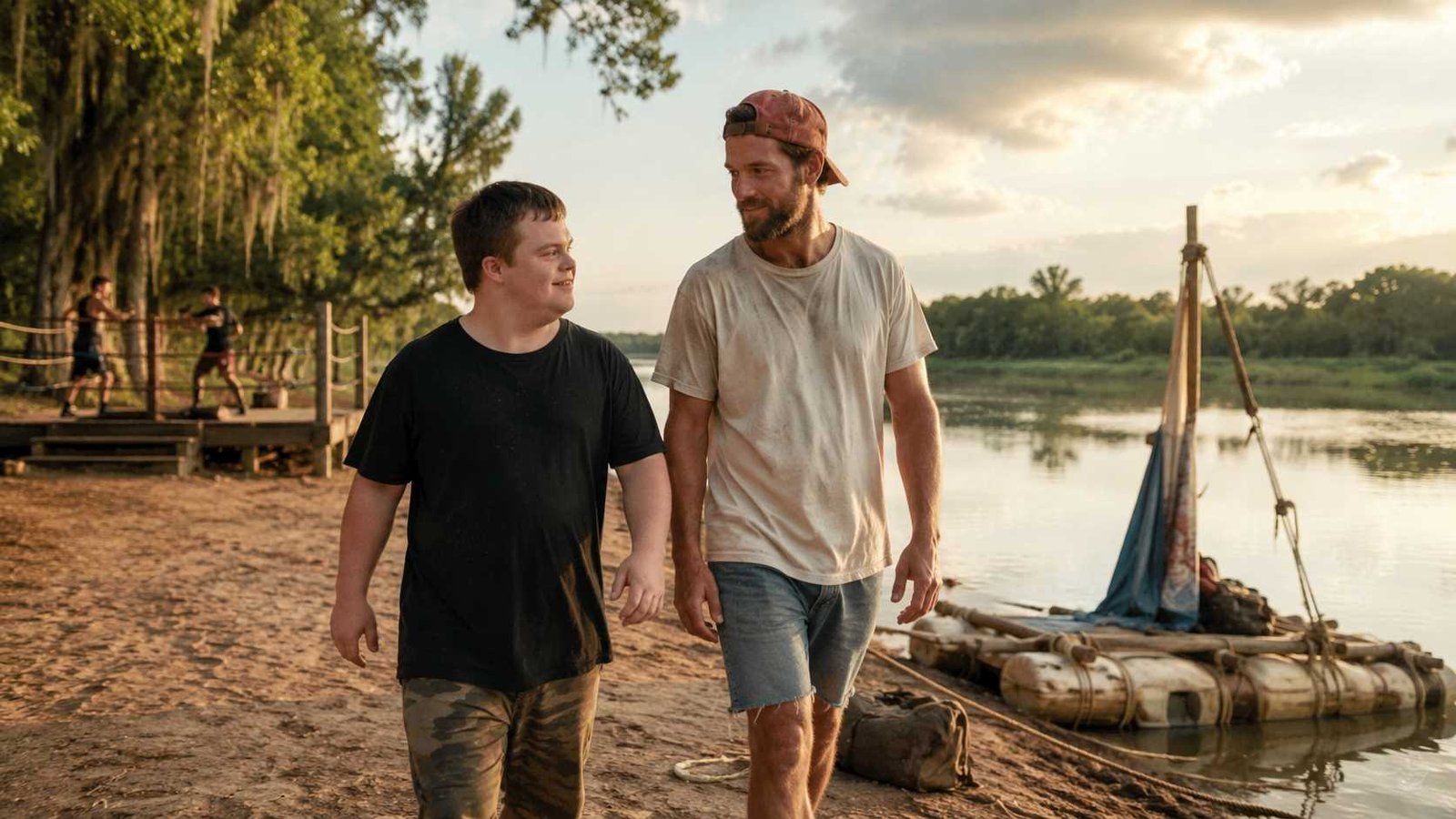
The movie feels unusually real. The friendship feels natural. Zack’s dream of becoming a wrestler never seems like a typical Hollywood plot device. Even the small jokes and quiet conversations feel as though somebody simply left a camera running while real people lived their lives.
So, is Peanut Butter Falcon a true story?
No. The Peanut Butter Falcon is not based on a specific true story. Directors and writers Tyler Nilson and Michael Schwartz created a fictional plot. However, the movie was built around the real personality, dreams, experiences, and abilities of actor Zack Gottsagen.
That distinction matters.
The adventure is fictional. The human being at its center is very real.
The Peanut Butter Falcon Is Fiction, but Zack Inspired Its Heart
The Peanut Butter Falcon follows Zak, a young man with Down syndrome who lives in a residential care facility but dreams of becoming a professional wrestler.
He escapes and begins traveling toward a wrestling school run by his hero, the Salt Water Redneck.
Along the way, he meets Tyler, played by Shia LaBeouf. Tyler is dealing with his own grief and trouble. What begins as an accidental meeting slowly turns into a friendship.
Dakota Johnson plays Eleanor, a caregiver searching for Zak.
It sounds like the kind of colorful road adventure that might have been taken from a strange newspaper story.
It was not.
When Tyler Nilson was directly asked whether the movie was based on a true story, his answer was straightforward: the story was completely made up.
But that is only half of the answer.
Nilson and Schwartz knew Zack Gottsagen before making the feature film. Gottsagen wanted to become a movie star, and the filmmakers decided to create a project in which he could genuinely be the lead rather than simply giving him a small supporting role.
That real ambition became the emotional starting point for the movie. Vanity Fair reported that the project grew from the filmmakers’ friendship with Gottsagen and their desire to help him pursue his acting dream.
So Zak’s exact journey is fictional.
Zack’s determination is not.
How Zack Gottsagen Helped Create the Movie
The origins of the film are almost as interesting as the movie itself.
Nilson and Schwartz were not established Hollywood directors when they began developing the project. They did not have major industry connections or an easy path to financing.
What they did have was Zack.
The filmmakers understood that some people in the industry might question whether Gottsagen could carry a feature film. Instead of accepting that assumption, they filmed a short proof-of-concept showing what he could do.
That helped demonstrate that Zack was not simply the inspiration for the movie. He could actually lead it.
Schwartz later explained that they wanted Zak to be a rounded character with frustration, happiness, dreams, sadness, humor, and independence rather than a stereotype.
That choice is one reason the movie feels different.
Zak is not treated as a lesson for the other characters.
He wants things.
He makes choices.
He gets angry.
He jokes.
He takes risks.
And he expects people to take his dreams seriously.
What Parts of The Peanut Butter Falcon Are Real?
There was no real-life journey matching the movie step for step.
There was no documented escape followed by the exact river adventure shown in the film. Tyler, Eleanor, the wrestling quest, and the events surrounding them belong to the screenplay.
But several elements have real roots.
Zack Really Wanted to Be an Actor
This may be the most important real-life connection.
Gottsagen genuinely wanted an acting career. The filmmakers’ friendship with him eventually became the starting point for creating a movie where he could have a substantial leading role.
In the film, Zak wants people to stop deciding what he cannot do.
Behind the film, Zack was also trying to prove what he could do.
That parallel gives the story much of its emotional power.
Zack’s Personality Shaped Zak
The fictional character is not a biography of Gottsagen.
Still, the filmmakers knew their lead actor personally. They wrote with his personality and strengths in mind rather than creating a generic character and asking him to fit into it.
That helps explain why some scenes feel so comfortable and spontaneous.
The movie was designed around the person playing its central role.
The Wrestling Dream Has a Real Personal Connection
Wrestling gives Zak a goal that is simple enough to understand immediately.
He does not merely want to escape a care facility. He is heading somewhere.
He wants training.
He wants a wrestling identity.
He wants to become the Peanut Butter Falcon.
The wrestling storyline itself belongs to the fictional adventure, but the filmmakers used Zack’s real hopes and interests when shaping a character who refuses to accept other people’s limits.
Are Zack Gottsagen and Shia LaBeouf Friends?
Yes, Zack Gottsagen and Shia LaBeouf developed a genuine friendship while making The Peanut Butter Falcon.
Their connection was not limited to pretending to be friends for the camera.
Vanity Fair’s account of the production describes the bond between Gottsagen and LaBeouf as an important part of the filmmaking experience. The production itself became unusually close and personal.
That relationship is easy to feel on screen.
Tyler initially behaves like someone who would rather travel alone. Zak refuses to disappear into the background, however. Little by little, their relationship moves away from protector and dependent.
They become partners.
That development works because the chemistry rarely feels forced.
There are teasing moments, arguments, physical jokes, and quiet exchanges that have the rhythm of real friendship.
And in several cases, that natural feeling was exactly what the filmmakers encouraged.
How Much of Peanut Butter Falcon Was Improvised?
You could easily watch the movie and assume large sections were improvised.
Surprisingly, most of it was not.
Director Michael Schwartz estimated that about 90 to 95 percent of the film remained on the page, meaning it followed the written screenplay.
The remaining unscripted moments made a big difference, though.
The filmmakers allowed Zack Gottsagen, Shia LaBeouf, Dakota Johnson, and the other actors room to add something when a scene naturally suggested it.
One famous example is Zak’s playful rule that the first rule is to party. Schwartz identified that moment as improvised. Small physical interactions between Zack and Shia were also created naturally while filming.
This explains why the movie can feel improvised even though most of the screenplay was carefully written.
It is less about actors inventing entire scenes and more about allowing human moments to survive.
The structure was planned.
The people inside it were given room to breathe.
Why Zack and Shia’s Chemistry Feels So Natural
There is a difference between good dialogue and believable friendship.
You can write two characters saying exactly the right things and still never believe that they care about one another.
The Peanut Butter Falcon avoids that problem.
Tyler does not instantly become Zak’s best friend.
At first, Zak is another complication in an already complicated life.
Their connection develops through traveling, eating, joking, fighting, learning, and simply spending time together.
Behind the camera, Gottsagen and LaBeouf were also forming a real bond. That reality appears to have strengthened what viewers see on screen.
The result is one of the movie’s biggest strengths.
You stop thinking about two actors performing a friendship.
You start believing in Tyler and Zak.
Did Dakota Johnson Like Working With Shia LaBeouf?
Yes. Dakota Johnson spoke very positively about working with Shia LaBeouf.
She later described him as possibly the greatest actor of her generation, while joking that she would not tell him that directly.
Her comments also suggest that the experience of making The Peanut Butter Falcon meant much more to her than another acting job.
Johnson has explained that she was going through a difficult personal period when the project came along. Looking back on the production, she recalled spending a great deal of time with Gottsagen, LaBeouf, and the directors and described the experience warmly.
Her bond with Zack appears to have been especially meaningful.
Johnson said Gottsagen became one of the great loves of her life and that knowing him changed her world.
That helps explain another quality the film gets right.
Eleanor’s relationship with Zak does not feel cold or clinical.
She cares about him, yet the story also challenges her tendency to protect him so much that she can accidentally limit his freedom.
The Movie Quietly Challenges the Way Disability Is Shown
One of the strongest parts of The Peanut Butter Falcon is what it does not do.
It does not turn Zak into a symbol of tragedy.
It also does not make him a perfect, endlessly cheerful character whose only purpose is to inspire everyone around him.
Schwartz has discussed wanting a more complete portrayal of a person with Down syndrome, including hopes, frustration, humor, sadness, and ambition.
That approach matters.
Zak can need help without being helpless.
He can make mistakes without being treated like a child.
He can be vulnerable while still wanting control over his own life.
The movie does not handle every complicated question about disability, independence, and care. No 97-minute adventure could.
But it places Zak’s wants at the center of the story.
That is a meaningful choice.
Was The Peanut Butter Falcon a Hit or a Flop?
For a small independent film, The Peanut Butter Falcon was a clear box-office success rather than a flop.
Box Office Mojo lists the film’s production budget at about $6.2 million.
Its worldwide theatrical gross reached approximately $23.7 million, including about $20.5 million from the domestic market.
That means the worldwide box office was almost four times the reported production budget.
This does not mean the producers simply pocketed the difference. Theaters keep part of ticket revenue, and marketing and distribution costs are separate considerations.
Still, the numbers show that audiences showed up for an independent film without the scale of a major studio blockbuster.
The movie also won an audience award at the South by Southwest festival before its theatrical release, helping build positive word of mouth.
Its success makes the story behind the production even more interesting.
The filmmakers originally struggled just to prove that the project could work.
Eventually, millions of dollars in ticket sales proved that audiences were willing to watch it.
Why The Peanut Butter Falcon Feels Like a True Story
This is where the movie plays a small trick on us.
Not a dishonest trick.
An emotional one.
Many films based on actual events become less believable because every moment has been polished into a dramatic Hollywood scene.
The Peanut Butter Falcon does something almost opposite.
Its story is invented, yet its relationships are loose, messy, affectionate, and sometimes awkward.
Characters talk over one another.
They make strange jokes.
They do not always express their feelings perfectly.
The landscapes look lived in rather than glamorous.
And the friendship at the center of the movie grew alongside a friendship between the actors themselves.
That creates authenticity without requiring the words based on a true story.
Is Zak From The Peanut Butter Falcon a Real Person?
Zak is a fictional character.
Zack Gottsagen is the real actor behind him.
The similar names sometimes cause confusion.
Gottsagen was not playing out a documented chapter from his own life. He did not literally live Zak’s full river journey.
Instead, the filmmakers wrote an original character specifically with Zack in mind.
This is a better way to understand the connection:
Zack Gottsagen inspired Zak, but Zack Gottsagen and Zak are not the same person.
Knowing that actually makes his performance more impressive.
He is acting, not simply reenacting his own life.
Did Zack Gottsagen Really Become an Actor?
Yes.
And that may be the best real ending to the story.
The entire project grew partly from Zack’s desire to work seriously as an actor.
Then The Peanut Butter Falcon placed him alongside established performers including Shia LaBeouf, Dakota Johnson, Bruce Dern, John Hawkes, and Thomas Haden Church. The film reached theaters and earned more than $23 million worldwide.
In other words, the fictional Zak spends the movie chasing a dream.
The real Zack was already achieving one by making the movie.
That is the part no screenwriter needed to invent.
Why the Answer Is Better Than a Simple Yes or No
So, is Peanut Butter Falcon a true story?
Not in the usual sense.
There was no real Zak who escaped a nursing facility, floated through the American South with Tyler, and fought his way toward the Salt Water Redneck’s wrestling school.
Tyler Nilson himself confirmed that the story was invented.
But calling the film completely disconnected from real life would miss what makes it special.
The movie grew out of Zack Gottsagen’s real dream of acting. His friendship with the filmmakers helped give the project life. His bond with Shia LaBeouf strengthened the friendship viewers see on screen. Dakota Johnson formed her own deep connection with him. And the directors left space for the actors’ personalities to enter the finished movie.
That is why The Peanut Butter Falcon feels true even when its adventure is fictional.
Sometimes a true story is about recreating exactly what happened.
This movie takes another route.
It invents the events, then fills them with something real: friendship, dignity, independence, grief, hope, and one man’s determination to be taken seriously.
And that real human story is ultimately what stays with you.

Jessica Savitch, with a deep passion for journalism, brings her expertise to istruestory.com as a dedicated author. MA in Arts & Journalism.