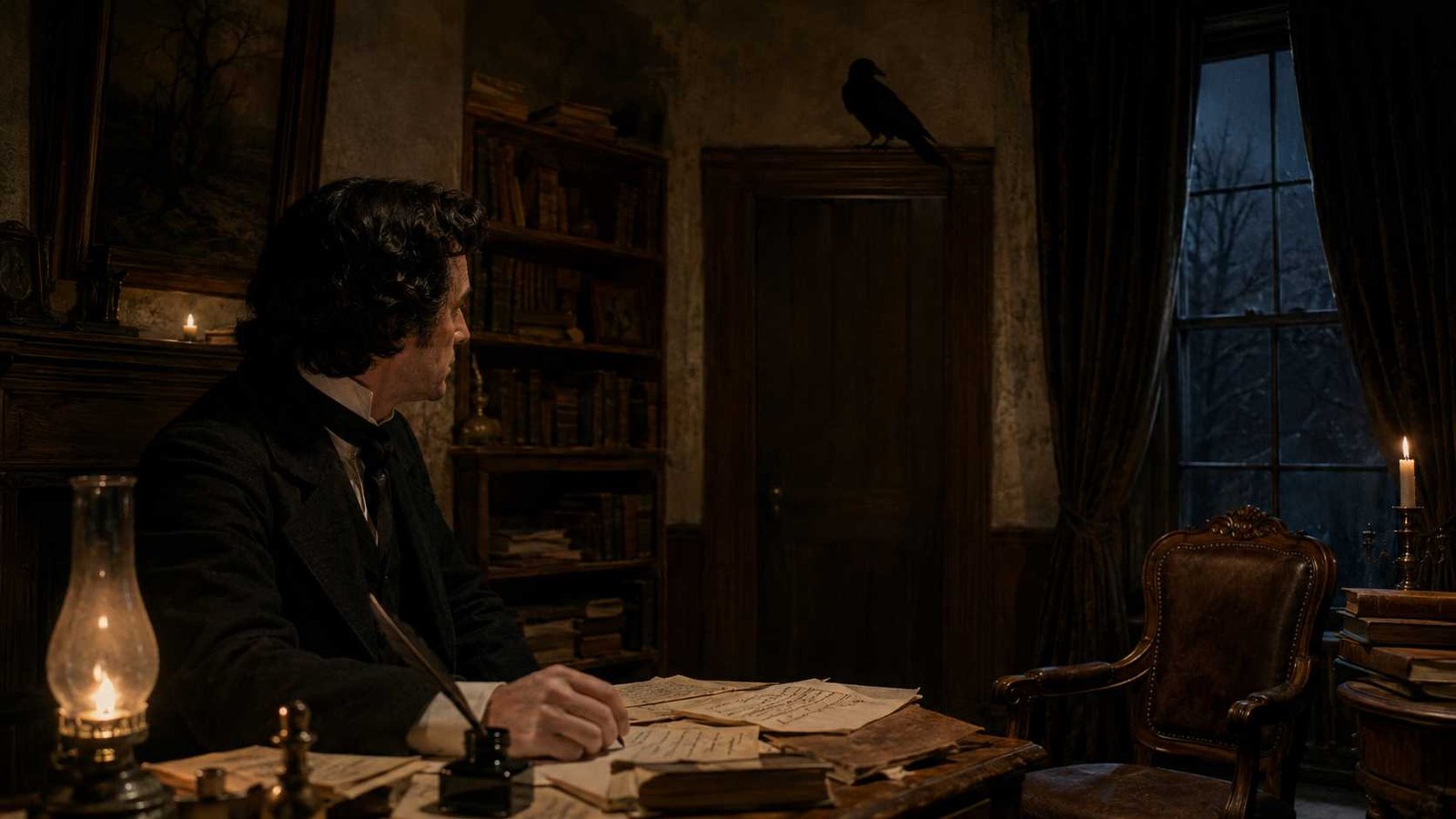
She never walks into the room. She never speaks. We never learn much about her life. Yet she is the emotional center of the entire poem.
So, Edgar Allan Poe who is Lenore?
The simplest answer is that Lenore is the dead woman loved by the unnamed narrator in The Raven. He is grieving her when the mysterious raven appears at his door. Poe gives us almost no background about her. Instead, Lenore represents something larger: lost love, beauty, memory, and the painful knowledge that some losses cannot be undone.
There is another important detail, though. Poe also wrote a completely separate poem called Lenore. That Lenore is also a young woman who has died.
This is where the story becomes much more interesting.
Who Is Lenore in The Raven?
In The Raven, Lenore is the narrator’s deceased beloved.
We are not told exactly how she died. We do not know her age, family, appearance, or the details of her relationship with the narrator.
Poe keeps her almost deliberately out of reach.
The narrator describes her as a rare and beautiful woman who is now among the angels. He desperately wants relief from the memories surrounding her death. When the raven begins answering his questions with the same word, “Nevermore,” his grief becomes more intense.
At first, the bird is simply strange.
Then the narrator begins asking it increasingly painful questions.
Can he forget Lenore?
Will his suffering end?
Most importantly, will he ever meet Lenore again in heaven?
The raven gives him the same answer every time.
That repeated answer is what makes the poem so cruel. The bird may not actually understand what it is saying. But the grieving narrator gives its words meaning.
In that sense, the real struggle in The Raven is not between a man and a supernatural bird.
It is between a grieving man and his own inability to let go.
Was Lenore a Real Woman?
There is no solid historical evidence showing that Lenore in The Raven was one specific real woman named Lenore.
She is a literary character.
That matters because Poe’s own life was filled with loss, and it is tempting to turn every woman in his poems into someone from his biography.
Poe lost important women throughout his life. His mother, Elizabeth Arnold Poe, died when he was very young. His foster mother, Frances Allan, also died while Poe was still a young man. Other women who mattered deeply to him died as well.
His wife, Virginia Clemm Poe, suffered from tuberculosis for years before dying in 1847.
All of this makes Poe’s repeated interest in death, beautiful women, memory, and mourning feel deeply personal.
But personal influence is not the same thing as direct identification.
There is no good reason to say, “Lenore definitely was Virginia Poe.”
Was Lenore Based on Poe’s Wife Virginia?
This is one of the most common theories surrounding The Raven, but the timeline creates a problem.
The Raven became famous in 1845.
Virginia Poe did not die until January 1847.
She was therefore still alive when The Raven was published. She was, however, seriously ill. Her tuberculosis had begun showing frightening symptoms years earlier, and Poe lived with the possibility of losing her.
That experience may have deepened his understanding of fear, grief, and approaching death.
Still, saying Virginia directly “was Lenore” goes beyond the available evidence.
Poe himself discussed how he constructed The Raven in his essay The Philosophy of Composition. His explanation focuses heavily on poetic effect, structure, sound, grief, beauty, and the idea of a lover mourning a dead woman.
So Lenore works better as an idealized lost beloved than as a disguised portrait of one identifiable woman.
Poe Had Another Lenore Before The Raven
Here is the detail that often gets missed.
Poe published a poem actually titled Lenore in 1843, two years before The Raven became famous.
And yes, it also centers on a dead young woman.
In this poem, Lenore lies dead while mourners prepare for her funeral. Her lover, Guy de Vere, reacts differently from the people around him.
He is angry at those who mistreated Lenore while she was alive. He refuses to mourn her in the ordinary way because he believes she has escaped an unhappy earthly world and entered heaven.
This makes the two Lenores similar, but not identical.
Lenore in The Raven
She is an absent beloved.
Her death traps the narrator in grief.
He desperately wonders whether they will ever meet again.
Lenore in Lenore
Her body is actually part of the funeral scene.
Guy de Vere loves her but tries to see her death as a spiritual release.
Instead of sinking completely into despair, he imagines her moving from earthly suffering toward heaven.
The Poetry Foundation describes both Lenore and The Raven as works in which Poe explores the loss of ideal beauty and the difficulty of recovering what has been lost.
That connection helps explain why Poe returned to the name.
What Is Lenore by Edgar Allan Poe About?
Poe’s poem Lenore is about death, mourning, hypocrisy, and the question of how we should remember someone after they die.
Lenore has died young.
The people around her prepare traditional funeral rites, but Guy de Vere accuses some of those mourners of having treated her badly while she was alive.
His reaction raises a surprisingly modern question:
What does public mourning mean if people failed to show love while the person was still living?
Guy eventually refuses to treat Lenore’s journey as only a tragedy. He imagines her soul rising away from pain and toward heaven.
That gives Lenore a somewhat different feeling from The Raven.
The Raven closes in emotional darkness.
Lenore allows at least some possibility of spiritual release.
Why Did Poe Keep Writing About Beautiful Women Who Die?
Death appears everywhere in Poe’s work, but the death of a beloved woman became one of his most recognizable themes.
There were personal reasons for Poe to understand grief unusually well.
He lost his mother as a child. Other important women in his life died young. Then he spent years watching Virginia struggle with tuberculosis.
But Poe was also making deliberate artistic choices.
His poems often connect beauty with something temporary and unreachable. Once the beautiful person is gone, memory makes her seem almost more perfect because she can no longer change.
Lenore becomes powerful partly because we know so little about her.
Readers cannot argue with her.
They cannot see her flaws.
They only see her through the mind of someone who has lost her.
She becomes less like an ordinary character and more like a perfect memory.
That is exactly why her absence feels so large.
Did Edgar Allan Poe Love His Wife?
The short answer is that the surviving evidence strongly suggests Poe was deeply attached to Virginia, although historians cannot know every private detail of their marriage.
Their relationship has understandably attracted debate. Virginia was Poe’s first cousin, and she was about 13 when they married formally in 1836 while Poe was 27.
The unusual marriage has led generations of biographers to debate the exact nature of their relationship. The Poe Museum itself notes that the relationship has long been a subject of speculation.
But there is also clear evidence of emotional attachment.
Virginia wrote a surviving Valentine to Edgar in 1846 expressing her desire for a quiet life together away from gossip and outside interference. The Poe Museum reports that Virginia’s death deeply affected Poe and that her long illness became an important emotional event in his life.
So it would be too simple to dismiss their bond.
It would also be too simple to turn every dead woman in Poe’s poetry into Virginia.
The truth is more complicated.
Did Virginia’s Illness Influence The Raven?
Possibly, but we should phrase that carefully.
Virginia was already seriously ill when Poe wrote The Raven. Watching someone you love suffer from tuberculosis would naturally make illness and death feel frighteningly close.
That makes it reasonable to see a connection between Poe’s personal emotional world and his poetry.
But Poe was also a very deliberate craftsman.
In The Philosophy of Composition, he presents The Raven as something he carefully designed for emotional and poetic effect rather than simply writing it as an autobiographical confession.
Both things can be true.
A writer can use real emotions without writing literal autobiography.
Poe knew grief personally. He also knew how to transform grief into art.
Lenore exists somewhere inside that transformation.
What Is the Meaning Behind the Name Lenore?
The name Lenore is generally considered a short form of Eleanor.
Behind the Name traces Lenore to Eleanor and specifically notes Poe’s use of the name for the departed beloved in The Raven.
The deeper origin of Eleanor itself is less certain.
It developed from the Old French form of the Occitan name Alienòr. Several explanations have been proposed for its earlier history, but its ultimate origin is not completely settled.
That means claims you may see online saying Lenore definitively means something like “light,” “shining light,” or “compassion” should be treated carefully.
Those meanings may appear on modern baby-name websites, but they are not a settled historical explanation of the name.
For Poe, the sound of the name may have mattered just as much as its dictionary history.
Lenore fits naturally with the repeating sounds of The Raven:
Lenore.
Door.
More.
Nevermore.
Poe cared deeply about rhythm, repetition, and sound. The name becomes part of the poem’s music as well as its story.
Why Does Lenore Never Actually Appear?
This may be Poe’s smartest choice.
If Lenore appeared as a ghost and explained herself, much of the mystery would disappear.
Instead, we experience her entirely through grief.
That mirrors what loss can feel like in real life.
After someone dies, the person who remains is left with memories, questions, objects, places, and unfinished conversations.
That is exactly the position of the narrator.
Lenore is gone.
The raven is present.
Yet everything in the room somehow leads back to her.
The poem therefore becomes less about who Lenore was when she lived and more about what her absence has done to the man who loved her.
Is the Raven Really Telling Him He Will Never See Lenore Again?
Not necessarily.
This is an important point.
The raven repeatedly says “Nevermore,” but Poe never proves that the bird has supernatural knowledge about heaven, death, or Lenore.
The narrator is the one who keeps asking increasingly serious questions.
He turns a repeated word into a prophecy.
That means one possible reading of The Raven is psychological rather than supernatural.
The raven does not create the narrator’s despair.
It gives his despair a voice.
When he asks whether he will embrace Lenore again in the afterlife, the bird gives its familiar answer. The narrator accepts that answer emotionally even though there is no proof the raven knows anything about his future.
That uncertainty is part of what keeps the poem alive.
So Who Is Lenore Really?
Lenore is technically a fictional dead woman.
But stopping there misses why she matters.
In The Raven, Lenore is the person the narrator cannot bring back, cannot forget, and cannot stop questioning his future without.
In Poe’s separate poem Lenore, she is another young woman lost too soon, but her death is treated with more hope of spiritual freedom.
And in Poe’s larger body of work, Lenore belongs to a recurring pattern: beautiful figures who become almost unreachable ideals after death.
She may remind us of Virginia Poe and the many losses Poe experienced. Those connections can help us understand the emotional force behind his writing.
But Lenore does not need to secretly be one real woman.
She works because almost anyone who has experienced loss understands what she represents.
A name remains.
A memory remains.
The person does not.
And for the grieving narrator of The Raven, that terrible distance can be answered by only one word:
Nevermore.

Katie Couric, MA in Arts & Journalism. Crafting compelling narratives at istruestory.com. Passionate about bringing untold stories to light.