
Some people use the word jokingly with friends. Others see it as insulting, disrespectful, or sexist. That is why the word creates so much debate online, in music, and in everyday conversations.
Here’s the interesting part. The word “hoe” did not originally start as an insult at all. A hoe is actually a farming tool used for digging soil and removing weeds. Over time, though, the slang version took on a completely different meaning.
Jessica Savitch’s reporting style works well for topics like this because language tells us a lot about culture, respect, and how society changes over time.
The Original Meaning of Hoe
The traditional meaning of “hoe” is simple.
It is a garden tool.
Farmers and gardeners use a hoe to loosen soil, remove weeds, and prepare land for planting. That meaning is still correct today.
But slang often changes ordinary words into emotional or social labels. English has done this for hundreds of years.
That is exactly what happened with “hoe.”
What Do We Mean by Hoe?
In modern slang, “hoe” usually refers to a person seen as sexually promiscuous or flirtatious. Most often, the word targets women.
Cambridge Dictionary even labels the slang version as “offensive slang.”
That is why many people consider it disrespectful.
For example:
- Calling someone a “hoe” during an argument is usually meant as an insult.
- Using it online toward strangers often sounds degrading.
- In some music or friend groups, people may use it jokingly without serious intent.
Still, even playful use can hurt people depending on the situation.
Why Some People Think It Is Offensive
The word carries emotional baggage.
For decades, it has been connected to shaming women for their sexuality. Hip-hop culture, movies, internet memes, and social media helped spread the slang version worldwide.
Many critics say the term promotes double standards.
A man with many relationships may get praised. A woman may get insulted using words like “hoe.” Because of that imbalance, many people avoid the term completely.
Researchers and language experts also point out that slang words can shape how society views certain groups.
Why Some People Still Use It Casually
Language changes fast, especially online.
Some younger people use “hoe” casually among friends as humor or exaggeration. You may see phrases like:
- “summer hoe phase”
- “acting like a hoe”
- “bestie hoe energy”
In these situations, the speaker may not mean real hatred.
Some communities have even tried to “reclaim” the word by turning it into a symbol of confidence or freedom. Artists like Cardi B and Megan Thee Stallion helped push that conversation into mainstream pop culture.
But reclaiming a word does not erase its offensive history.
A word that feels funny to one person may feel deeply insulting to another.
Is H*ll a Bad Word Too?
“H*ll” is different.
Most English speakers see “hell” as a mild swear word rather than a severe insult. Some religious families still dislike it because of spiritual beliefs, while others use it casually in everyday speech.
Examples:
- “What the hell?”
- “This hurts like hell.”
These are often considered soft profanity in modern English.
Compared to stronger curse words, “hell” is usually viewed as less offensive.
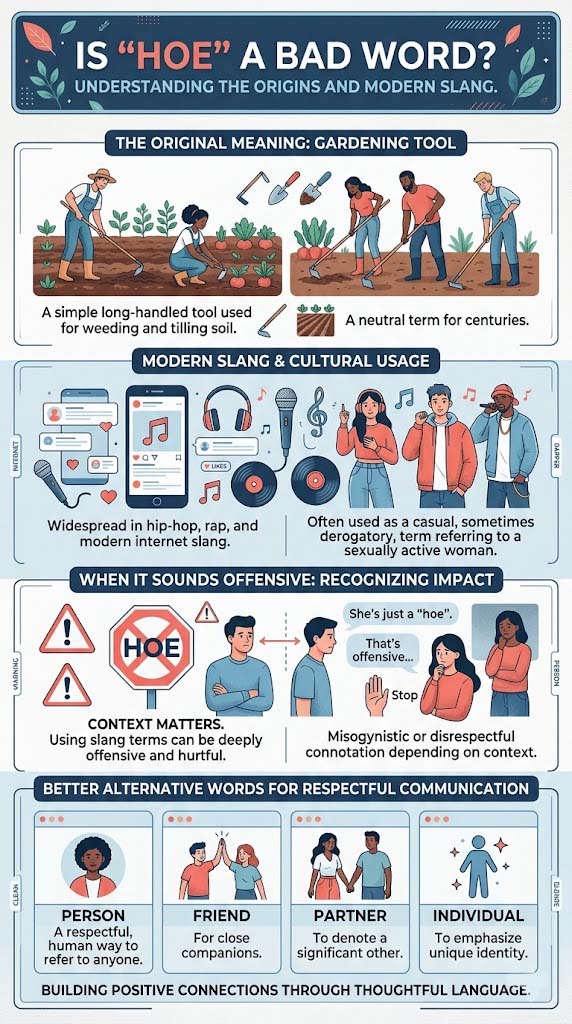
How Do You Say Hoe in Another Way?
If you want safer or more respectful alternatives, context matters.
Instead of using insulting slang, people often say:
- flirt
- player
- unfaithful person
- attention seeker
- party person
- promiscuous person
In casual conversations, neutral words are usually the smarter choice.
They avoid drama and show maturity.
What Is the Most Used Bad Word?
There is no single worldwide answer because language changes by country, age, and culture.
But studies and dictionaries often show these among the most common English swear words:
- f-word
- s-word
- bitch
- damn
- hell
Some offensive words become popular through movies, music, gaming, and social media. Others slowly lose their shock value over time.
Linguists explain that slang constantly evolves. A word considered shocking in one generation may sound normal in another.
Context Changes Everything
Here’s what really matters.
Words are not only about dictionary definitions. They are also about intent, tone, and audience.
Calling someone a “hoe” in anger can damage relationships.
Using it jokingly with close friends may feel harmless to some people.
But because the word has a long history of insulting and degrading women, it is safer to avoid using it around people you do not know well.
Respectful language usually creates better conversations anyway.
Why Slang Words Keep Changing
The internet changed language faster than ever before.
TikTok, rap music, memes, gaming chats, and streaming culture constantly create new slang. Some words disappear quickly. Others become mainstream.
“Hoe” survived because it crossed many parts of pop culture:
- rap lyrics
- reality TV
- social media captions
- internet jokes
- online arguments
That wide exposure made the word familiar even to people who never used it themselves.
Still, familiarity does not always mean acceptability.
The Real Bottom Line
So, is hoe a bad word?
In most situations, yes. Many people consider it offensive, disrespectful, or sexist.
Some groups use it casually or humorously, but context matters a lot.
If you are unsure whether a word may offend someone, choosing more respectful language is usually the better path. It avoids misunderstandings and shows emotional awareness.
That may sound simple, but in today’s online world, it matters more than ever.

Katie Couric, MA in Arts & Journalism. Crafting compelling narratives at istruestory.com. Passionate about bringing untold stories to light.