They rise, fall, hesitate, and begin again. There is no dramatic crash. No clear beat telling you where the music is going. Instead, Claude Debussy makes us feel as if we have opened our eyes in the middle of someone else’s dream.
That is exactly the world of Prelude to the Afternoon of the Faun.
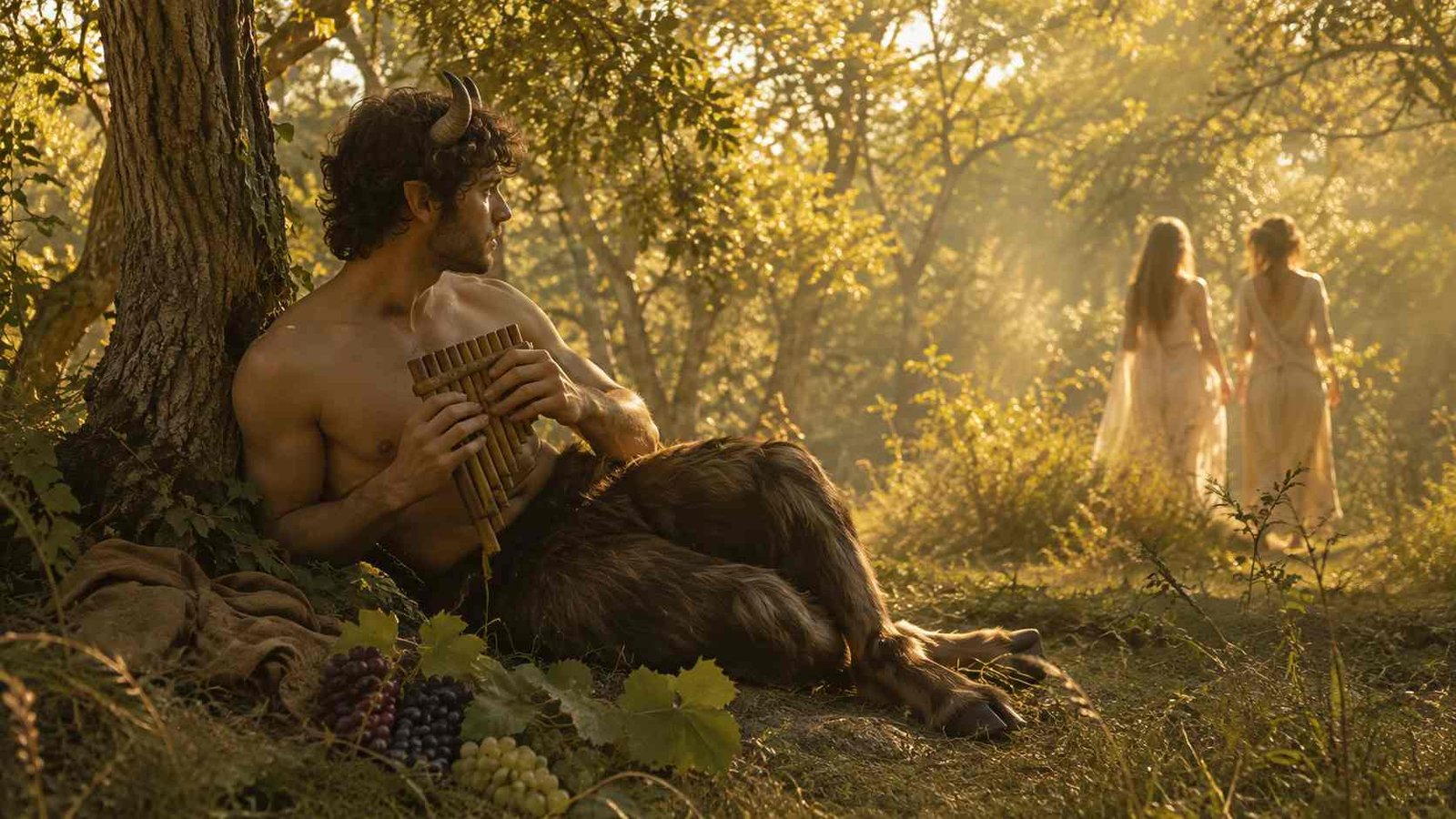
Debussy’s famous orchestral piece was inspired by L’Après-midi d’un faune, a poem by French Symbolist writer Stéphane Mallarmé. At the center of both works is a faun who spends a hot afternoon thinking about two nymphs. He cannot decide whether he really met them or simply dreamed about them.
That uncertainty is the heart of the story.
Debussy composed the work between 1892 and 1894. It lasts only about ten minutes, but its strange harmonies, floating rhythms, delicate orchestral colors, and unforgettable flute opening helped change the direction of modern music.
What Is Prelude to the Afternoon of the Faun About?
The simplest way to understand the piece is to picture a warm afternoon in an ancient Mediterranean landscape.
A faun wakes from sleep.
A faun is a mythological creature, usually shown as partly human and partly goat. In Mallarmé’s poem, this faun is alone in nature. As he wakes, he begins remembering two beautiful nymphs.
But there is a problem.
He does not know whether the encounter really happened.
Were the nymphs actually there?
Did he see them before falling asleep?
Was everything only a dream?
The poem never gives us a firm answer.
The faun keeps moving between memory, desire, imagination, and reality. As the afternoon becomes hotter, he grows sleepy again. Eventually, he gives himself back to sleep, where his desires can continue without the limits of the real world.
That may sound like a very small story.
It is.
But Mallarmé was less interested in telling us what happened than in exploring what it feels like when memory and imagination become impossible to separate.
Debussy understood that perfectly.
The Story Begins With Stéphane Mallarmé
Before there was Debussy’s music, there was Mallarmé’s poem.
Stéphane Mallarmé was one of the leading figures associated with French Symbolism. Instead of describing everything directly, Symbolist writers often preferred suggestion, atmosphere, images, and ideas that could have several meanings.
Mallarmé worked on L’Après-midi d’un faune over a long period. The poem appeared in book form in 1876, in an edition illustrated by artist Édouard Manet. A surviving copy is preserved by the Bibliothèque nationale de France.
The poem is written largely as the faun’s own thoughts.
That matters because we never get an outside narrator who can tell us what is true.
We are trapped inside the faun’s mind.
He remembers the nymphs. He questions himself. He reconstructs moments. Then doubt enters again.
It feels much like waking from an unusually vivid dream.
For a few seconds, you are certain it happened.
Then reality starts pushing back.
Details disappear. Faces become less clear. The dream still feels emotionally real even though you cannot prove any of it was real.
Mallarmé builds his poem around that feeling.
Was the Faun’s Encounter With the Nymphs Real?
There is no definite answer.
And that is not a weakness in the story. It is the point of the story.
The faun wants to believe in his encounter with the nymphs, yet he repeatedly questions his own memories.
Mallarmé creates a world where desire can shape what the faun thinks he remembers.
Perhaps he really encountered the nymphs.
Perhaps he dreamed about them.
Perhaps his mind has mixed a real event with fantasy.
The poem leaves all three possibilities open.
This also helps explain why Debussy’s music never behaves like a normal piece of storytelling music.
There is no obvious musical signal saying, “Now the nymphs appear.”
There is no clearly marked battle between dream and reality.
Instead, everything flows into everything else.
That was deliberate.
Debussy described his Prelude as a “very free interpretation” of Mallarmé’s poem. He explained that he was not trying to create a complete musical version of the poem. His music follows the faun’s desires, dreams, afternoon heat, pursuit of the nymphs, and eventual return to sleep.
In other words, Debussy gives us the faun’s state of mind rather than a literal soundtrack.
What Does “Afternoon of a Faun” Mean?
The title becomes much easier once you understand what a faun is.
In classical mythology, a faun is a nature spirit associated with woods, countryside, music, pleasure, and desire.
So The Afternoon of a Faun simply means an afternoon experienced by this mythological creature.
But Mallarmé turns that ordinary afternoon into something stranger.
The heat slows everything down.
Reality becomes hazy.
The faun remembers nymphs.
His thoughts wander.
He desires something he cannot fully possess or even prove existed.
Then he falls asleep again.
The “afternoon” therefore becomes more than a time of day. It creates the sleepy space between being awake and dreaming.
That same in-between feeling fills Debussy’s music.
What Is the Meaning of Prelude to the Afternoon of a Faun?
At its deepest level, Prelude to the Afternoon of the Faun is about desire, memory, imagination, and the uncertain border between dreams and reality.
The faun wants something that keeps escaping him.
He wants the nymphs.
He wants his memory of them to be true.
He wants to hold on to a beautiful experience.
Yet the harder he tries to understand it, the less certain it becomes.
There is something very human in that idea.
We all have memories that change with time. Sometimes we remember the feeling of an experience more clearly than the details.
We may even wonder whether a moment really happened exactly as we remember it.
Mallarmé takes that familiar experience and places it inside a mythological dream.
The result is sensual, but it is also philosophical.
Desire versus reality
The faun’s desires are vivid.
Reality is less cooperative.
The nymphs remain beyond his control, whether they were real or imagined.
This creates one of the poem’s central tensions: the world inside the mind can offer possibilities that the physical world cannot.
Memory versus imagination
The faun thinks he is remembering.
But memory slowly becomes fantasy.
The two are so closely mixed that neither he nor the reader can confidently separate them.
Art versus the thing being described
Mallarmé’s Symbolist approach often depends on suggestion rather than direct explanation.
That makes the faun’s disappearing nymphs interesting on another level.
A beautiful idea can feel clear in your mind, but the moment you try to capture it perfectly in words, music, or art, part of it seems to escape.
The faun cannot completely possess his dream.
An artist cannot completely possess an ideal image either.
That is one reason the poem can feel like a story about artistic creation as much as a story about desire.
How Debussy Turned a Poem Into Music
This is where Prelude to the Afternoon of the Faun becomes remarkable.
Debussy did not simply ask, “What happens in the poem?”
He seems to have asked a harder question:
What does this poem feel like?
His answer begins with a flute.
The opening melody moves in a way that makes the musical ground feel unstable. Instead of immediately establishing a strong key, rhythm, or direction, Debussy allows the flute to hover.
The Los Angeles Philharmonic notes that the opening melody uses chromatic movement and emphasizes the tritone, helping create the tonal uncertainty that defines the piece. Muted horns and harp quietly respond while strings add a soft, sleepy background.
You do not need to know music theory to hear the effect.
The music feels as if it is searching.
Then relaxing.
Then remembering something.
Then losing it again.
Exactly like the faun.
Why the Opening Flute Sounds So Important
That flute is not just a pretty introduction.
It is almost the faun’s voice.
Fauns have long been associated with pipes and woodland music, so giving the opening thought to the flute immediately connects Debussy’s orchestra with the mythological character.
But Debussy does something unusual with it.
The melody does not sound like a confident statement.
It sounds private.
Half-awake.
Almost improvised.
Behind it, the orchestra does not overpower the flute. Harps, horns, woodwinds, and strings create changing shades around it.
The original orchestration calls for three flutes, two oboes, English horn, two clarinets, two bassoons, four horns, two harps, small antique cymbals, and strings. There are no trumpets or trombones driving the music toward a heroic climax.
Color matters more than force.
That choice was a major part of what made the piece feel new.
A Ten-Minute Piece That Helped Change Music
Debussy began work on the Prelude in 1892 and completed it in 1894. The first performance took place at the Société Nationale de Musique in Paris on December 22, 1894, with Gustave Doret conducting.
The audience response was strong enough that the piece was repeated, although critical reaction was more divided.
Today it can be difficult to understand why the music sounded so new.
We have heard more than a century of film scores, jazz, modern classical music, ambient music, and experimental harmony since then.
Listeners in 1894 had not.
Debussy weakened some of the musical expectations audiences had learned to depend on. Instead of pushing steadily toward a destination, the music could simply exist in a moment.
Harmony became color.
Silence mattered.
An instrument could appear for only a few seconds and completely change the atmosphere.
Musical form could feel fluid rather than architectural.
The LA Phil describes the score as revolutionary for its fluid form and unusually important use of instrumental color. Later composer and conductor Pierre Boulez famously viewed Debussy’s faun as a decisive moment in modern music.
The revolution arrived quietly.
With a flute.
Is Prelude to the Afternoon of the Faun Impressionist Music?
You will often see Debussy described as an Impressionist composer.
The comparison makes sense in some ways.
Like Impressionist painters, Debussy often seems more interested in changing color, light, texture, and atmosphere than in creating hard outlines.
But the label needs care.
Debussy himself resisted being boxed into the term “Impressionism.” His artistic world also had strong connections with Symbolist poetry, including Mallarmé and the circle around him.
For this piece, Symbolism may actually be the more useful idea.
Mallarmé suggests rather than explains.
Debussy does the same.
Neither artist tells you exactly what to think.
They create an atmosphere and allow your imagination to complete it.
What Happens at the End?
There is no conventional dramatic ending.
The faun does not solve the mystery of the nymphs.
He does not suddenly discover whether his experience was real.
He simply moves back toward sleep.
Debussy’s music follows that emotional direction. The energy settles. Familiar material returns in a softer, more distant form. Harp, woodwinds, strings, and the delicate sound of antique cymbals help the music dissolve rather than stop with a grand statement.
That ending makes sense.
The faun cannot settle the argument between dream and reality.
So he returns to the one place where the argument does not matter.
His dreams.
Where Does Nijinsky’s Afternoon of a Faun Fit In?
This is where the history can become confusing.
Mallarmé’s poem, Debussy’s Prelude, and Nijinsky’s ballet are three related works, but they are not the same work.
Mallarmé’s poem came first in the nineteenth century.
Debussy then used the poem as inspiration for his orchestral Prelude, completed in 1894.
Almost two decades later, dancer and choreographer Vaslav Nijinsky created a ballet using Debussy’s music.
The Ballets Russes premiered Nijinsky’s L’Après-midi d’un faune in Paris on May 29, 1912. The production caused controversy because its stylized choreography and sexual imagery challenged expectations of ballet at the time.
The Metropolitan Museum of Art preserves photographs connected with that 1912 production. Its account describes Nijinsky’s ballet as being inspired by Mallarmé’s poem and set to Debussy’s score.
So when someone asks for “the story of Afternoon of a Faun,” it helps to ask which version they mean.
The poem is the source.
Debussy’s work is the musical interpretation.
Nijinsky’s ballet is a later dance interpretation.
Questions Readers Often Ask
What is the story of Prelude to the Afternoon of a Faun?
A faun wakes during a hot afternoon and remembers an encounter with two nymphs. He cannot tell whether the encounter actually happened or was part of a dream. His memories and desires mix together until he finally falls asleep again.
What is the meaning of Prelude to the Afternoon of a Faun?
The work explores desire, memory, imagination, sensuality, dreams, and reality. Debussy does not literally narrate Mallarmé’s poem. Instead, his music captures its uncertain, dreamlike atmosphere.
What does “afternoon of a faun” mean?
It refers to an afternoon experienced by a faun, a mythological nature spirit often represented as partly human and partly goat. Mallarmé uses the faun’s sleepy afternoon to explore desire and the uncertain line between imagination and reality.
What is the story of Afternoon of a Faun?
Mallarmé’s original poem follows a faun trying to understand his memories of two nymphs. Debussy turned the poem’s mood into an orchestral work in 1894. Nijinsky later used Debussy’s score for his own ballet in 1912.
Why the Faun Still Feels So Modern
More than a century later, Prelude to the Afternoon of the Faun still has the strange power to make time feel slower.
Perhaps that is because Debussy never tells us exactly what happened.
He leaves room for uncertainty.
The faun remembers.
He doubts.
He desires.
He dreams.
And somewhere between those things, reality becomes difficult to define.
Mallarmé found that feeling in poetry. Debussy found it in sound.
The famous flute opening does not announce a story so much as open a door. For the next ten minutes, we enter a world where memory can become fantasy, a warm afternoon can become a dream, and music does not need to explain everything to make us feel that something important has happened.
That mystery is not something Prelude to the Afternoon of the Faun asks us to solve.
It asks us to listen to it.

Katie Couric, MA in Arts & Journalism. Crafting compelling narratives at istruestory.com. Passionate about bringing untold stories to light.