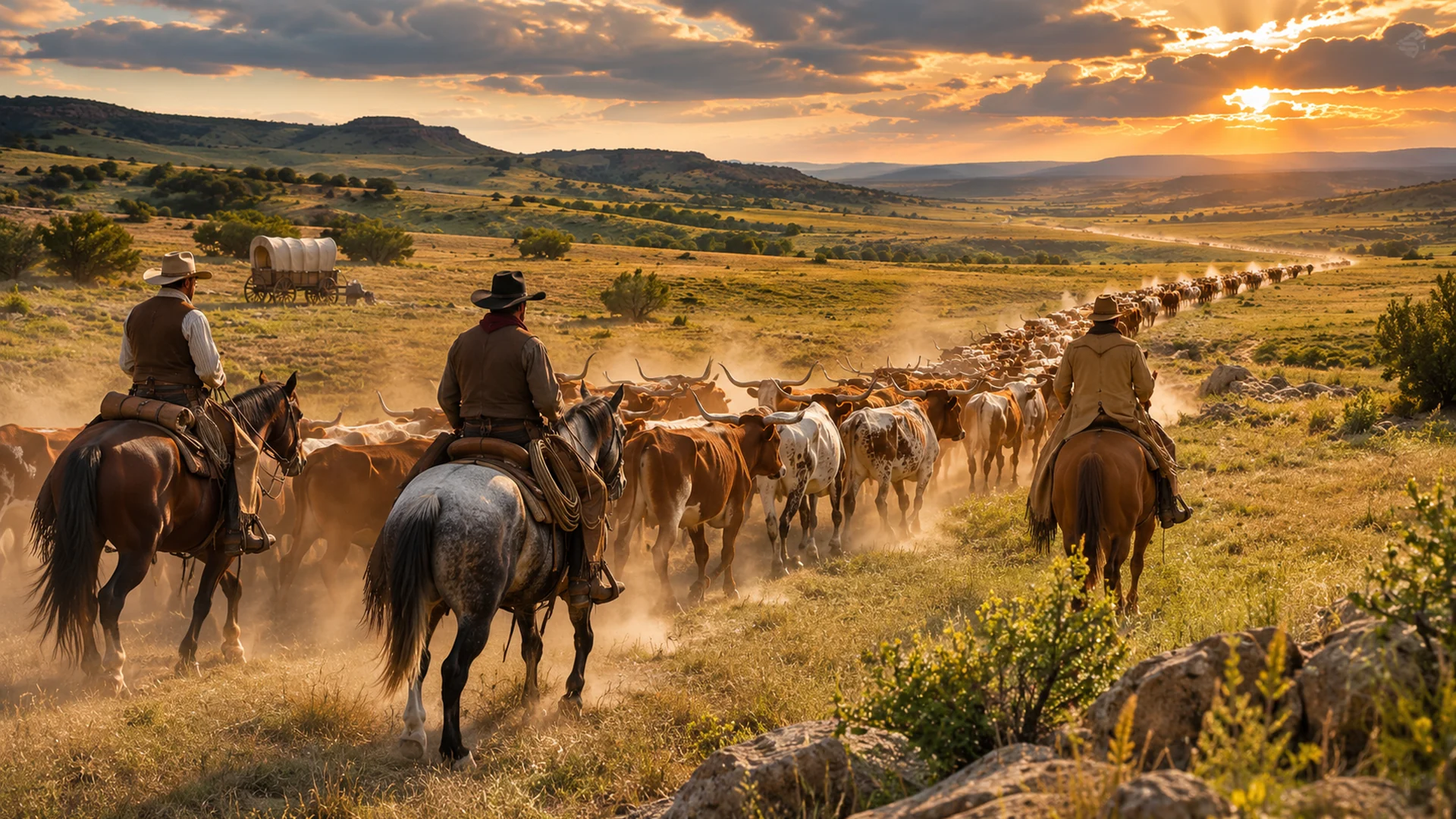
Two old Texas Rangers, a herd of cattle, and a dangerous journey north. Lonesome Dove feels so lived-in that it can seem like a record of the American West rather than a made-up adventure. But how much of that journey really happened?
No, Lonesome Dove is not a true story. Larry McMurtry’s 1985 novel, and the 1989 television miniseries based on it, tell a fictional tale. Yet the story draws on real 19th-century cattle drives, especially the lives and friendship of Texas cattlemen Charles Goodnight and Oliver Loving. Historical inspiration does not make every event real. The National Park Service describes the book as loosely inspired by the two men’s history.
Is Lonesome Dove Based on a True Story?
It is more accurate to call Lonesome Dove historical fiction inspired by true events. The work uses a real period of Western expansion as its setting, then invents people and dramatic scenes to explore friendship, ambition, regret, and loss.
The novelist did not set out to write a biography of Goodnight and Loving. As Texas Standard’s account of McMurtry’s views explains, he wanted the West to feel convincing while challenging the romantic image of cowboy life.
Think of the story as a fictional journey built from real frontier experience. It also shapes many historical fiction books based on true stories: the past supplies the world, but the writer decides what happens inside it.
What Is Lonesome Dove About?
At the heart of the story are Augustus “Gus” McCrae and Captain Woodrow F. Call, two former Texas Rangers who run a small cattle operation near the Texas-Mexico border. Gus is talkative, funny, and fond of life’s pleasures. Call is reserved, disciplined, and driven by work. They know each other better than almost anyone, yet they often see life in opposite ways.
When their old friend Jake Spoon arrives with stories about the open range in Montana, Call becomes determined to drive a herd north and start a ranch. Gus goes along, though he questions what any of them will gain. Their crew faces dangerous crossings, outlaws, and grief. The story also follows people caught up in the journey, including Lorena Wood, Newt Dobbs, and scout Joshua Deets.
The publisher’s description confirms the central journey from Texas to Montana. What makes it memorable is the travelers’ personal lives. The cattle drive moves the plot; the relationships give it weight.
The Real Cowboys Who Inspired Lonesome Dove
Charles Goodnight and Oliver Loving
There really were two cattlemen whose partnership resembles Gus and Call’s. Charles Goodnight and Oliver Loving joined forces after the American Civil War, when Texas ranchers needed markets for large herds of cattle. In 1866, they drove cattle toward Fort Sumner in New Mexico and farther north. Their route became known as the Goodnight-Loving Trail.
According to the Texas State Historical Association’s account of Loving, the partners’ cattle business took them through demanding country along the Pecos River. Their route differed from McMurtry’s novel. The real trail ran toward New Mexico and Colorado; Hat Creek aims for Montana.
In 1867, Loving was badly wounded while traveling ahead of a herd. He reached Fort Sumner but died there from gangrene. Goodnight promised to honor Loving’s wish to be buried back in Texas. Loving was eventually laid to rest in Weatherford in 1868. That promise and the return of the body offer one of the story’s clearest links between fact and fiction.
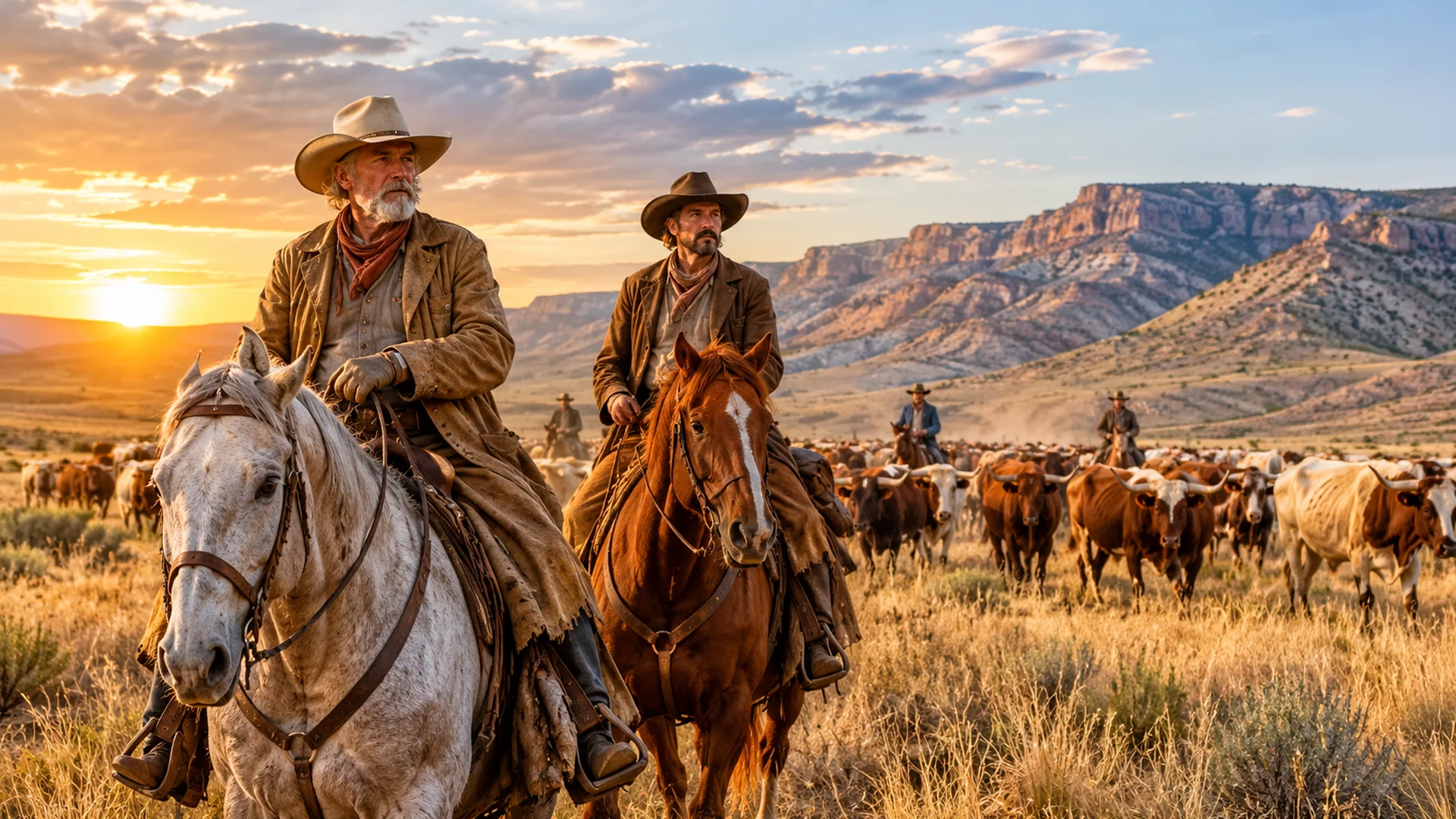
In the novel, Gus’s fate and Call’s determination to take him home echo this real episode, although the fictional events, distances, and final resting place differ. Texas Highways identifies Loving as a key inspiration for Gus and Goodnight as an inspiration for Call.
Was Captain Woodrow Call a Real Person?
No. Woodrow F. Call is a fictional character. His stern manner, cattle-ranching ambition, and Ranger background share qualities with Charles Goodnight, but Call is not a renamed version of him. Loving influenced Gus, but Gus is not his biography.
There is another revealing comparison. McMurtry described Gus and Call in terms of the contrasting temperaments of Don Quixote and Sancho Panza, the famous literary companions, according to Texas Standard. Their conversations matter as much as their adventures. One dreams and jokes; the other plans and presses ahead.
Not every supporting character came entirely from imagination, either. Joshua Deets was partly inspired by Bose Ikard, a Black cowboy who worked with Goodnight. An epitaph that Goodnight wrote for Ikard helped shape a memorial scene in the novel. The historical comparison in Texas Highways describes that link. Deets’s fictional death, however, is not how Ikard died.
How Historically Accurate Is Lonesome Dove?
Its atmosphere is rooted in history, but its plot is not a historical record. Long cattle drives were real, and so were the exhaustion, isolation, risk, and business pressures that came with them. The story captures why people could spend months moving cattle over great distances. It exposes the hard work behind cowboy myths.
Real cattle drives versus fictional events
The biggest difference is the route. The historic Goodnight-Loving partnership took cattle toward New Mexico and Colorado beginning in 1866. Gus and Call’s company, by contrast, tries to establish a new cattle operation in Montana. They do not represent a single documented expedition.
Other details blend fact with invention. Lonesome Dove, the border town where the story begins, is fictional. But Texas Highways reports that McMurtry took the novel’s name from Lonesome Dove Baptist Church in present-day Southlake, Texas. The church is real, even though the novel’s town is not.
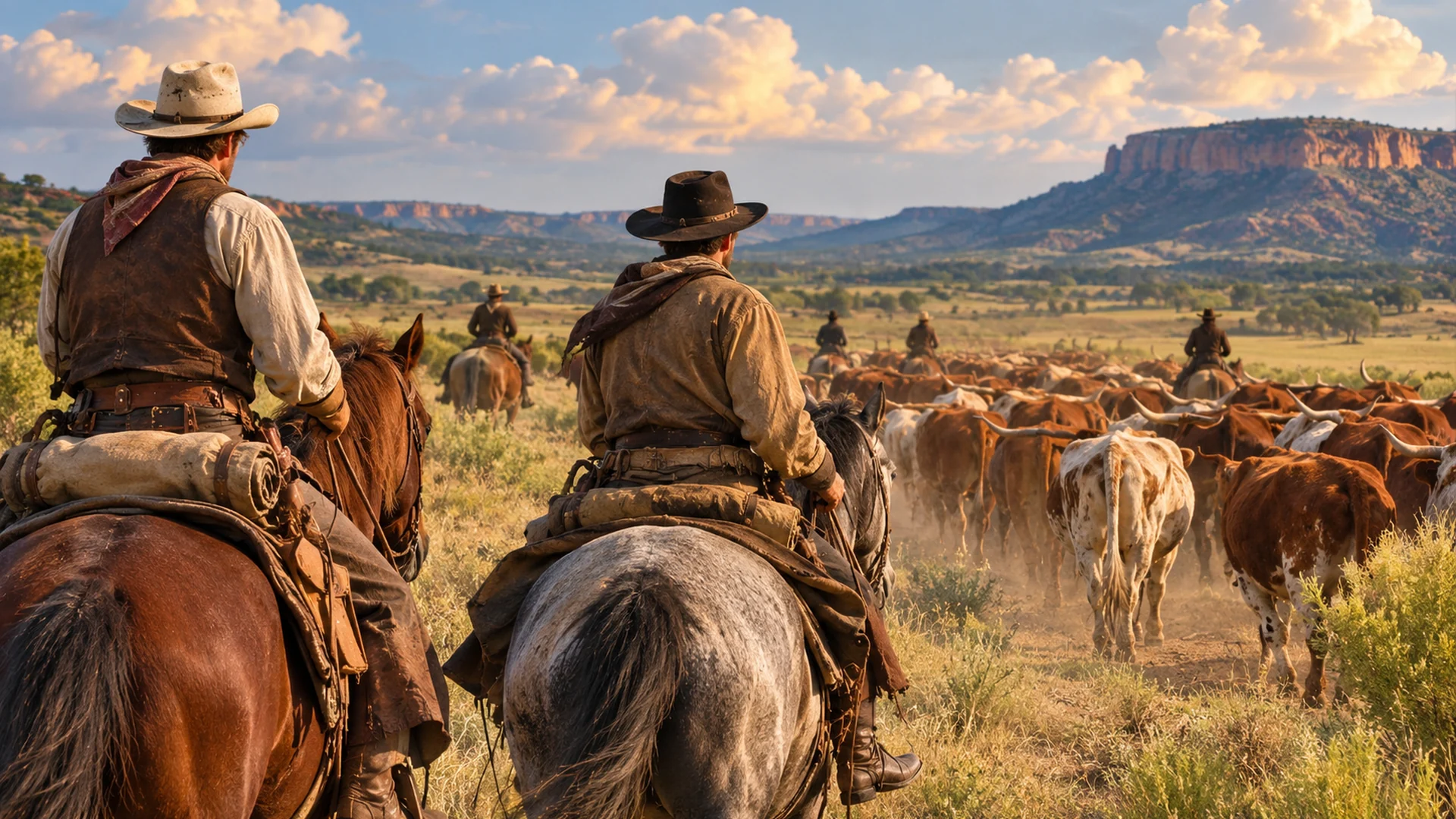
The wider frontier world also needs context. Cattle routes crossed lands with long Indigenous histories. Westerns often view those lands mainly through the eyes of settlers and cowboys. McMurtry did show violence and moral failure in that world, but readers should not treat every depiction of Native people or conflict as an objective account of what happened.
For a useful comparison, our look at the real history behind News of the World examines another Western tale set against genuine historical change. Both stories feel believable because their settings are grounded, not because every dramatic scene has a real-life match.
There is no single percentage of accuracy for Lonesome Dove. A better test is to separate the ingredients: the cattle-drive era is real, several inspirations are documented, and the main storyline is invented. That’s also a useful habit with historical dramas about actual feuds, such as the Hatfields and McCoys true story.
Why Is Lonesome Dove So Famous?
First, the characters are difficult to forget. Gus can be wise and foolish in the same conversation. Call can be brave, loyal, and emotionally distant all at once. Their friendship feels imperfect rather than polished, and the supporting cast gives the trip consequences beyond whether the herd reaches Montana.
Second, the story balances two kinds of Western: a broad adventure and a close study of human choices. There are rivers to cross, cattle to move, and miles to survive. But there are also questions about aging, missed chances, love, and what makes a life worthwhile. That balance appeals beyond Western fans.
The awards help explain its standing, too. Larry McMurtry’s novel won the 1986 Pulitzer Prize for Fiction. The 1989 CBS television adaptation starred Robert Duvall as Gus and Tommy Lee Jones as Call. It earned 18 Emmy nominations and six wins, including directing and cinematography recognition.
Its popularity does not depend on perfect historical detail. It lasts because viewers feel as if they know the people making that impossible-looking journey. That is a rare achievement for a story with such a sweeping setting.
What Was the Famous Line From Lonesome Dove?
There is no official single “most famous” line, but Gus has several widely remembered remarks. One short line from the 1989 miniseries sums up the story’s deeper concern: “It’s not dying I’m talking about, it’s living.” It is listed among Gus McCrae’s lines in the miniseries’ quote record.
Why does that line stay with people? Because the story repeatedly asks the same question without giving an easy answer. Call measures life through duty and accomplishment. Gus notices small pleasures and personal bonds. Neither man gets everything right. By the end, their arguments about how to live matter at least as much as the cattle drive.
Is Lonesome Dove LGBTQ?
Lonesome Dove is not primarily an LGBTQ romance. The novel and 1989 miniseries center on a close male friendship, heterosexual relationships, and the pressures of frontier life. Gus and Call are not presented as an explicitly romantic couple in the main story.
That does not make an LGBTQ reading impossible. Readers can interpret the depth of their bond, their emotional dependence, or the way they struggle to express affection through a queer lens. Such a reading is an interpretation of the characters, not proof that the plot secretly confirms a relationship.
The story has room for different reactions because it treats loyalty, love, and loneliness seriously. Those feelings cross many kinds of relationships. Distinguish what the text shows from audience interpretation.
The real story behind Lonesome Dove is therefore a combination, not a contradiction: Goodnight and Loving were real, the cattle-drive era was real, and some events echo documented history. Gus, Call, and their particular Montana adventure belong to fiction. If you enjoy exploring that boundary, our investigation of West with Giraffes offers another example of a novel that draws emotion from a true historical background.

I am Jeremy Jahns – Your Cinematic Explorer
Immerse in movie reviews, Hollywood insights, and behind-the-scenes stories.