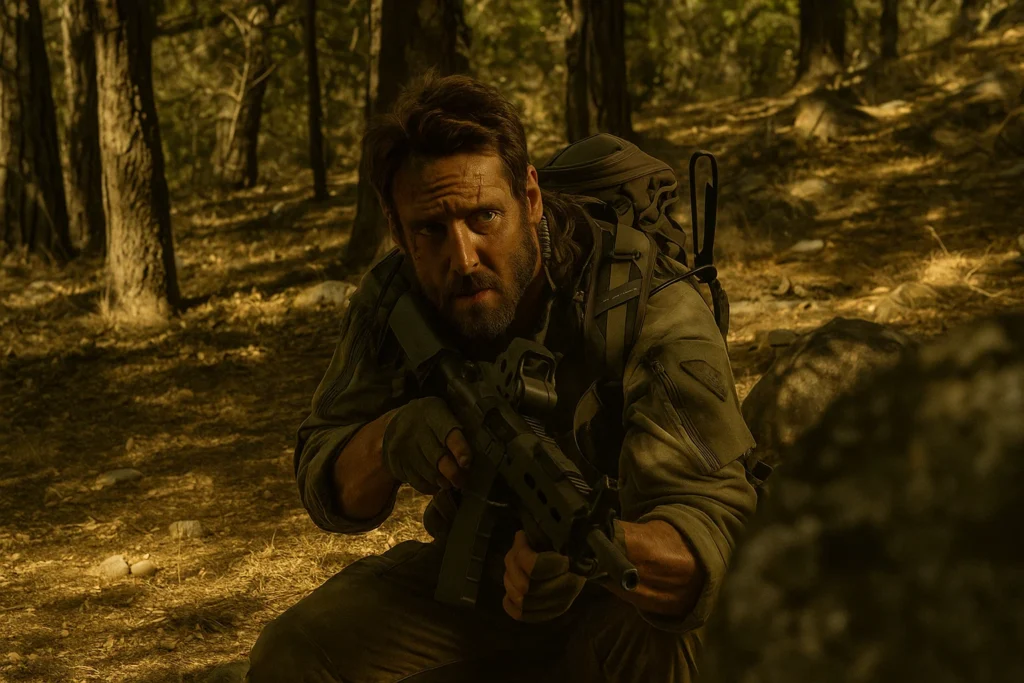
The question that naturally rises is simple:
Is Warhorse One a true story?
Here’s what matters.
A Story Rooted in the Feelings of War, Not the Facts
Let’s start with the bottom line.
Warhorse One is not a true story.
It’s not a reenactment of a real mission. There is no official report describing the exact helicopter crash, the exact rescue, or the exact people portrayed in the film. But that doesn’t mean the story came out of nowhere.
In an interview, writer-director-actor Johnny Strong explained that the film grows out of the real emotional terrain of military life the trauma, the moral weight, the sense of purpose, and the cost carried long after the battlefield fades. His intention wasn’t to document a single soldier’s journey; it was to capture the truth of what war does to the human spirit.
That’s why the movie feels personal even without being based on a specific true event.
The Spark Behind the Story
Strong has talked about keeping things simple as a storyteller trusting instinct, leaning on lived emotional knowledge, and focusing on the “why” instead of the spectacle. He wanted to make a film that honors the unseen corners of military service.
The heart of the film revolves around a SEAL named Master Chief Richard Mirko and a child named Zoe. The relationship between them isn’t based on a documented case, but it mirrors real wartime rescues where soldiers took responsibility for civilians especially children caught in the chaos of conflict. Those real patterns helped shape the emotional backbone of the story.
So while Mirko himself is fictional, the world he moves through echoes pieces of reality from Afghanistan warzones.
Does Zoe Survive in Warhorse One?
This is one of the most frequently asked questions, and it tells you something about how strongly the film builds emotional stakes.
Yes Zoe survives.
Her survival is essential to the film’s message. She represents innocence, hope, and the future that soldiers often fight to protect. Mirko’s entire journey becomes a symbol of the lengths someone will go to protect a life worth saving. The movie doesn’t exist to show military triumph; it exists to show human connection in a place where it shouldn’t be possible.
How Historically Accurate Is Warhorse One?
Accuracy in this movie sits somewhere in the middle.
Here’s the honest breakdown:
What Feels Real
- The terrain, gear, and military operations reflect real Afghanistan combat zones.
- The emotional behaviors of soldiers hyperawareness, trauma responses, moral conflict are drawn from lived accounts.
- The presence of children in war-torn regions is painfully accurate.
What’s Fictionalized
- The exact mission never happened.
- The characters are original creations.
- Several tactical sequences are dramatized for film pacing rather than strict realism.
It’s historically inspired rather than historically bound.
What Inspired the Filmmakers
Johnny Strong’s body of work has always leaned toward gritty realism, but this time he focused more on the inner life of a soldier. His approach, as he said, was to strip away noise and trust the emotional truth above everything else.
He isn’t just the director he’s the actor performing the weight of the role. That dual responsibility shaped the film into something more grounded and human. The goal wasn’t to showcase war; it was to show what war takes from a person and what they cling to in order to survive it.
But What About the Confusion With War Horse?
Search engines mix these two films constantly, so let’s sort that out quickly.
War Horse (2011) is based on a novel set during World War I, and that novel was inspired by real wartime experiences though the specific horse, Joey, never existed exactly as portrayed.
Warhorse One (2023) is something different:
a fictional story wrapped in the emotional truth of modern warfare.
They share a similar name, but not a similar origin.
Why Stories Like This Matter
Even fictional war films leave an imprint. They remind us that behind every operation report, every news headline, every statistic, there are real people trying to survive the day. Strong wanted the film to feel like a window into that reality not perfect, not polished, but human.
Whether it’s Mirko fighting to protect Zoe or Zoe fighting simply to stay alive, Warhorse One carries a real emotional truth even without being based on a single documented event.
Character Deep-Dive Understanding the Heart of the Film
Master Chief Richard Mirko
Mirko is the spine of the film. Everything passes through him fear, duty, exhaustion, and the instinct to protect.
Here’s what defines him:
A man carrying old pain
He doesn’t speak much, but his silence says enough. You see it in the hesitations, the glances, and the way he keeps scanning the horizon. This is someone who has lived through far more than he ever talks about.
Driven by purpose rather than orders
He stays alive because he has something to do, someone to protect. Once he finds Zoe, the mission becomes personal. Not political. Not strategic. Human.
Made believable by restraint
Johnny Strong plays Mirko without theatrics. There’s no “movie hero” swagger. Just a tired man trying to do what’s right. That grounded portrayal is why the character feels like he could be based on someone real even though he isn’t.
His choices anchor the emotional truth
Every decision Mirko makes echoes real accounts from veterans moments where instinct and moral responsibility outweigh fear.
This is where fiction meets truth.
Zoe
Zoe is the emotional center.
She gives the story its stakes
Without her, the film becomes a lone-survivor tale. With her, it becomes a promise:
You protect the innocent because someone must.
She represents every child caught in war
Her fear isn’t dramatized. It’s quiet, confused, and real. That grounded performance makes the story hit harder.
She changes Mirko
Zoe is his reason to keep moving. And she allows the film to explore one of war’s unspoken realities:
Sometimes the smallest life forces the biggest actions.
The Opposition (Militants)
They’re not fleshed out as individuals, and that’s intentional. The film doesn’t try to explain their motives or give them political depth. They serve as forces of danger another part of the hostile landscape Mirko and Zoe must move through.
It keeps the focus narrowly on survival and human connection.
Behind-the-Scenes Notes What Shaped the Final Film
Johnny Strong Wore Multiple Hats
Actor. Writer. Director. Composer.
That alone explains the film’s unified tone. Strong shaped the movie’s emotional heartbeat, physical tension, and visual world. There’s no disconnect between his performance and the directing because they came from the same creative mind.
“Keep it simple” was the core filmmaking principle
In his interview, Strong repeats a specific belief:
Simplify the story. Trust the process.
This explains why:
- the plot is straightforward
- the emotional beats linger
- the action scenes aren’t flashy
- the pacing feels patient and thoughtful
He wasn’t trying to impress; he was trying to connect.
Authenticity Over Spectacle
Instead of massive explosions or military choreography, Strong favored:
- natural terrain
- real physical movement
- grounded cinematography
The film feels “raw” by design. Shadows, dust, weather, silence they all do part of the storytelling.
A Score That Reflects Internal Conflict
Strong also composed the music. That matters because the score isn’t dramatic. It’s moody, subdued, and shaped around Mirko’s heartbeat quiet tension rather than loud emotion.
A Story Shaped Around Two Performances
At its core, the film is a two-person emotional journey. Many scenes rely on body language, breath, eye contact, and the space between them. This keeps the story intimate and human.
A Tribute Without Calling It One
Even though the movie isn’t a true story, it quietly honors real soldiers, real civilians, and real moments of compassion that happened in Afghanistan and similar warzones. The film doesn’t announce this it just lets the feeling settle in.
FAQs:
Is Warhorse One based on a true story?
No. The film is not a direct retelling of a real mission. Instead, it’s a fictional story shaped by the emotional realities of war loss, trauma, and the protective instinct soldiers often feel toward civilians caught in conflict.
What inspired Warhorse One?
Filmmaker Johnny Strong explained that the movie grew from his desire to portray the human truth of war rather than document a specific event. He focused on simplicity, instinct, emotional honesty, and the weight soldiers carry long after combat.
Is the film connected to the Steven Spielberg movie War Horse?
No. The titles sound similar, but they are unrelated. Spielberg’s War Horse is based on a World War I novel. Warhorse One is a modern fictional survival drama about a Navy SEAL in Afghanistan.
Does Zoe survive in Warhorse One?
Yes. Her survival is central to the story’s emotional arc. She symbolizes innocence and hope two things the main character, Mirko, fights to protect.
How accurate is the military portrayal?
It’s a blend. The environments, weapons, and tension reflect real Afghanistan operations. But the mission, the crash, and the exact encounters are fictionalized for storytelling.
Is Richard Mirko based on a real Navy SEAL?
There is no documented SEAL named Richard Mirko connected to this type of mission. He is a fictional character designed to represent the internal struggles and moral weight many real soldiers have described.
Where was Warhorse One filmed?
The film used rugged outdoor landscapes that resemble the mountainous terrain of Afghanistan, with a focus on natural lighting and realistic movement.
Why is the film so focused on emotion instead of action?
Johnny Strong intentionally shifted away from the typical “loud” war-film formula. He wanted to highlight connection, trauma, and humanity especially through Mirko and Zoe’s bond.
I am Jeremy Jahns – Your Cinematic Explorer
Immerse in movie reviews, Hollywood insights, and behind-the-scenes stories.