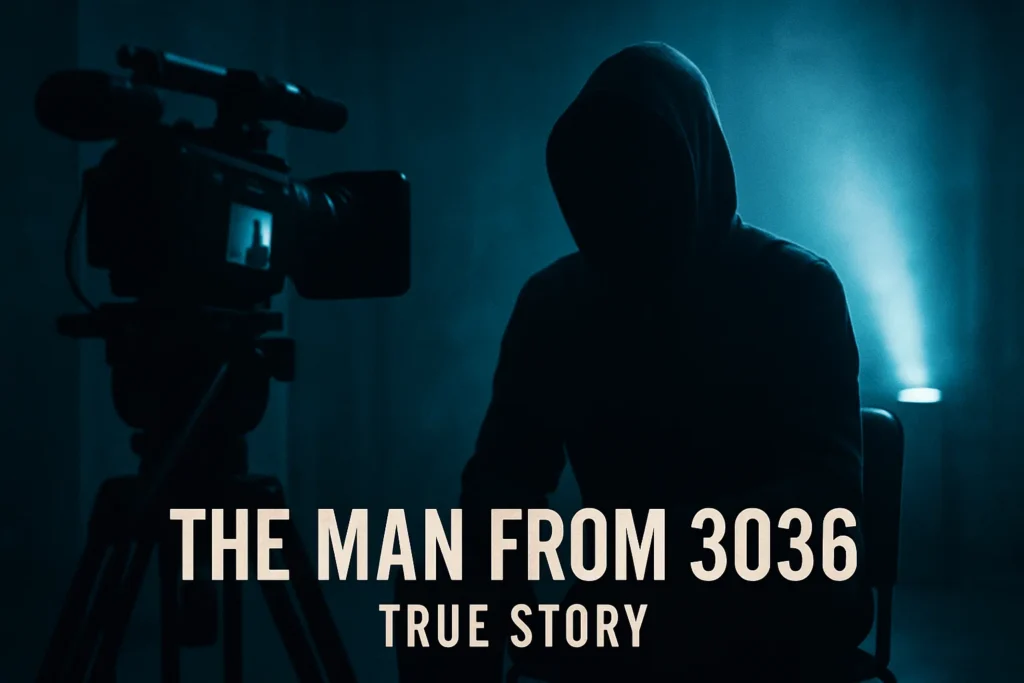
Here’s what matters. To understand whether The Man From 3036 is a true story, you have to look at the film itself, the people who made it, and the claims surrounding it. You also have to separate the emotional pull of the documentary style from the facts behind it. This article walks through what we actually know, what viewers believe, and what the filmmakers intended.
The Film at the Center of the Mystery
The documentary-style movie first appeared on platforms like Tubi under the title Confessions of a Time Traveler: The Man From 3036. Its IMDb listing confirms the basics: the film presents a man who claims he traveled from the year 3036 and sits down for a tense interview to “warn” humanity of future events.
It’s filmed as if a crew stumbled into something dangerous. There’s dim lighting, a slightly anxious atmosphere, and an interviewer who treats the subject with a mix of suspicion and curiosity. The way it’s shot is no accident. Movies that mimic investigative reporting often feel real because they borrow the visual language of journalism still frames, quiet pauses, handheld shots. That’s where the emotional hook begins.
This is why the film spread quickly. To an untrained eye, it looks like someone uploaded something they weren’t supposed to.
So, Is It Actually a True Story?
Here’s the bottom line. No confirmed evidence, documentation, or scientific record supports the existence of a real “man from 3036.” Every detail points to a scripted production created for entertainment, not a real interview.
The film itself is categorized under sci-fi and mockumentary-style content. Its structure controlled lighting, rehearsed dialogue, planned camera angles fits filmmaking, not investigative reporting. The actor portraying the alleged time traveler is performing a role, not giving a sworn testimony. The production credits listed on IMDb also reveal actors, a director, and the usual filmmaking team, which signals that the project was created like any other fictional feature.
The story feels real because it plays with documentary conventions. But the facts don’t support it being true.
That said, the idea caught fire because people love the question more than the answer. What if it were real? That curiosity is part of why these films thrive.
Did the Documentary Predict Real Events?
Many viewers claimed the film hinted at future disasters. Some said the “warnings” were surprisingly similar to later global events. But this pattern shows up in almost every time-travel story ever written. When you speak in broad strokes war, climate challenges, political unrest you will always find something in the news that matches.
This isn’t prophecy. It’s psychology.
People connect dots because they want patterns, especially when the story is built around mystery. That’s the same reason films about the Bermuda Triangle, alien encounters, or lost civilizations continue to circulate. The stories feel real enough to invite what-if speculation, even when the evidence doesn’t support it.
Who Played Sebastian in The Man From 3036?
The question pops up often because people assume “Sebastian” is a real individual connected to a hidden event. According to IMDb listings for Confessions of a Time Traveler, the characters are actors performing scripted roles. The film does not present verified identities, and no publicly available data confirms a real Sebastian connected to a time-travel case.
This again supports what the evidence already indicates it’s a performed story.
Where Is the Man From 3036 Now?
If this story were true, there would be trails documentation, scientific records, interviews, government statements, or verified sightings. None exist. The figure at the center of the documentary is an actor whose identity fits within the production. There is no real person who later went missing or left clues behind.
It’s natural to wonder what happened to someone in a mysterious film, but with this one, the path ends at the credits.
The Broader Trend: Why Time-Travel Stories Feel “Possible”
There’s another layer here worth noting. The film is part of a long tradition of pseudo-documentaries that are designed to feel real. Think of projects like The History of Time Travel, which is often mistaken for an actual documentary even though it’s a fictional movie presented in a documentary format.
Many viewers ask, “Is The History of Time Travel real?” The answer is the same: no, it’s a scripted film designed to imitate documentary storytelling. The style tricks the brain into thinking the story is unfolding in real time.
As for “Carlos Roma 2492,” he is another internet figure tied to fabricated time-travel stories, not a documented historical or scientific personality. These characters exist in the world of fiction and viral storytelling, not in verifiable records.
Time-travel myths often spread because they blend entertainment with the language of journalism. The visual cues make people forget they’re watching a creative project.
Is There a Movie Called Time Traveler?
Yes many, actually. Time travel is one of the most popular sci-fi topics in film. You’ll find dozens of titles across genres, from thrillers to romance. Some are serious, some are playful, and some like The Man From 3036 play with the idea that something real is being documented.
This tidal wave of stories makes it easy for people to mix titles, characters, and versions of time-travel myths across the internet.
Why People Still Ask if It’s True
Here’s the real human part of the story. Even when something is fictional, if it’s presented with enough seriousness, people want to believe there’s more to it. It’s the same instinct that fuels questions about UFO files, lost tapes, and unexplained disappearances.
Stories like The Man From 3036 hit a soft spot where imagination meets fear. They invite the viewer to ask:
What does the future look like? Could someone really come back and warn us?
Even though evidence points to fiction, curiosity keeps the conversation alive.
What About The Man From 3036 Part 2?
As of now, there is interest online, but there is no officially released sequel titled The Man From 3036 Part 2. Some platforms have fan-made videos, theories, and unofficial continuations, but not a validated second installment from the original creative team.
Time-travel stories almost always generate requests for more. Whether or not a sequel appears will depend entirely on the filmmakers not on any real-world mystery.
The Heart of the Matter
When you strip away the theories, the dramatic lighting, and the mysterious interview atmosphere, you’re left with this: Confessions of a Time Traveler: The Man From 3036 is a creative project presented in documentary form. It’s entertainment that uses realism as a style choice. The actors, the script, and the filmed setting all point toward fiction.
But that doesn’t take away from why the film resonates. It taps into a timeless human desire to imagine that someone has seen the future and wants to guide us through it. Fiction or not, that idea carries power.
And sometimes, that’s enough to keep a story alive.

Jessica Savitch, with a deep passion for journalism, brings her expertise to istruestory.com as a dedicated author. MA in Arts & Journalism.