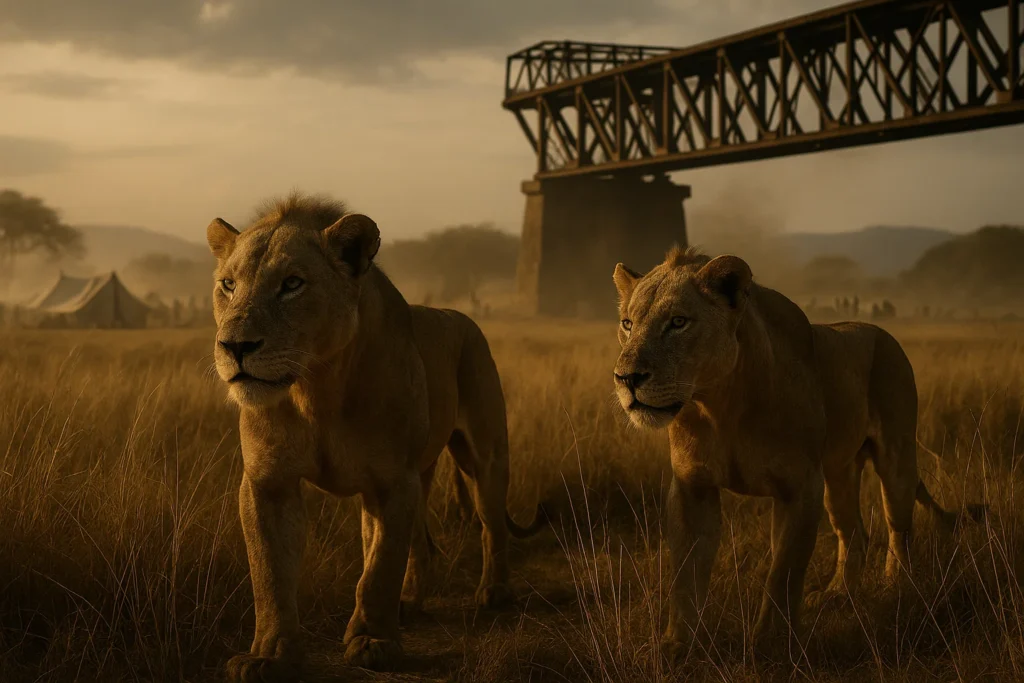
Here’s what matters: two lions stopped a massive railway project, terrified thousands of workers, and left a trail of fear so intense that their names still echo more than a century later.
Let me walk you through what really happened.
The Real Story Behind The Ghost and the Darkness
In 1898, the British Empire began building the Kenya–Uganda railway. It was supposed to be a symbol of progress. Instead, it turned into a nightmare.
Workers in the Tsavo region started disappearing at night. Some vanished without a sound. Others were dragged from tents as their teams watched, frozen with shock.
The killers?
Not a rogue animal. Not even a hungry predator.
But two unusually large, maneless lions who seemed far too bold and far too intelligent for their own kind.
Historical records describe months of fear. Workers refused to sleep in their tents. Some built thorn barricades. Others climbed trees at night. Stories spread fast, and so did panic. At one point, construction nearly stopped completely.
British engineer Lieutenant Colonel John Henry Patterson was sent to handle the crisis. His detailed notes later became the backbone of the film.
But the real Patterson wasn’t a Hollywood hero. He was a problem-solver in an impossible situation, trying to protect workers who were losing faith by the day.
Who Actually Killed the Lions?
The film gives us dramatic, stylized encounters. The truth is simpler but no less tense.
Patterson tracked the lions for months, often sleeping in makeshift towers, traps, and even trees.
He wrote that the lions showed no fear, even after being shot at. At times, they seemed to stalk him deliberately.
Finally:
- He shot the first lion on December 9, 1898 after it walked into a trap.
- The second lion was killed three weeks later, but only after multiple gunshots.
This part is true:
Patterson himself killed both lions.
No fictional “Remington.” No last-minute showdown. Just a tired engineer who refused to let his workers be hunted any longer.
Was the Character Remington Really Killed by the Lions?
The movie creates the legendary hunter Charles Remington, played by Michael Douglas, and gives him a dramatic death.
But here’s the truth:
Remington never existed.
He was entirely fictional added for drama, conflict, and star power.
So no, he wasn’t killed by the lions because he wasn’t there at all.
How Many People Did the Lions Actually Kill?
This question still sparks debate.
- Patterson claimed the lions killed 135 people.
- Modern research suggests around 30–35 workers, with the rest possibly being misattributed.
Here’s the honest part:
It’s difficult to confirm exact numbers because the victims came from different regions, and records were inconsistent. But even the lower estimates make these lions some of the most dangerous man-eaters in recorded history.
Scientists later studied their remains and found that the lions had worn-down teeth, making it harder to hunt natural prey. Humans may have simply been easier targets.
Where Are the Tsavo Lions Now?
After Patterson killed the lions, their bodies were eventually sold to the Field Museum in Chicago. Today, the preserved skins and reconstructed bodies stand in glass displays, still drawing crowds more than a century later.
Visitors often say they look smaller than expected. But museum experts explain that the original skins were damaged and stretched over time, so the mounts don’t fully capture their real size or power.
Still, staring into the glass, you feel the weight of history behind those amber eyes.
What the Film Changed
Movies do what movies do:
they heighten emotion, add conflict, and reshape timelines. The Ghost and the Darkness is no different.
Here’s what shifted:
1. The lions weren’t supernatural.
They were aggressive and unusually bold, but not mystical forces.
2. There was no Remington.
His character was created purely for storytelling.
3. Patterson’s role was simplified.
The real hunt took longer, required more attempts, and involved far more frustration than the film suggests.
4. The workers’ fear was even more intense in reality.
Historical accounts describe a level of terror that may have been impossible to capture on screen.
Bottom line:
The film stays loyal to the emotional truth fear, courage, survival but takes creative freedom with the details.
Why This Story Still Haunts Us
Some true stories fade. This one never does.
Maybe because it’s about the thin line between human progress and the natural world.
Maybe because it shows how fear spreads when night falls and answers feel far away.
Or maybe it’s simply because there’s something unforgettable about two lions who challenged an empire.
What we know is this:
The Tsavo man-eaters were real.
Their impact was real.
And their story will always be one of the most chilling chapters in colonial African history.
Final Thoughts
The real events behind The Ghost and the Darkness are powerful not because of myths, but because they don’t need any. Two lions changed the course of a major engineering project, terrified thousands, and left behind a legend still told more than a century later.
The movie gave us a dramatic version of that legend.
History gave us something even stronger: a reminder that nature can rewrite human plans in a single night.

Jessica Savitch, with a deep passion for journalism, brings her expertise to istruestory.com as a dedicated author. MA in Arts & Journalism.
I think the addition of a fictional Remington was a good idea, even if it distorts the truth- since the movie is drama, not a documentary. And Michael Douglas greatly enhances any movie he’s in.