The story hits close to home because its inspiration comes from a pattern not one person. Headlines about fallen pastors, hidden misconduct, and institutional silence formed the backbone of this fictional pastor’s world. The filmmakers openly said they looked at the larger ecosystem of prosperity preachers and high-profile church leaders who faced accusations of sexual misconduct and emotional manipulation. That’s the frame you need before stepping into the film.
Who Is Pastor Lee-Curtis Childs Supposed to Represent?
The character is fictional. But he feels familiar because we’ve seen versions of him in the news. Real megachurch leaders have faced scandals involving:
- abuse of power
- coercion
- secret settlements
- sexual misconduct allegations
- public apologies followed by rapid attempts at church restoration
The filmmakers never point to one specific pastor, yet viewers immediately notice similarities to real stories reported across the Southern U.S.
According to interviews cited by multiple outlets, the goal wasn’t to recreate an individual it was to explore the emotional fallout of leaders who built empires on charisma, only to watch everything collapse when the truth surfaced.
So while Lee-Curtis Childs is fictional, the environment that shaped him is very real.
What Is Honk for Jesus Really About?
On its surface, the film follows Pastor Lee-Curtis Childs and his wife Trinitie as they try to rebuild their megachurch after the pastor’s misconduct scandal makes national headlines. But look a little closer and the film becomes something else entirely.
Here’s the heart of it:
- It critiques the prosperity gospel culture flashy suits, expensive cars, choreographed performances.
- It highlights how some church leaders use charm as a shield against accountability.
- It shows how congregations often struggle to separate faith from the people who lead them.
- And at its core, it’s the story of a couple trying to hold on to a life that no longer wants them.
The tone jumps between mockumentary humor and deeply vulnerable drama. That blend isn’t accidental. Real scandals don’t unfold neatly. Some moments feel absurd. Others hurt to watch. The film captures that tension.
What Was the Point of the Movie?
The point wasn’t to shame religion. Instead, the filmmakers wanted to examine what happens when image becomes more important than truth. Real-life scandals rarely start with public exposure they start with small secrets that grow until they’re impossible to hide.
The movie asks a simple question with a heavy weight:
If your entire identity is built on being admired, what are you without the admiration?
Lee-Curtis clings to cameras, crowds, and publicity because he doesn’t know who he is outside of them. Trinitie stays by his side because she built her life around a role that suddenly feels hollow. Their unraveling becomes the emotional center of the film.
The point isn’t the scandal. It’s the human fallout.
Where Was Honk for Jesus. Save Your Soul. Filmed?
The movie was filmed primarily in Atlanta, Georgia, one of the biggest hubs for both Southern megachurch culture and modern film production.
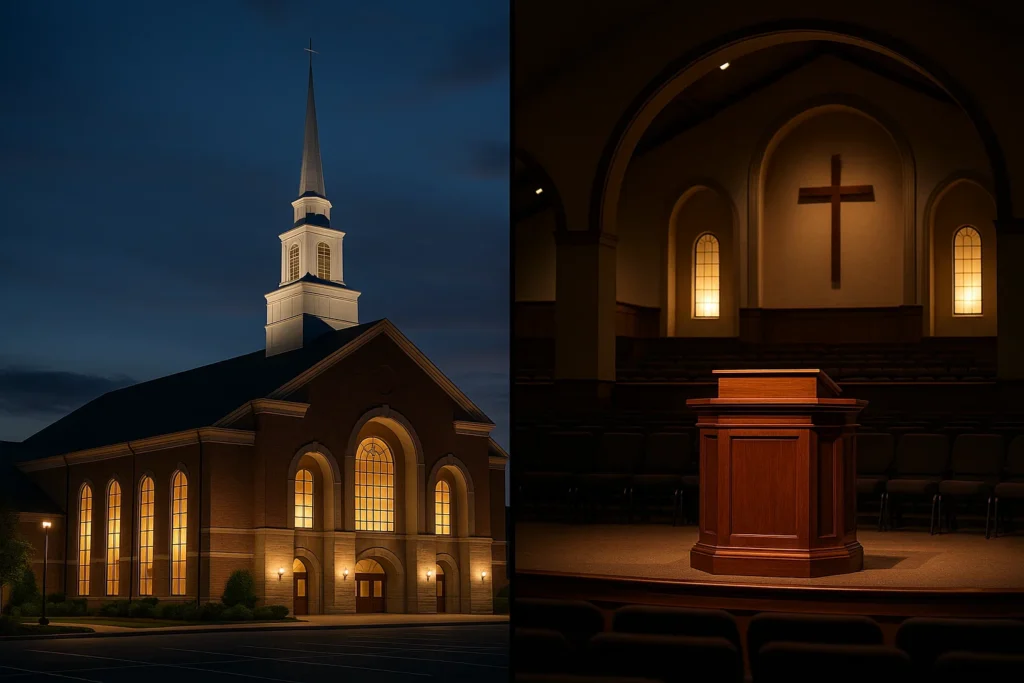
The setting matters because it grounds the story in a region where large, charismatic churches are woven into daily life. The architecture, the wide parking lots, the polished interiors all feel familiar to anyone who grew up in the American South.
The location gives the film its authenticity. Even without naming real churches, the environment feels unmistakably real.
Is Honk for Jesus Appropriate for Kids?
This isn’t a family movie. The humor, themes, and underlying accusations are all aimed at adults. Younger viewers won’t understand the satire, and the film deals with sexual misconduct, psychological manipulation, verbal aggression, and the emotional strain of spiritual leadership gone wrong.
For teens and adults who want a deeper look at faith, power, and accountability, the film opens a meaningful conversation. For kids, the themes are simply too heavy.
So What Is the Real Story Behind Pastor Lee-Curtis Childs?
When people search for “Pastor Lee-Curtis Childs true story,” they’re looking for a single name to attach him to. But the truth is broader and more uncomfortable. He represents:
- the polished image of prosperity Christianity
- the unchecked authority of certain megachurch leaders
- the silence that often surrounds abuse
- the loyal spouses who carry the emotional cost
- the members who feel torn between faith and truth
The film pulls pieces from multiple real-world scandals reported in the last decade. It’s not a biography it’s a reflection.
Think of Pastor Lee-Curtis as a composite character built from real patterns of misconduct, public apologies, and eventual collapse. The emotional truth is what the filmmakers wanted to capture.
Why The Film Resonates So Strongly
It’s not the scandal that lingers. It’s the pressure. The desperation. The sense that reputation has become a prison. Trinitie’s forced smile, Lee-Curtis’s frantic need for approval, the congregation’s hesitation they all echo the human cost of institutions that protect power instead of people.
That’s why the story feels real.
Because in many places across the country, versions of this story have already happened.
Final Reflection
Pastor Lee-Curtis Childs isn’t a documentary figure. But he is a mirror one polished by real pastors, real scandals, and real communities shaken by leaders they once trusted. The movie steps into that space where faith meets disappointment, and where image meets truth.
That’s what gives it weight. And that’s why the story stays with you long after the credits roll.

Jessica Savitch, with a deep passion for journalism, brings her expertise to istruestory.com as a dedicated author. MA in Arts & Journalism.