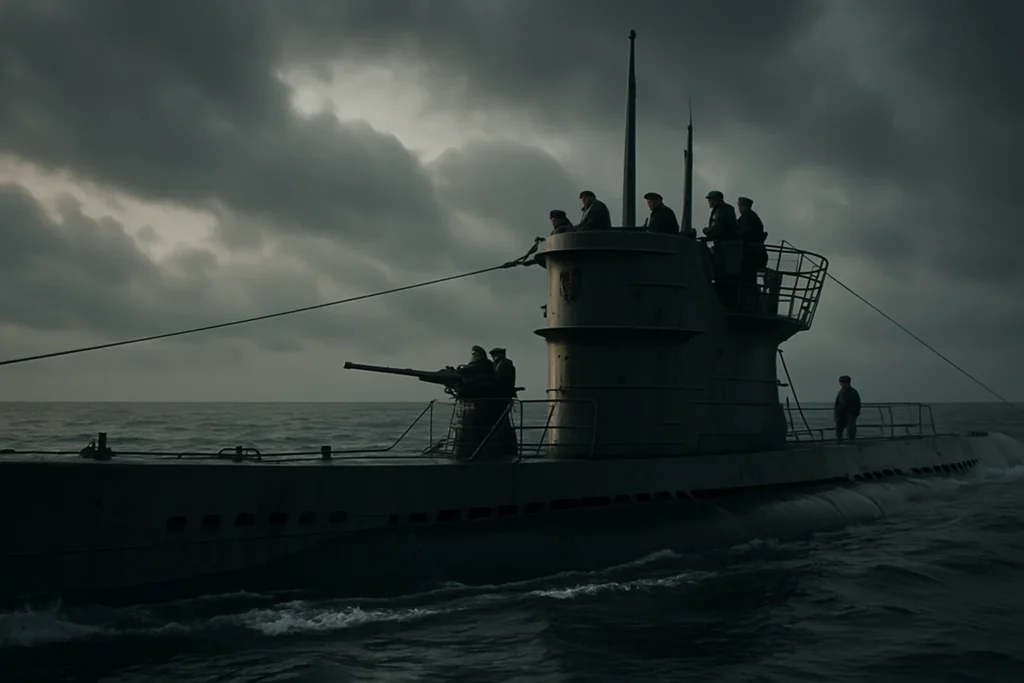
Let me explain where the movie connects with reality, where it drifts away, and why its portrayal stirred up strong reactions from historians and veterans who lived through the real war.
A Film Built on Real Ideas, Not Real Events
The movie follows an American submarine crew going undercover to capture a German U-boat and steal its Enigma coding machine. Capture the machine, break the codes, turn the war around. It’s a gripping setup, and the emotional stakes rise fast.
But the bottom line is simple:
The specific mission shown in U-571 never happened.
Multiple sources, including naval historians and official military records, confirm this.
The story is built on a possibility, not an actual American operation. The U.S. Navy did play important roles in the Battle of the Atlantic, but the key historical event shown in the film the capture of an Enigma machine from a German U-boat belongs to someone else entirely.
So, How Much of U-571 Is True?
Pieces of it are true. The atmosphere, the submarine tactics, and the wartime codebreaking urgency all reflect reality. Enigma machines were indeed the heart of Germany’s naval communication system. Whoever controlled the codes had a major advantage.
But the mission?
The crew?
The identity of the people who made the breakthrough?
That’s where the fiction takes over.
The Most Important Fact:
The first successful capture of a naval Enigma machine was done by the British not the Americans.
And it happened long before the U.S. entered the war.
This historical moment happened on May 9, 1941, when sailors from HMS Bulldog boarded the German U-boat U-110 and recovered an intact Enigma and codebooks. This capture helped Allied codebreakers at Bletchley Park read German naval messages for much of the war.
The movie U-571 quietly moves this credit across the ocean and rewrites it as an American mission.
It’s not just a small shift; it changes the entire ownership of a major wartime achievement.
Did the U.S. Navy Ever Capture an Enigma Machine?
Here’s the truth:
Yes, the U.S. Navy did eventually recover Enigma material but not in the way the movie shows.
In June 1944, American forces boarded U-505 and captured valuable codebooks and equipment. It was a daring operation and one the U.S. Navy is rightly proud of. But this happened three years after the British first cracked open the German naval code system and long after the Allies had already made huge gains in understanding Enigma messages.
So yes, the U.S. contributed.
But the movie shifts the timeline and creates a fictional mission that gives America the “first capture,” which is historically inaccurate.
Even the U.S. Naval Institute acknowledged the movie as “plausible fiction,” not a retelling of real events.
What Do We Know About the Real U-571?
Since the film uses the number U-571, many assume the events truly happened aboard that submarine. Here’s the reality:
- U-571 was a real German Type VIIC submarine.
- It never carried an Enigma machine that was captured by Americans.
- It was sunk by the Royal Australian Air Force in January 1944.
- There was no undercover American operation tied to its story.
So while the submarine’s number is real, nothing that happens in the movie reflects its actual history.
Why Historians Criticized the Film
When U-571 was released in 2000, some viewers enjoyed it as an action thriller. But many historians, veterans, and even political leaders expressed frustration. The main issue wasn’t the filmmaking it was the way the movie rewrote important moments of WWII.
Here’s why the criticism was so strong:
1. It Took a British Achievement and Reassigned It
The early capture of an Enigma machine saved Allied lives. It played a major role in turning the Battle of the Atlantic. The people who risked their lives to make it happen were British sailors.
They didn’t get their credit on screen.
The identity swap rubbed many the wrong way.
2. Timing Matters in Real War
The film places America in a timeline before America actually entered WWII. That alone reshapes viewer understanding of how events unfolded.
3. Real Veterans Saw Their History Erased
For families of those who served on HMS Bulldog and other vessels involved in codebreaking operations, the movie felt like a rewrite that shaded out their sacrifice.
This isn’t about demanding perfect realism in movies.
It’s about respecting real history when the plot revolves around pivotal, documented events.
What Was the Most Feared Submarine in WWII?
The film hints at Germany’s U-boat force as a menacing power and that part is accurate. During the early years of WWII, German submarines were incredibly deadly. The name “Wolfpacks” described groups of U-boats hunting Allied ships across the Atlantic.
One submarine often mentioned as especially dangerous was U-48, which sank over 50 Allied ships. It had one of the most successful combat records in the entire war.
The fear wasn’t about one boat it was the entire U-boat strategy. The Atlantic was a chessboard, and German submarines were powerful pieces until the Allies cracked Enigma and shifted the advantage.
Did the Hunt for Red October Really Happen?
This question often comes up alongside U-571 because both films deal with submarine stealth and military secrets.
The short answer is: not exactly.
The Hunt for Red October is inspired by Cold War submarine technology and some real defection stories, but it isn’t based on a single true event. Much like U-571, it blends imagination with small fragments of history.
It’s another example of how submarine films often touch reality without fully living in it.
Where the Movie Gets the Feel of History Right
Although the facts bend, the movie captures the emotional truth of submarine warfare:
- The pressure of silence.
- The fear of depth charges.
- The teamwork needed to survive in steel corridors under the sea.
- The tension between hope and disaster.
These parts ring true because they reflect the lived experiences of submarine crews on all sides of the war.
If viewers watch U-571 as a thriller, it delivers that feeling well.
If they watch it as a documentary, things fall apart quickly.
Where the Movie Steps Away from Reality
The biggest leaps happen here:
1. The Nationality Swap
This is the core issue.
The British capture became an American one.
2. The Use of U-571
The real submarine played no role in codebreaking.
3. The Mission Structure
The raid shown in the movie is entirely fictional.
There was never an American scheme to disguise a naval crew as Germans to steal an Enigma.
4. The Timing
Events portrayed in the early 1940s are out of order with the real war timeline.
5. Enigma Breakthrough Credits
Bletchley Park’s codebreakers, Polish mathematicians, and Allied naval intelligence contributed far more than the film suggests.
So… Is U-571 a True Story?
Here’s the most honest answer:
No, U-571 is not a true story.
It’s a work of fiction inspired by real wartime themes, but the plot, mission, and characters are invented. The movie borrows the idea of Enigma capture but changes who did it, when it happened, how it unfolded, and what submarine was involved.
Watch it for the tension, the performances, and the filmmaking.
Don’t watch it expecting historical accuracy.
Why the Truth Still Matters
Some may argue that movies don’t need to follow history perfectly. And that’s fair cinema is storytelling. But stories set in real wars often shape how future generations understand those wars.
When a film rewrites who performed a heroic act, it doesn’t just entertain it reassigns credit.
And that’s why understanding the difference between the movie version and the real version matters, even decades later.
A Final Thought
The real Enigma captures were acts of courage. They involved young sailors who had no script, no retakes, and no guarantee of survival. Their work shortened the war and saved lives. Whether their nation gets named in a blockbuster or not, their story still stands.
U-571 offers excitement.
History offers truth.
And sometimes, the best understanding comes from holding both side by side.

Jessica Savitch, with a deep passion for journalism, brings her expertise to istruestory.com as a dedicated author. MA in Arts & Journalism.