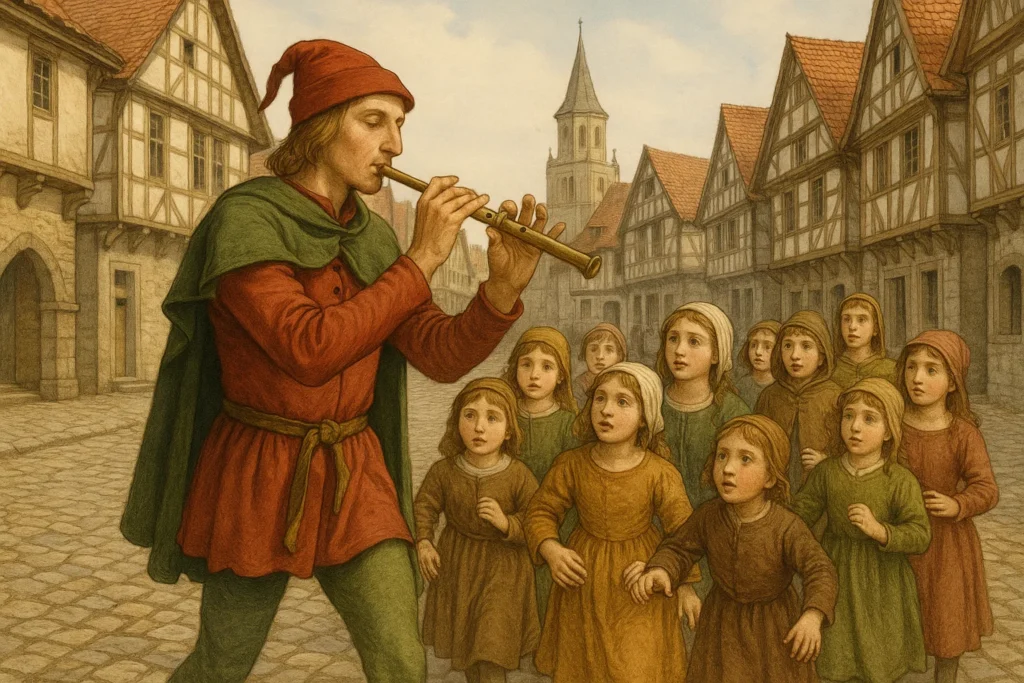
But here’s what matters. Behind the story is a real town, a real date, and a real tragedy that left a deep scar on Hamelin, Germany. The legend didn’t appear out of nowhere. It grew from something so painful that townspeople wrote about it for centuries in church records, town logs, and stained-glass windows. That alone tells you this was never just fiction.
The question is simple: did something truly happen to the children of Hamelin? When you follow the trail of old evidence, the tale sharpens. It becomes less about a magical piper and more about a community trying to explain a loss it could not understand.
Let’s walk through what history still remembers.
The Story We Think We Know
Every version shares the same core: a piper comes to Hamelin in 1284. First he removes a rat infestation. When the townspeople refuse to pay him, he returns dressed in a striking new outfit and plays again this time leading away 130 children. They disappear behind a mountain and never return.
The details change from storyteller to storyteller, but the missing children never disappear from the narrative. That consistency matters. It points toward a real event that people refused to forget.
The Records That Won’t Let the Story Die
For a moment, step away from the legend and look at the town’s history. Medieval Hamelin kept careful church documents. One of those notes dated June 26, 1284 mentions that “130 children left the town and were lost.” Not taken. Not kidnapped. Lost.
A church window created around the same period showed the Piper leading children away. It stood until the 1600s before fading with time, but modern descriptions match what we know today.
Local chronicles also stopped counting years from Christ’s birth. They counted from the day the children vanished. People don’t change their entire dating system for a story they didn’t believe.
All of this suggests one thing: Hamelin experienced a real disappearance of its young, even if the details blurred with time.
So What Really Happened?
Historians have wrestled with this mystery for years because there is no single explanation that fits cleanly. Instead, several theories attempt to fill the gaps.
Here’s the clearest picture based on the evidence we have.
1. A Mass Migration The Most Accepted Theory
Many researchers believe the “children” weren’t literal children but young people teenagers and young adults who left Hamelin as part of a migration movement across Eastern Europe.
During the 13th century, German settlers traveled east for farmland and opportunity. Recruiters, sometimes called “locators,” went from town to town gathering groups willing to move. Over time, people may have turned these recruiters into the figure of the Piper someone who lured Hamelin’s youth away with promises instead of music.
This explains several parts of the story:
- A charismatic figure arrives
- A large group leaves together
- They never return
And over generations, the tale shifts from migration to something more haunting.
2. A Tragedy the Town Could Not Name
Another possibility is that the children died together in a disaster. In medieval Europe, events like landslides, disease outbreaks, or accidents were often recorded vaguely or symbolically.
A mountain collapse near Hamelin would line up with the part of the legend where children vanish inside a hillside. Illness could explain why no survivors remained. And symbolic storytelling was a way for communities to talk about pain without repeating trauma.
If the tragedy was too heavy, turning it into a cautionary tale may have been the only way people could cope.
3. A Lost Connection to the Children’s Crusade
Some historians once believed Hamelin’s youth joined the Children’s Crusade, a movement where thousands of young people tried to reach the Holy Land. But dates don’t match exactly, and Hamelin’s records treat the event as isolated not part of a larger religious push.
This theory still lingers because it reflects a broader medieval pattern of young people leaving their towns for what they believed was a divine mission.
4. Could the Piper Himself Be Real?
There is no evidence of a single musician or magical figure behind the event. But the image of a piper is powerful. Music was often used as a symbol of persuasion and influence. A real person recruiter, leader, or even a criminal could have been transformed into a mythical figure through retellings.
Legends exaggerate. Communities simplify. Over time, a man with authority becomes a man with a flute.
How Many Children Survived?
Historical texts say none.
In every version of the story and every surviving record, the children never return.
This detail is also why the story endures: a community loses its young, and the silence afterward is too heavy to dismiss.
Is There a Real Pied Piper Statue?
Yes. If you visit Hamelin today, you’ll find:
- statues of the Piper
- murals showing the event
- plaques marking the “Street of No Drums,” where music is still traditionally banned
- annual performances retelling the legend in the town square
Hamelin doesn’t treat this as fiction. They treat it as memory.
The Evidence Underneath the Legend
When you gather everything church notes, windows, local histories, and centuries of retellings the conclusion is steady:
Something happened in Hamelin in 1284.
No one knows the full truth, but the disappearance was real enough for a community to immortalize it in story, song, artwork, and cultural ritual.
The Pied Piper is not a fairy tale that came from thin air. It’s a myth built on a wound.
Why the Story Still Haunts Us
The legend survives because it hits a deep human fear losing children without explanation. It also echoes a recurring truth about history: communities often turn trauma into stories that can be retold.
The Piper becomes a symbol of betrayal.
The music becomes a warning.
The missing children become a reminder of how fragile life was in the medieval world.
We may never know exactly what happened. But the story tells us how Hamelin felt about what happened. And sometimes, that is the most honest part of history we can recover.
Final Thoughts
When you peel away the bright clothes and the flute, you’re left with a simple, painful truth. Something took Hamelin’s young people migration, tragedy, or something lost to time. The town remembered it the only way it knew how: through story.
That’s why the legend endures. Not because of magic.
But because of memory.

Jessica Savitch, with a deep passion for journalism, brings her expertise to istruestory.com as a dedicated author. MA in Arts & Journalism.