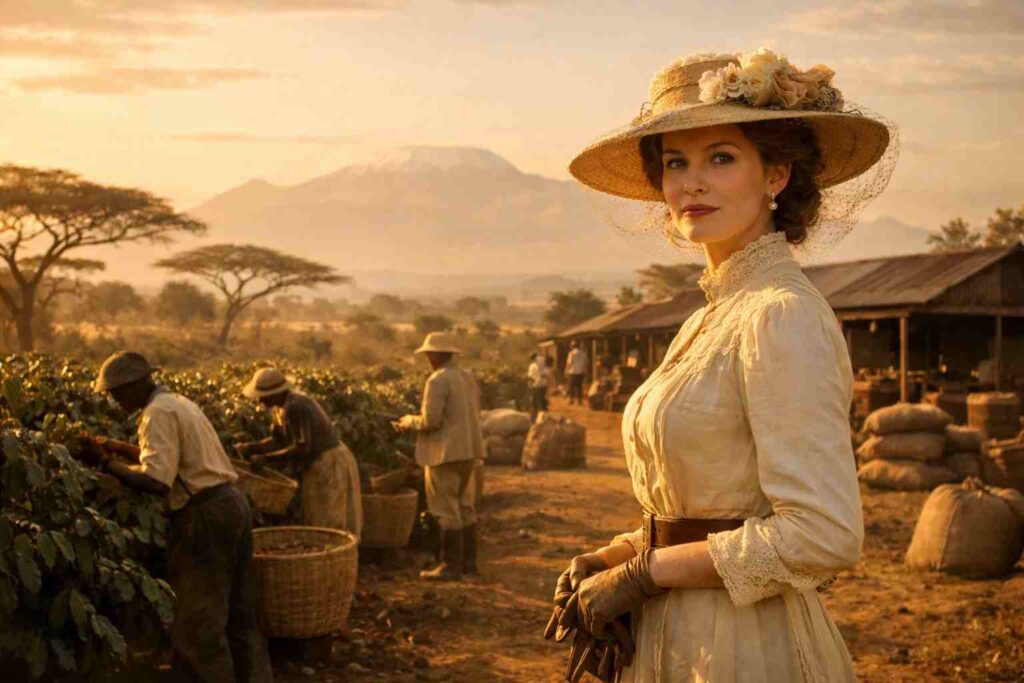
Out of Africa feels real because it is rooted in real life. But like many Hollywood films, it tells a softer, more romantic version of the truth.
Let me explain.
The movie is based on the memoir “Out of Africa” (1937) by Danish writer Karen Blixen (who also wrote under the name Isak Dinesen). She lived in Kenya during the early 1900s and ran a coffee farm. The film follows her life, her struggles, and her relationship with Denys Finch Hatton.
So yes, the story is real at its core.
But the details? That’s where things change.
The Real Story Behind Out of Africa
Karen Blixen moved to British East Africa (now Kenya) in 1914. She married Baron Bror Blixen, hoping to build a new life. Together, they started a coffee plantation near Nairobi.
But life didn’t go as planned.
- The marriage quickly fell apart
- The farm struggled financially
- Kenya’s climate made coffee farming difficult
- She faced loneliness and uncertainty
Later, she met Denys Finch Hatton, a British aristocrat and adventurer. Their relationship became the emotional center of her life and later, the film.
But here’s the truth:
Their relationship was complicated, not the smooth romance you see on screen.
How True Is the Out of Africa Movie?
The movie stays true to the spirit of Karen’s life. But it simplifies reality.
What the film gets right:
- Karen Blixen really owned a coffee farm in Kenya
- Her marriage did fail
- Denys Finch Hatton was a real person
- He died in a plane crash in 1931
What the film changes:
- It romanticizes her relationship with Denys
- It removes many of the harsh realities of colonial life
- It softens her financial struggles
- It avoids deeper cultural and social tensions of the time
Bottom line:
The movie tells an emotional truth, not a full historical one.
Was Karen Blixen Cured of Syphilis?
This is one of the most searched and misunderstood questions.
Karen Blixen did contract syphilis, most likely from her husband Bror. At the time, treatment options were limited and often painful.
She received treatment in Europe, and many historians believe the disease was controlled or cured enough for her to live a long life. She died in 1962 at age 77.
But the illness had lasting effects on her health.
And the film? It barely touches this part of her life.
Did Karen Blixen Ever Remarry?
No, she never remarried.
After her divorce from Bror Blixen, she had relationships, but none led to marriage. Her bond with Denys Finch Hatton remained the most important emotional connection in her life.
After Denys died, she eventually left Africa and returned to Denmark.
She spent the rest of her life writing and remembering.
Why Didn’t Robert Redford Have a British Accent?
Let’s be honest. This one stands out.
Denys Finch Hatton was British. But in the film, Robert Redford speaks in his natural American accent.
Why?
- The filmmakers chose star power over strict accuracy
- Redford’s presence was meant to carry emotional weight
- They avoided forcing an accent that might feel unnatural
It’s not historically accurate, but it works for the film’s tone.
Still, if you’re watching closely, it’s one of the biggest breaks from reality.
The Love Story: Real or Hollywood?
The film presents Karen and Denys as a deep, almost poetic love story.
The reality? More complex.
- Denys valued independence and avoided commitment
- Their relationship was on-and-off
- He never wanted marriage
- Karen often wanted more than he could give
So while love was real, it wasn’t perfect.
The movie turns it into something cleaner, more timeless.
What the Film Leaves Out
This is where Jessica Savitch’s lens matters looking at what’s missing, not just what’s shown.
The movie largely avoids:
- The full impact of colonialism in Kenya
- The experiences of local African communities
- The power dynamics of that era
- The deeper emotional struggles Karen faced
These aren’t small details.
They shape the real story in ways the film doesn’t fully explore.
So, Is Out of Africa a True Story?
Yes but only partly.
It’s based on real people, real places, and real events.
But it tells the story through a romantic, cinematic filter.
Here’s the simplest way to see it:
- True foundation: Karen Blixen’s life in Kenya
- Adjusted reality: Her relationships and struggles
- Hollywood layer: Emotion, romance, and visual beauty
The Human Truth Behind the Story
At its heart, Out of Africa isn’t just about history.
It’s about memory.
Karen didn’t just write facts. She wrote feelings.
She wrote how Africa changed her.
And that’s what the film captures best.
Not every detail is accurate.
But the sense of loss, love, and longing? That part feels real.
Final Thoughts
If you’re asking whether Out of Africa is a true story, the honest answer is this:
It’s a true story shaped by memory and softened by cinema.
Watch it for the emotion.
Read about it for the truth.
And somewhere in between, you’ll find the real Karen Blixen.

Jessica Savitch, with a deep passion for journalism, brings her expertise to istruestory.com as a dedicated author. MA in Arts & Journalism.