
No One Would Tell is one of those movies.
At first, it looks like a teenage love story. A popular boy falls for a girl who believes she has found someone special. But as their relationship develops, his affection turns into jealousy, control, and violence.
What makes the story even more heartbreaking is that it did not come entirely from someone’s imagination.
Yes, No One Would Tell is based on a true story. The original 1996 television movie and the 2018 Lifetime remake were inspired by the murder of 14-year-old Amy Carnevale, who was killed by her teenage boyfriend, Jamie Fuller, in Beverly, Massachusetts, in August 1991.
However, the movies use fictional characters and dramatized events. Understanding the difference between the films and the real case reveals a tragedy that deserves to be remembered.
The Real Girl Behind No One Would Tell
Who was Amy Carnevale?
Amy Carnevale was a 14-year-old girl from Beverly, Massachusetts. She was a cheerleader with friends, family, and a future that should have been filled with possibilities.
In 1991, she was involved in a relationship with Jamie Fuller, a 16-year-old high school student and bodybuilder.
According to contemporary news reports, Fuller was extremely possessive and jealous. Friends described a relationship in which his anger could become frightening, particularly when Amy interacted with other boys.
What may have looked like ordinary teenage jealousy from the outside was part of something much more dangerous.
On August 23, 1991, Amy was killed. Her body was later discovered in Shoe Pond in Beverly.
The crime shocked the local community. Young people who knew the couple began speaking about warning signs they had witnessed before her death.
Contemporary reporting by United Press International described allegations that Fuller had spoken about harming Amy before the murder.
It was a disturbing detail. The danger had not been completely invisible, even if the full seriousness of the situation was not understood or reported in time.
What happened to Jamie Fuller?
Fuller was arrested and charged with Amy’s murder.
During his trial, prosecutors argued that the killing was planned and driven by jealousy.
Witnesses described events surrounding Amy’s death, including Fuller’s behavior before and after the crime. Testimony also established that her body had been placed in a pond.
The defense argued that alcohol and anabolic steroid use had affected Fuller’s mental state and criminal responsibility.
The jury rejected that argument.
On October 23, 1992, Jamie Fuller was convicted of first-degree murder. He was sentenced to life in prison without the possibility of parole.
The conviction and sentence were reported by United Press International in October 1992.
Amy’s death was not simply a romantic relationship that ended badly. It was a murder committed by someone who had shown possessive and threatening behavior.
That distinction matters when we look at the movies.
How the 1996 Movie Told Amy’s Story
The original No One Would Tell premiered on NBC on May 6, 1996.
Directed by Noel Nosseck, the television drama starred Candace Cameron as Stacy Collins and Fred Savage as Bobby Tennison.
The filmmakers changed the characters’ names and aspects of the story while keeping the central theme of teenage dating violence.
What happened between Stacy and Bobby?
Stacy Collins is a teenage girl who becomes involved with Bobby Tennison, a popular high school wrestler.
Bobby initially appears confident, charming, and affectionate.
Stacy feels special when he gives her attention. Their relationship seems exciting, particularly because Bobby is admired by many students at school.
But his behavior gradually changes.
He begins questioning Stacy about the people she talks to. He becomes angry about her clothing and tries to control how she spends her time.
When Stacy does something he dislikes, Bobby reacts with threats or physical violence.
Later, he apologizes and promises to behave differently.
This pattern creates confusion for Stacy. She remembers the boyfriend who once made her happy and hopes that version of him will return.
Meanwhile, her friends notice that something is wrong.
Her friend Nicki becomes increasingly worried after seeing signs of abuse and watching Stacy pull away from people who care about her.
Yet Stacy continues defending Bobby, even when the relationship becomes dangerous.
The film shows how fear, emotional attachment, and manipulation can make leaving an abusive relationship difficult.
Do they find Stacy in No One Would Tell?
Yes, Stacy is eventually found, but she does not survive.
After Stacy tries to end the relationship, Bobby refuses to accept her decision.
He later persuades her to accompany him to a lake. Stacy disappears, leaving her mother and friends desperately searching for answers.
At first, Bobby attempts to appear helpful and concerned.
However, details surrounding Stacy’s disappearance lead investigators to question him and other teenagers who were with him.
The investigation reveals that Bobby killed Stacy after she refused to continue their relationship.
Police eventually recover her body from the lake.
The story then moves to a courtroom, where witnesses explain what they knew about Bobby’s behavior.
Bobby is found guilty of first-degree murder and sentenced to life without parole.
The movie closes with a painful message about recognizing abuse and speaking up when someone may be in danger.
It is important to remember that these are events in the fictional movie, even though the central crime was inspired by Amy Carnevale’s murder.
What Changed in No One Would Tell 2018?
More than two decades after the original movie, Lifetime released a new version of No One Would Tell on September 16, 2018.
The remake was directed by Gail Harvey and featured:
- Matreya Scarrwener as Sarah Collins
- Callan Potter as Rob Tennison
- Shannen Doherty as Laura Collins
- Chanelle Peloso as Nikki Farrow
- Mira Sorvino as Judge Elizabeth Hanover
The basic story remains familiar, but the remake gives more attention to Sarah’s relationship with her mother and the concerns raised by her friends.
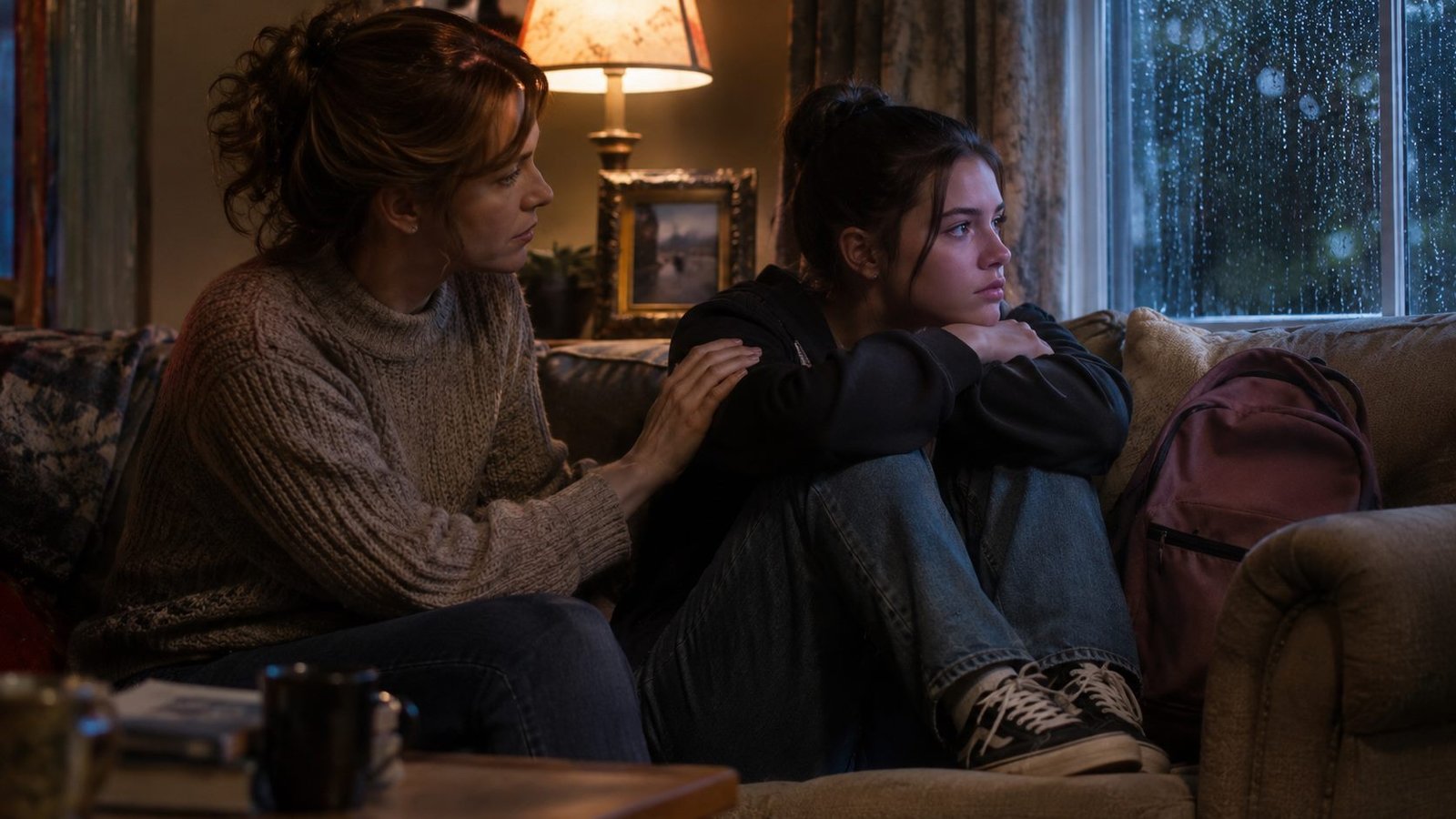
The 2018 movie explores emotional and physical abuse in teenage relationships, showing how an apparently loving boyfriend can become controlling and dangerous.
Sarah and Rob’s relationship
Sarah Collins begins dating Rob Tennison, a popular and seemingly charming student.
Her mother, Laura, is initially happy about the relationship.
But Rob’s behavior soon becomes troubling.
He gets angry when Sarah spends time with her friends. He becomes jealous over small interactions and tries to control her appearance and decisions.
Sarah slowly begins changing her behavior to avoid upsetting him.
Her friend Nikki recognizes that the relationship is unhealthy and becomes concerned about Sarah’s safety.
Sarah, however, struggles with her feelings for Rob and his repeated promises to change.
The remake spends considerable time showing this emotional conflict.
Rather than presenting abuse as something that begins with obvious violence, the movie shows how controlling behavior can become more serious over time.
It also explores the way family members and friends may misunderstand what is happening.
What happens at the end of No One Would Tell 2018?
Sarah is murdered by Rob, and he is eventually found guilty.
After Sarah finally decides to end their relationship, Rob continues trying to contact her.
He persuades her to go with him, but instead of taking her home, he brings her to an isolated location.
When Sarah refuses to resume the relationship, Rob kills her.
Sarah’s disappearance leaves Laura devastated.
Nikki eventually tells Laura about the abuse she witnessed, and the investigation leads to Rob.
Laura and Nikki discover Sarah’s ring near Rob’s family’s lake house. Police subsequently recover Sarah’s body from the lake.
Rob is arrested and charged with murder.
During the trial, witnesses describe his controlling behavior, and the circumstances surrounding Sarah’s death become clearer.
The courtroom scenes also give attention to the wider problem of domestic violence and the need for people to take warning signs seriously.
The ending offers legal accountability, but it cannot bring Sarah back.
That absence of a happy ending is what gives the story much of its emotional weight.
How Close Are the Movies to the Actual Events?
Both versions of No One Would Tell share important elements with Amy Carnevale’s real case.
But neither film should be treated as a documentary.
Here is how the main details compare.
| Detail | Real case | Movie adaptations |
|---|---|---|
| Teenage victim | Amy Carnevale, age 14 | Stacy Collins in 1996; Sarah Collins in 2018 |
| Boyfriend | Jamie Fuller, age 16 at the time of the crime | Bobby Tennison in 1996; Rob Tennison in 2018 |
| Location | Beverly, Massachusetts | Fictionalized settings |
| Crime | Amy was murdered in August 1991 | Both movies portray the murder of a teenage girl |
| Body discovery | Amy’s body was recovered from a pond | Both films include a body recovered from a lake |
| Court outcome | Fuller convicted of first-degree murder in 1992 | The fictional boyfriend is found guilty of murder |
Which parts of the story are real?
The strongest factual connection is the underlying crime.
Amy Carnevale was killed by her teenage boyfriend. Reports from the investigation and trial described jealousy, possessiveness, threats, and witnesses who knew troubling details.
Her body was discovered in water, and her boyfriend was convicted of murder.
These elements form the foundation of both movies.
Other details, including specific conversations, romantic scenes, school incidents, and family interactions, belong to the dramatized stories.
We should not assume that every incident involving Stacy or Sarah happened to Amy.
That would blur the line between a screenwriter’s interpretation and a real person’s life.
Why did the filmmakers change the names?
The films tell a dramatized version of the crime rather than a scene-by-scene reconstruction.
Using fictional names gives the filmmakers room to develop characters, relationships, and scenes that help communicate the central message.
It also means viewers must be careful when searching for the real Stacy Collins or Sarah Collins.
Amy Carnevale was the real victim. Stacy and Sarah are fictional characters inspired by her case.
The emotional truth behind the story is important, but so is factual accuracy.
Why No One Would Tell Still Feels So Disturbing
One of the hardest things about watching No One Would Tell is recognizing how ordinary the relationship looks at the beginning.
The couple goes to school. They spend time with friends. They experience many of the same emotions as other teenagers.
Then small warning signs begin appearing.
A jealous comment becomes an angry confrontation.
An apology follows an act of aggression.
A girl begins losing contact with her friends because she is afraid of upsetting her boyfriend.
The danger grows while the people around her struggle to understand what is happening.
These behaviors are not merely fictional plot devices.
Relationship-support organizations identify extreme jealousy, isolation, intimidation, physical harm, and controlling behavior as warning signs of dating abuse.
That makes the movie’s central message relevant beyond the events of 1991.
Why didn’t anyone speak up sooner?
This question sits at the heart of both films.
In the movies, friends, family members, and classmates notice pieces of the problem.
Some see physical injuries. Others hear angry arguments or observe controlling behavior.
But many people hesitate to intervene.
Some fear damaging a friendship. Others assume that the couple will resolve their problems or that the behavior is not serious enough to report.
The real case also involved witness testimony about threats and disturbing behavior before Amy’s death.
Still, it is important not to confuse missed warning signs with responsibility for the crime.
The person who committed the violence was responsible for the murder.
Friends and family members cannot always predict what an abusive person will do. They may also need help responding safely.
The meaningful lesson is not to blame people who failed to recognize every danger.
It is to understand that listening, taking threats seriously, and seeking appropriate support can matter.
Why was leaving so difficult?
Both Stacy and Sarah experience emotional conflict while trying to leave their relationships.
They remember happier moments. They want to believe their boyfriends’ apologies.
They also fear what might happen if they refuse to continue the relationship.
This reflects an important reality about abusive relationships.
A person can recognize that something is wrong and still struggle to leave, particularly when the other person uses fear, guilt, or manipulation.
The films encourage viewers to look beyond the simple question of why someone stayed.
A more helpful question is how people can offer support without judgment.
Is No One Would Tell One of the Saddest True-Story Movies?
There is no official answer to the question of which movie based on a true story is the saddest.
Different stories affect viewers in different ways.
Films such as Schindler’s List and Hachi: A Dog’s Tale are often remembered for their emotional treatment of loss, loyalty, and real events.
No One Would Tell belongs to a different kind of heartbreaking drama.
Its tragedy comes from watching a young person lose her freedom, confidence, and eventually her life because of someone who claims to love her.
The fact that Amy Carnevale was only 14 makes the real story especially painful.
She was not simply a character created for television.
She was a real girl whose life ended far too soon.
Where Can You Watch No One Would Tell 2018?
The 2018 remake was originally released by Lifetime, and its viewing options depend on your country and the streaming rights currently in effect.
Viewers can check Lifetime, Lifetime Movie Club, Tubi, and major digital movie rental services for availability.
Some services may offer the movie with a subscription, while others may provide advertising-supported viewing or rental options.
Availability can change, so these platforms should be treated as places to check rather than confirmed options in every region.
Make sure to select the 2018 version starring Shannen Doherty if that is the movie you want to watch. The 1996 film starring Candace Cameron and Fred Savage is a separate release.
Questions Viewers Still Ask
Is No One Would Tell 2018 a true story?
Yes. The 2018 Lifetime movie is a fictionalized remake of the 1996 television drama, which was inspired by the 1991 murder of Amy Carnevale. It retains the core themes of possessive behavior, teenage dating abuse, and murder, but changes names and story details.
Who was the real girl in No One Would Tell?
The real girl was Amy Carnevale, a 14-year-old cheerleader from Beverly, Massachusetts. Her boyfriend, Jamie Fuller, murdered her in August 1991 and was convicted of first-degree murder the following year.
What happened to Stacy in No One Would Tell?
In the 1996 movie, Stacy Collins is murdered by her boyfriend, Bobby Tennison, after she attempts to end their relationship. Investigators eventually recover her body from a lake.
Does Sarah survive in No One Would Tell 2018?
No. Sarah Collins is killed by Rob Tennison after she refuses to continue their relationship. Her body is later found in a lake, and Rob is found guilty of murder.
Is Bobby Tennison a real person?
Bobby Tennison is a fictional character in the 1996 movie. He was inspired by Jamie Fuller, the teenager convicted of murdering Amy Carnevale. In the 2018 remake, the corresponding character is named Rob Tennison.
Was Jamie Fuller found guilty?
Yes. Fuller was convicted of first-degree murder on October 23, 1992, and sentenced to life imprisonment without the possibility of parole.
Are the 1996 and 2018 versions the same movie?
No. They are separate television films with a shared story foundation. The 1996 version stars Candace Cameron and Fred Savage, while the 2018 remake stars Matreya Scarrwener, Callan Potter, and Shannen Doherty.
What is the main message of No One Would Tell?
The movie warns viewers that jealousy, manipulation, and controlling behavior can be signs of an abusive relationship. It encourages people to recognize those signs and seek support rather than dismissing harmful behavior as ordinary romance.
A Story That Still Deserves to Be Heard
When we ask whether No One Would Tell is a true story, the answer takes us beyond the movie screen.
Yes, both versions were inspired by real events.
But the most important part of that answer is not the cast, the courtroom scenes, or the changes made for television.
It is Amy Carnevale.
She was 14 years old when her life was taken in 1991. Her death became the foundation for a story that would reach television audiences in 1996 and again in 2018.
The films cannot tell us everything about who Amy was, what she dreamed of, or the life she might have lived.
They can, however, encourage a conversation about abuse, fear, respect, and the importance of taking threats seriously.
Love should never require someone to surrender their safety or freedom.
And perhaps the most lasting message of No One Would Tell is that when someone is being hurt, their story deserves to be heard long before it becomes a tragedy.

Jessica Savitch, with a deep passion for journalism, brings her expertise to istruestory.com as a dedicated author. MA in Arts & Journalism.