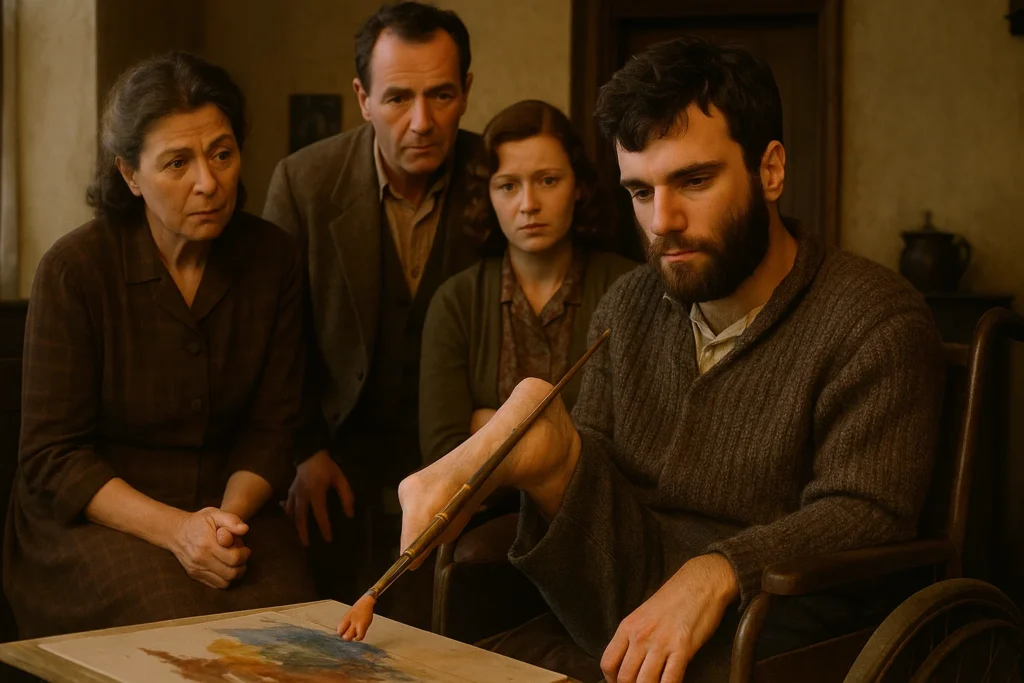
Here’s what matters. Yes, the film is based on a real man with a real, difficult, extraordinary life. But like any adaptation, some pieces are precise, some are softened, and some are shaped for the screen.
Let me explain how the film connects to reality and where it shifts gears.
The Story Is Real, and So Is the Man Behind It
My Left Foot is rooted in Christy Brown’s autobiography, where he tells his story in his own words. He was born in 1932 in Dublin with severe cerebral palsy, a condition that left almost his entire body under tight control except for one part his left foot.
According to factual accounts, including the film’s source material, Brown learned to communicate and create by using that single limb. His family is not fictionalized; the Browns were a large, working-class Irish family who lived with limited resources and enormous strain.
The film keeps that truth close. It captures the way his mother refused to give up on him, how she believed in the intelligence locked inside a body that wouldn’t cooperate. That belief changed his life. It wasn’t cinematic exaggeration; it was real.
How Much of the Film Is True?
Most of the emotional bones of the film come directly from Christy Brown’s own writing. His childhood, his frustration, his moment of writing his first word with his foot, and his early steps into painting those moments are drawn from real events he documented.
But like any film adaptation, the story shapes reality into a cleaner arc.
Here’s what stays true:
- His disability and the physical limitations it created
- The fierce dedication of his mother
- His discovery of writing and painting through his left foot
- His acute intelligence, which many people around him failed to recognize
- His struggle with belonging and independence
- His early interactions with people who encouraged his art
And here’s where the story becomes more cinematic:
- Some characters are composites of multiple real individuals
- Certain relationships are simplified
- Emotional beats like his romantic feelings for a therapist are heightened for storytelling
- Timelines are condensed to fit a film structure
Nothing unusual for a biographical film. What stands out is how much truth the filmmakers chose to keep rather than adjust. Even Daniel Day-Lewis, known for going all-in on preparation, stayed in physical character throughout filming to honor Brown’s real experience.
Who Was Christy Brown, Really?
To understand the film, you have to meet the person behind it.
Christy Brown wasn’t simply an artist who overcame adversity he was someone who lived with intense physical and emotional strain. He wrote poetry, novels, journalism, and, eventually, the autobiography that inspired the film.
But life didn’t suddenly become easy because he became known.
He faced:
- Ongoing pain due to cerebral palsy
- Complicated personal relationships
- A constant fight for autonomy
- Internal battles with confidence and identity
His later years, especially, were marked by both artistic recognition and personal challenges. He died in 1981 at the age of 49, leaving behind a body of work that continues to reveal a mind that refused to be silenced.
What Happened to Christy Brown After the Events of the Film?
The film ends at a hopeful point in Brown’s life, but history keeps going.
Here’s a simple rundown of his later years:
- He continued painting and writing
- His reputation grew across Ireland and beyond
- He married Mary Carr, a nurse
- He battled physical decline and struggled with personal turbulence
- His life ended unexpectedly in 1981 after choking during a meal
Recent discussions around his marriage and care have raised difficult questions, suggesting he may not have received the support he needed in his final years. These parts of his life are not shown in the film, but they add weight to understanding the man behind the legend.
How Many Oscars Did My Left Foot Win?
Here’s the bottom line: the film didn’t just earn praise it made history.
My Left Foot won two Academy Awards:
- Best Actor – Daniel Day-Lewis
- Best Supporting Actress – Brenda Fricker
Both awards were completely deserved. Day-Lewis immersed himself so fully into Christy Brown’s physical world that people still reference this performance when talking about method acting.
The film was also nominated for:
- Best Picture
- Best Director
- Best Adapted Screenplay
Not bad for a deeply personal story made on a modest budget.
Why Christy Brown’s Story Still Matters
It’s easy to treat My Left Foot as a film about perseverance, but that flattens the truth. Brown wasn’t a symbol he was a person. A complicated, brilliant, often frustrated man whose reality didn’t fit neatly into inspirational slogans.
What the film captures beautifully is this:
He had a voice trapped inside a body that wouldn’t cooperate, and he fought for decades to bring that voice out.
The real story isn’t just about talent or disability. It’s about the power of recognition what happens when even one person believes in you enough to break through the noise. Christy Brown’s mother did that. And because she did, the world heard him.
The Takeaway
So, is My Left Foot a true story?
Yes. It’s grounded in real events, real struggles, and real triumphs. It follows a man who had every reason to be overlooked yet found a way to express himself through art and words. The film adds dramatic shape where needed, but at its core, the heart of the story remains absolutely authentic.
Christy Brown lived a life that was difficult, brilliant, and deeply human.
The film honors that and that’s why it still resonates.

Jessica Savitch, with a deep passion for journalism, brings her expertise to istruestory.com as a dedicated author. MA in Arts & Journalism.