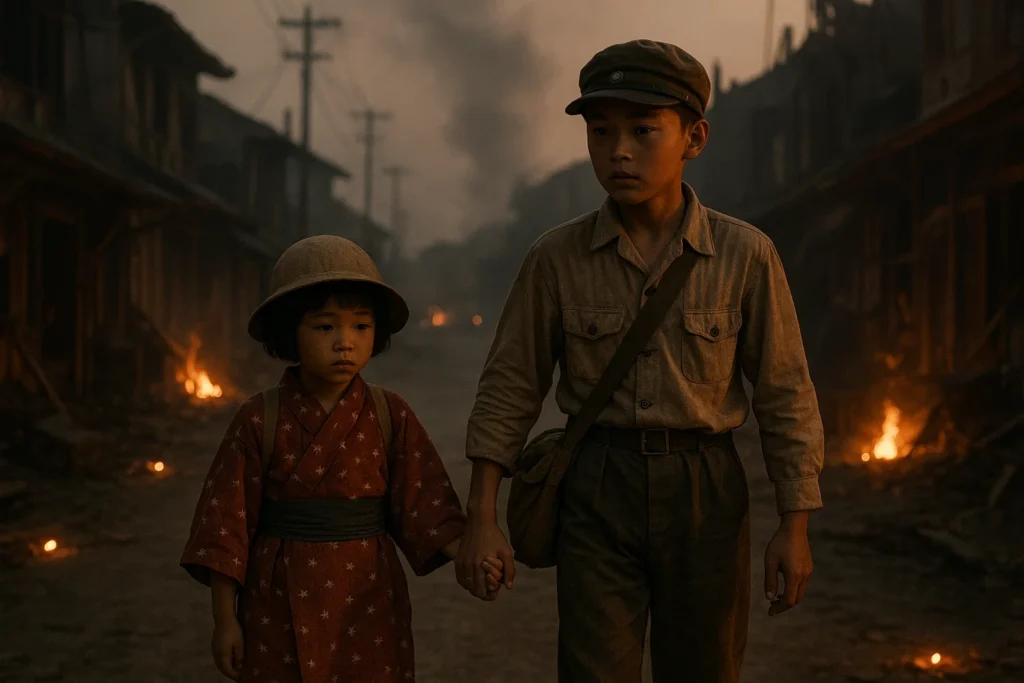
Let me explain how deep the truth runs.
The Real Story Behind the Film
The movie is based on a semi-autobiographical short story written in 1967 by Akiyuki Nosaka. He wasn’t just imagining tragedy he was trying to make sense of his own grief. During World War II, he lost his little sister, Keiko, to malnutrition after the bombings. He blamed himself for not being able to save her, a pain he carried for the rest of his life.
The film isn’t a documentary, but the emotional foundation is true. The guilt, the hunger, the collapse of a childhood all of it comes straight from Nosaka’s memories. When Studio Ghibli adapted the story, they stayed committed to the raw truth rather than creating a polished or heroic version.
Bottom line: the movie is fiction built on real wounds.
Was the Movie Based on Hiroshima?
Not exactly. Many viewers assume the film is set around the Hiroshima bombing, but the story actually takes place in Kobe, Japan. The city suffered repeated firebombings by American forces in 1945. Nosaka and his siblings lived through those attacks, and the aftermath is what shaped the world we see in the film.
So while Hiroshima and Nagasaki were nuclear tragedies, Grave of the Fireflies reflects a different part of the war the relentless firebombing of Japanese cities. Thousands of families were displaced, and survival became the only goal.
The setting may differ, but the devastation was just as real.
How Much of Seita and Setsuko Is Real?
Seita and Setsuko are fictional characters, but their journey mirrors Nosaka and his sister closely. Setsuko’s innocence, her confusion, her slow decline all of it came from real memories Nosaka couldn’t forget. He once admitted that writing the story was his way of apologizing, even though he knew the apology came too late.
Seita, on the other hand, represents the burden Nosaka placed on himself. His pride, his desperation, and his tragic decisions reflect how complicated survival can be when the world around you collapses.
Here’s the heartbreaking truth: Nosaka’s sister died in a shelter, just like in the story. And he carried the weight of that moment with him forever.
What Happened to Seita After Setsuko Died?
The movie ends with Seita’s death, and it doesn’t try to soften anything. This matches the emotional reality of the original story. Nosaka didn’t die as a child, but he wrote Seita’s ending as a symbolic response to his guilt.
In the real world, Nosaka survived the war, but the trauma shaped him. He became an author, a cultural figure, and eventually the voice behind one of Japan’s most important wartime stories. Seita’s final moments aren’t about historical accuracy they’re about showing what war takes from children long before it touches their bodies.
Why the Story Still Matters
Grave of the Fireflies isn’t just a war movie. It’s a human story about two children who had no say in the world that destroyed them. It forces you to sit with the quiet spaces of war the hunger, the confusion, the loneliness. Those parts rarely make it into history books.
Akiyuki Nosaka didn’t want the story to inspire anger or patriotism. He wanted people to understand how fragile childhood becomes during conflict. And decades later, the message still holds. When nations go to war, it’s children who absorb the impact first.
That’s why the film hits so hard. It doesn’t try to shock you. It simply tells the truth.
The Emotional Accuracy of the Film
Even when the movie diverges from Nosaka’s real experiences, the emotional tone never changes. The animation, the music, the small moments like Setsuko playing with fireflies or picking up marbles pull you into a world where childhood and death sit uncomfortably close.
It’s not uncommon for viewers to think the entire story is historically exact. That’s how real it feels. But Studio Ghibli intentionally shaped the narrative around the emotions rather than only the facts. They wanted you to feel what the children felt and see the world through their eyes.
And they succeeded.
Why People Ask If It’s a True Story
Because no other animated film looks or feels like this. There are no magical creatures, no triumphant ending, and no sense of comfort. Instead, it shows war the way children experience it through whispers, misunderstandings, and struggles too big for their small hands.
People ask if it’s based on a true story because it feels authentically painful. Every scene carries weight. Every moment says something. And the film never gives you space to forget that these events happened to many families during the war.
In a way, the question is the film’s greatest success. It means the story reached you.
Final Thoughts
Grave of the Fireflies is not a documentary, but it is undeniably rooted in truth. The heartbreak comes from lived experience, the setting comes from real historical destruction, and the emotions come straight from a man who never stopped grieving his sister.
The film doesn’t ask you to choose sides or judge the past. It asks you to remember what war costs especially when the victims are too young to understand why everything around them is falling apart.
And that’s why it remains one of the most powerful true-story-inspired films ever made.

Jessica Savitch, with a deep passion for journalism, brings her expertise to istruestory.com as a dedicated author. MA in Arts & Journalism.