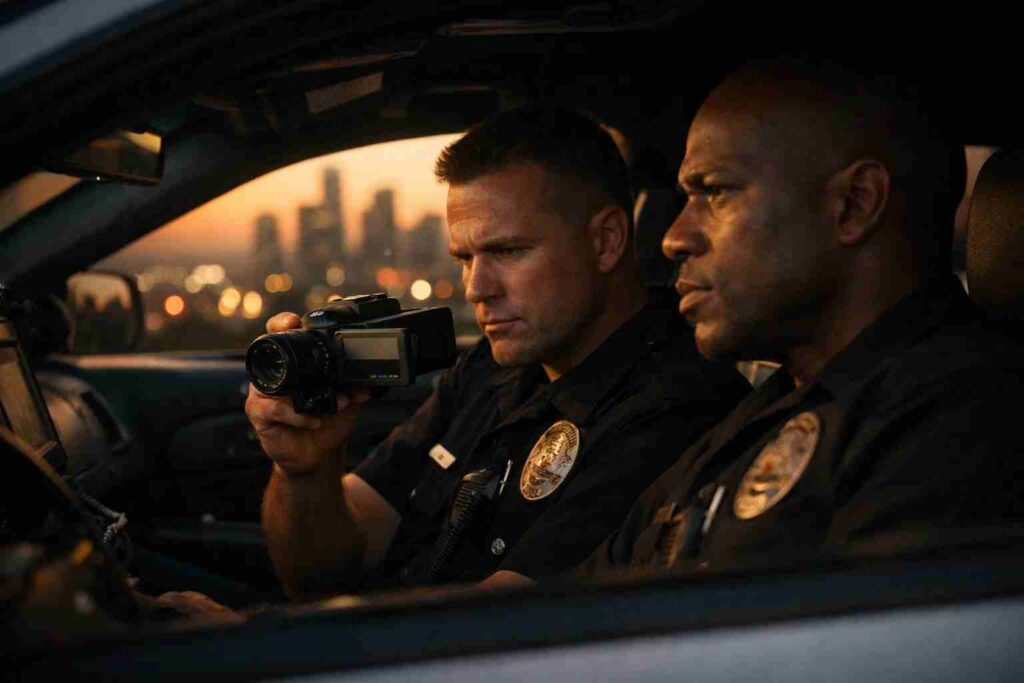
So naturally, people started asking: Is End Of Watch A True Story?
Here’s the short answer. No, it is not based on one specific real case. But that does not mean it came out of thin air.
Let me explain.
The Real Inspiration Behind the Film
End of Watch was written and directed by David Ayer. Before becoming known for gritty crime dramas, Ayer grew up in South Los Angeles. He witnessed gang culture, police tension, and street violence firsthand.
That background shaped this film.
Ayer spent time with real officers from the Los Angeles Police Department while developing the script. He went on ride-alongs. He listened to stories. He studied how partners talk inside a patrol car when the public is not watching.
So while the characters Brian Taylor and Mike Zavala are fictional, the world they move through is grounded in real police experience.
This is not a true story about two specific officers. It is a story built from many real ones.
Is “End of Watch” a Realistic Depiction?
This question comes up often.
Police officers and veterans have discussed the film online, especially on forums like Reddit. Many have said the bond between the two leads feels authentic. The way they joke, argue, and protect each other mirrors real patrol partnerships.
The handheld camera style also adds realism. The film mixes dashboard cameras, body cams, and personal footage shot by the characters themselves. That raw format makes it feel like a documentary.
Still, realism does not mean everything is accurate.
Some officers have pointed out that certain situations escalate more dramatically than typical patrol life. The intensity is compressed for storytelling. Real police work includes long stretches of routine calls. The film focuses on the most dangerous possibilities.
So yes, End of Watch is widely viewed as one of the more realistic police dramas. But it is still a scripted film designed to build suspense.
Did Michael Peña and Jake Gyllenhaal Get Along?
One reason the movie feels so real is the chemistry between its stars.
Jake Gyllenhaal and Michael Peña reportedly trained together before filming began. They went through a kind of unofficial police-style bonding process. They spent time with LAPD officers. They practiced tactical movements. They built trust.
Interviews suggest they became close friends during production. That connection translates on screen. Their banter feels unscripted at times. Their loyalty feels lived-in.
The emotional impact of the final act would not work without that believable friendship.
That part may not be a true story, but it feels like one.
Is It Based on One Specific Case?
No.
There is no single documented incident that directly inspired the exact storyline involving the cartel and the tragic ending.
Instead, the script pulls from real themes:
- Gang violence in Los Angeles
- The risks of patrol duty
- The emotional toll on officers and families
- The deep bond between police partners
In other words, it reflects reality without recreating one headline.
That distinction matters.
Is “True Story” with James Franco a True Story?
Some viewers confuse titles. That leads to another common search question.
True Story, starring James Franco, is based on real events. It tells the story of journalist Michael Finkel and convicted murderer Christian Longo.
That is a different film entirely.
So if you are wondering whether “True Story” is actually true, the answer there is yes, it is rooted in a real criminal case.
But End of Watch stands in a different category. It is inspired by reality, not drawn from a specific documented case.
Why the Film Feels So Personal
Here is what makes the question “Is End Of Watch A True Story?” more complicated than a simple yes or no.
The emotional core feels authentic.
The film does not glamorize police work. It shows fear. It shows moral conflict. It shows officers who laugh one moment and face life-threatening danger the next.
Director David Ayer has said he wanted to honor patrol officers. Not superheroes. Not movie cops. Real street-level officers who respond to domestic disputes, gang calls, and unpredictable violence.
That intention shows.
Even though the story is fictional, it respects the lived experience of many real officers.
The Human Cost at the Center
At its heart, this is a story about brotherhood.
Taylor and Zavala are not just coworkers. They are family. They attend each other’s milestones. They stand up in each other’s weddings. They promise to protect one another.
That bond is not unique to this movie. Many police officers describe their partners the same way.
When tragedy strikes in the film, it resonates because viewers understand that this kind of loss does happen in real life.
Police officers are killed in the line of duty every year. That truth gives the movie emotional weight, even if the exact scenario is fictional.
So, Is End Of Watch A True Story?
Let’s bring it together clearly.
- It is not based on one real case.
- The characters are fictional.
- The events are scripted.
- But the experiences are drawn from real police life.
- The atmosphere reflects authentic LAPD culture.
That blend is why the film feels so believable.
It is fiction built on truth.
And sometimes, that kind of storytelling hits harder than a direct biopic.
Final Thoughts
When people ask whether End of Watch is a true story, what they are really asking is something deeper.
Did this feel real because it was real?
In some ways, yes. In others, no.
The power of the film comes from its emotional honesty. The danger may be heightened. The timeline may be compressed. But the friendship, the fear, and the sacrifice reflect realities faced by officers across America.
That is why it stays with people long after the credits roll.
And that is why the question keeps coming back.

Jessica Savitch, with a deep passion for journalism, brings her expertise to istruestory.com as a dedicated author. MA in Arts & Journalism.