
Some stories feel larger than life. Others feel close enough to touch.
4 Minute Mile sits right in between.
It tells the story of Drew Jacobs, a gifted teenage runner with raw speed and a complicated home life. He has talent. He has drive. But he also carries pressure that no stopwatch can measure. That’s why so many viewers walk away asking the same question:
Was Drew Jacobs based on a real runner?
And just as important:
Is 4 Minute Mile a true story about someone who chased the legendary four-minute barrier?
Let’s separate fact from fiction carefully and honestly.
Is Drew Jacobs a Real Runner?
Here is the clear answer:
No, Drew Jacobs is not a real historical athlete.
He is a fictional character created for the 2014 sports drama film 4 Minute Mile, directed by Charles-Olivier Michaud and starring Kelly Blatz as Drew and Richard Jenkins as Coach Coleman.
You won’t find Drew Jacobs in official track records.
You won’t see his name listed in elite mile rankings.
There is no documented high school phenom with that exact story.
The character was written to represent a type of athlete not one specific real person.
But here’s where it gets interesting.
Even though Drew isn’t real, the emotional weight of his story absolutely is.
What the Film Is Really About
On the surface, the movie looks like a classic sports drama. A talented but troubled teen meets a hardened former coach. Discipline follows. Improvement follows. The big race looms.
But the heart of the story isn’t really about a time on a clock.
It’s about:
- Growing up in instability
- Trying to escape a difficult home life
- Carrying family pressure
- Finding a mentor at the right moment
- Fighting self-doubt as much as physical limits
Drew’s brother is involved in criminal trouble. His mother is overwhelmed. His neighborhood feels limiting. Running becomes his outlet and possibly his way out.
That emotional realism is why so many viewers assume the movie must be based on a true story.
It feels lived in.
The Real History Behind the 4-Minute Mile
While Drew Jacobs is fictional, the four-minute mile absolutely is not.
For decades, experts believed the human body could not run a mile in under four minutes. Doctors claimed the heart would fail. Scientists suggested the lungs could not sustain the pace.
Then, on May 6, 1954, everything changed.
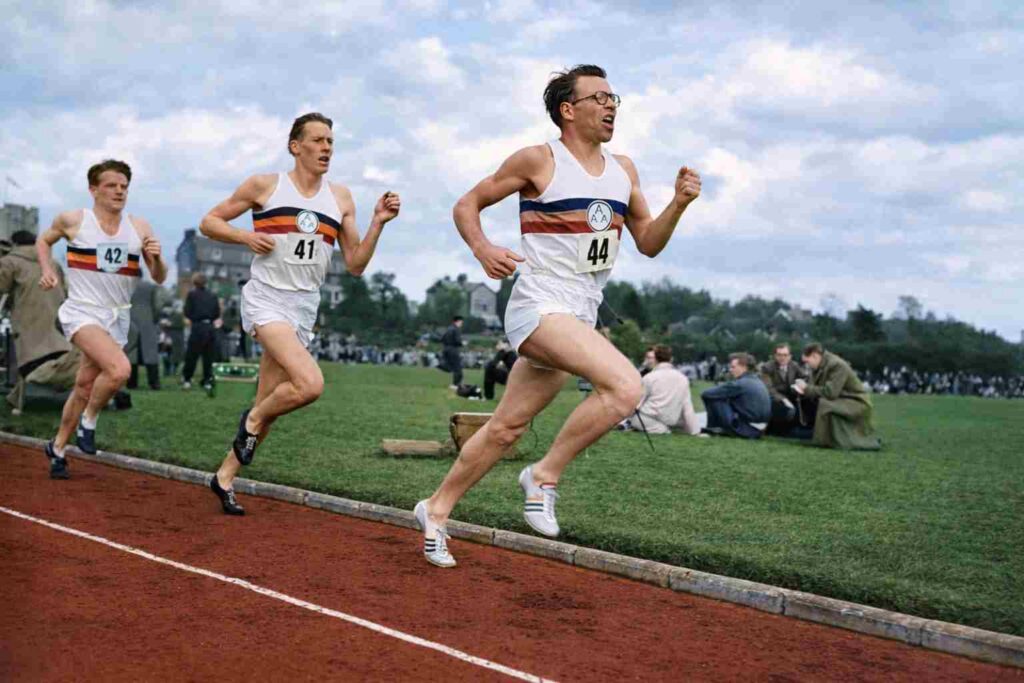
Roger Bannister became the first man in history to run a mile in under four minutes. His official time was 3:59.4, achieved at the Iffley Road Track in Oxford, England.
That moment didn’t just break a record.
It broke a psychological barrier.
Within weeks, other runners followed. The “impossible” suddenly became possible.
Today, hundreds of elite athletes have run sub-four-minute miles. But in 1954, it felt revolutionary.
The film uses this historic milestone as a symbol. Drew isn’t trying to beat Bannister’s record in a literal sense. The four-minute mark represents something bigger pushing past limits that society says cannot be crossed.
Is 4 Minute Mile Based on a True Story?
In strict factual terms:
No, the movie is not based on a specific real individual.
There is no official biography that mirrors Drew Jacobs’ life step by step.
However, the film reflects real-world experiences common in youth athletics:
- At-risk teens finding structure in sports
- Coaches acting as surrogate parental figures
- Talent emerging from disadvantaged neighborhoods
- The mental battle behind elite training
- The pressure placed on young athletes to “make it out”
That’s why the movie feels authentic even without being biographical.
It draws from real social patterns not one real file.
Why the Running Feels So Real
One reason viewers believe Drew Jacobs could be real is how the film treats training.
There is no magical transformation.
No unrealistic overnight success.
No superhero montage.
The running sequences show:
- Exhaustion
- Repetition
- Isolation
- Physical pain
- Mental resistance
That portrayal matches what serious middle-distance runners experience. Breaking four minutes requires not only speed but:
- Aerobic conditioning
- Anaerobic strength
- Technical stride efficiency
- Mental resilience
- Race strategy
The movie respects that process. That realism gives the story credibility.
Quick Fact Summary
To make things clear for readers and search engines alike, here’s a simple breakdown:
| Topic | Verified Fact |
|---|---|
| Is Drew Jacobs real? | No, fictional character |
| Is 4 Minute Mile a true story? | No, fictional sports drama |
| Year film released | 2014 |
| Director | Charles-Olivier Michaud |
| First sub-4 mile runner | Roger Bannister |
| Year 4-minute barrier broken | 1954 |
| Bannister’s time | 3:59.4 |
| Is sub-4 mile possible today? | Yes, achieved by many elite runners |
This table helps clarify the distinction between historical record and cinematic storytelling.
Can Athletes Still Run a Sub-4 Mile Today?
Yes.
In fact, the benchmark remains one of the defining standards in middle-distance running.
Elite male runners routinely dip under four minutes. Some reach times below 3:50 in professional competitions.
However, for high school athletes, breaking four minutes is extremely rare. It requires:
- Advanced training infrastructure
- Exceptional genetics
- Years of disciplined preparation
- Supportive coaching
That’s why the four-minute barrier still holds symbolic power. It separates very good from extraordinary.
And that’s exactly why the film centers around it.
Why People Keep Searching “Drew Jacobs True Story”
Search behavior tells us something important.
When audiences type “Drew Jacobs runner true story,” they are reacting emotionally. They want reassurance that someone like him existed.
That impulse happens when:
- The character feels authentic
- The struggle feels familiar
- The mentorship feels genuine
- The social issues feel accurate
The movie mirrors the experience of countless teens who use sport as an escape. That mirror creates confusion between fiction and biography.
But there is no documented runner whose life the film officially adapts.
What Drew Jacobs Represents
Drew isn’t meant to stand for one name in history.
He represents:
- The teenager training in worn-out shoes
- The athlete balancing family chaos and performance
- The kid who finds direction through discipline
- The young person trying to outrun circumstance
The four-minute mile becomes a metaphor.
Not just for speed.
But for crossing a line everyone told you was too far.
Final Answer
Let’s close this clearly.
Drew Jacobs is not a real runner.
4 Minute Mile is not based on a specific true story.
But the film’s emotional truth is rooted in very real social dynamics and athletic realities. The struggles, mentorship, discipline, and psychological pressure portrayed in the movie reflect authentic experiences shared by many young athletes.
That’s why the story feels honest.
And sometimes, emotional honesty carries more weight than a name in a record book.
When you watch Drew chase that four-minute barrier, you’re not watching a documentary.
You’re watching a symbol of what happens when someone decides they are stronger than the limits placed on them.
And that idea unlike the character is completely real.

Jessica Savitch, with a deep passion for journalism, brings her expertise to istruestory.com as a dedicated author. MA in Arts & Journalism.