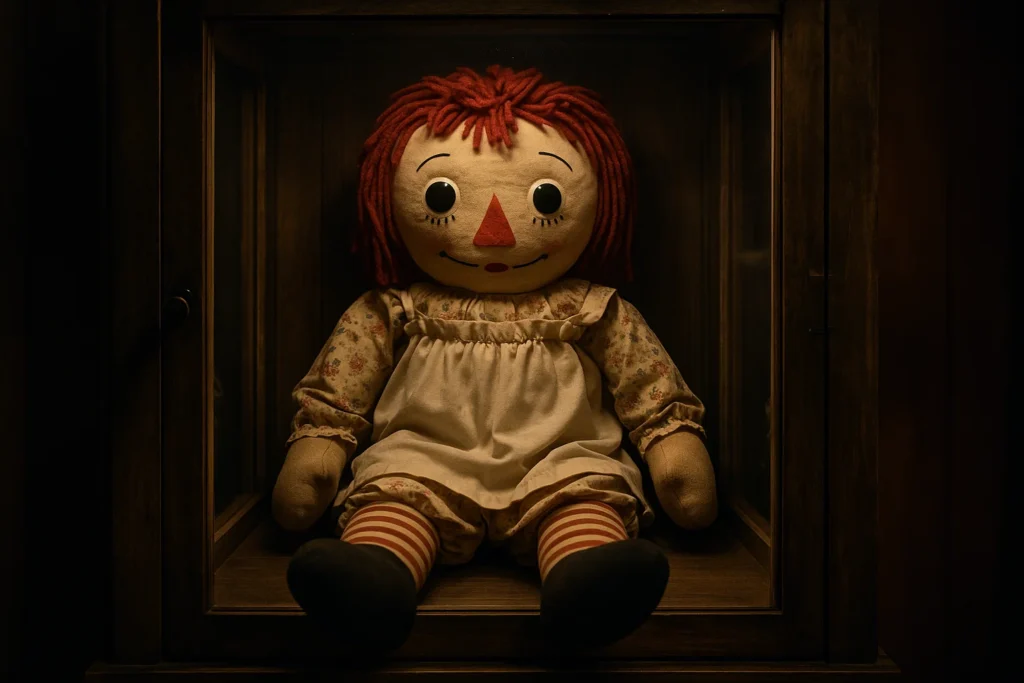
Here’s what matters. The real Annabelle doll never walked, talked, or chased anyone. The terror came from what people said happened around her: the footsteps, the shifting positions, the notes left behind, the scratches on skin, and a warning from paranormal researchers that this wasn’t a ghost at all but something darker trying to get close.
To understand how Annabelle went from a simple rag doll to one of the most talked-about “haunted objects” in the world, we need to walk through the story the way those involved experienced it. Slowly, carefully, and with the facts laid out in order.
How the Story Begins
In 1970, a nursing student named Donna received a Raggedy Ann doll as a birthday present from her mother. It was a sweet gift, something simple to decorate her apartment. Donna and her roommate Angie placed the doll on a small couch and didn’t think about it again until they started noticing it wasn’t exactly staying where they left it.
At first, the movement was small. A slight shift in the doll’s posture. A different angle of the head. But the changes grew more obvious as time went on. Donna said the doll would be in another room entirely, sitting in a place no one had put it. Angie reported the same thing. The experiences weren’t dramatic, but they were consistent enough to unsettle two college students who were otherwise practical, focused, and grounded.
Then the notes started appearing. Small pieces of parchment paper the kind they didn’t even keep in their apartment with messages written in a childlike hand:
“Help us.”
“Help Lou.”
Lou was a close friend who often visited the apartment. He took the events more seriously than the others, not because he believed in ghosts but because he felt something was wrong. He later said the doll made him uncomfortable from the start.
That discomfort became fear after one particular night.
The Night Lou Was Attacked
According to the accounts collected by paranormal investigators, Lou had been sleeping in the apartment when he woke up unable to move. He said he saw Annabelle at his feet. In the next moment, the doll was on his chest. Then, something invisible wrapped around his neck. Lou felt himself losing breath, convinced he was about to die.
When he finally broke free, the doll was back in its place motionless.
It would be easy to dismiss this as a nightmare or sleep paralysis. But the next morning, scratches appeared across Lou’s chest. Bleeding. Fresh. Three long marks.
They disappeared within two days.
This was the moment Donna and Angie decided they needed help.
Enter the Warrens
Ed and Lorraine Warren, paranormal investigators known for studying spirit activity, stepped into the story when they received a call from the students. According to their case files and interviews Lorraine gave through the years, the first thing they noticed was the atmosphere in the apartment. It wasn’t just fear there was a heaviness, a feeling that something was waiting.
The Warrens asked questions, took notes, walked through the timeline, and studied the doll. Their conclusion was very different from what the girls expected.
This wasn’t a spirit of a child, they explained. In fact, there was no child involved at all.
The story the girls had been told by a medium that a young girl named Annabelle had died nearby and wanted to live through the doll was, according to the Warrens, a lie. They described it as an attempt to gain trust. Not by a child spirit, but by something pretending to be one.
What they believed lived inside that doll was not a ghost. They said it was a demonic entity, using fear and attention as a way to get closer to the people in the apartment.
Their view was clear:
Annabelle was not possessed. The doll was being used as a tool.
Why the Doll Couldn’t Be Destroyed
Once the Warrens decided the doll needed to be removed, one question came up again and again: Why not just get rid of it?
People often ask:
“Why can’t you burn Annabelle?”
“Why not throw it away?”
The Warrens gave a simple explanation. Destroying the doll does nothing if the entity itself isn’t removed. In their words, the doll was a conduit, not the source. Burning it could make things worse because the act might provoke the spirit attached to it.
So the Warrens took Annabelle with them, performing a series of prayers and placing her in their car. Even that drive didn’t go smoothly. According to Ed Warren, the brakes failed more than once on the way home, and the car swerved dangerously. He sprinkled holy water on the doll, and the disturbances stopped.
Life Inside the Occult Museum
Annabelle eventually became part of the Warrens’ Occult Museum locked in a wooden case with a warning sign:
“Positively Do Not Open.”
The doll stayed behind glass for decades. Visitors came from all over the world some curious, some skeptical, some hoping to see the object behind one of the most famous supernatural stories in modern culture. Despite its simple Raggedy Ann appearance, the case around Annabelle became almost as iconic as the doll itself.
Before Lorraine Warren passed away, she often gave interviews about the doll. She insisted it was one of the few objects she never felt comfortable being near, even after years of experience. In one interview, she said that mocking or challenging the doll was dangerous. The stories shared from the museum suggested that at least one visitor who ignored that warning suffered a fatal motorcycle accident shortly after leaving.
It’s impossible to verify such stories with absolute certainty, but they remain part of the cultural memory attached to Annabelle. They help explain why the doll was kept locked, blessed regularly, and treated with extreme caution.
Today, the real Annabelle doll remains under the care of the Warren family and their team, still sealed inside its iconic case. It’s no longer in the public museum due to zoning issues, but it hasn’t been moved far from its original home.
How Hollywood Changed the Story
When The Conjuring series introduced Annabelle to audiences, they made one major change they redesigned the doll. The original Raggedy Ann didn’t look frightening. So the movies turned Annabelle into a cracked porcelain nightmare with glowing eyes and a mean expression.
It worked for cinema, but it changed the way people imagined the true story.
The real Annabelle doll never looked evil. That’s part of why the story is so unsettling. Horror doesn’t always come with sharp teeth or dramatic shadows. Sometimes it comes dressed in red yarn hair and a stitched-on smile.
Hollywood also amplified the events for entertainment. The possessions, the violent encounters, the dark hallways none of that happened in real life. What did happen were small, consistent disturbances that built into something the people involved could no longer ignore.
What Is the Demon Behind Annabelle?
The Warrens never gave the entity a name. They never tried to identify it the way people might identify spirits in folklore. Their focus was on understanding its behavior rather than its identity.
But they described it with a few key traits:
- It was non-human.
- It was manipulative, pretending to be innocent.
- It wanted recognition and control, not friendship.
- It targeted emotional vulnerability.
To the Warrens, the most important rule was that a doll cannot be possessed. Only people can. The presence attached to Annabelle was always seeking something beyond the doll something it could influence directly.
Whether one believes in demons or not, this explanation shaped the entire narrative of the Annabelle case.
Why the Story Still Matters
Annabelle is not just a scary story. It’s a study of belief, fear, and the way people explain the unknown. Some see the Warrens’ work as sincere and based on genuine experiences. Others doubt the entire case and view it as folklore shaped by human imagination.
Either way, the story holds power because it taps into something universal: the feeling that familiar objects can hold unfamiliar forces. A doll meant to comfort a child suddenly becomes something that watches, moves, and responds.
People often ask:
“What is the true story of the Annabelle doll?”
The truth is simple and complicated at once.
The real doll is a piece of cloth and stuffing. The meaning comes from the people who lived with it, feared it, and tried to understand what was happening around them.
The story endures because it sits in the space between certainty and possibility. Not proven, not disproven but carried forward through testimony, emotion, and time.
So, Is the Annabelle Story Real?
Here’s the bottom line.
The events linked to Annabelle come from eyewitness accounts, the Warrens’ documentation, newspaper interviews, and decades of retelling. The doll exists. The museum existed. The investigators were real. The scratches, notes, and disturbances were real to the people who experienced them.
But the interpretation whether it was a spirit, a demon, or something that can be explained through psychology or coincidence depends on what you believe about the world.
In the end, Annabelle is both a true story and a legend. A documented case and a cultural symbol. A harmless rag doll and a vessel for some of the most debated paranormal claims of the last century.
And perhaps that’s why her story stays alive. Because fear, once attached to an object, doesn’t fade easily.
It lingers.
Just like Annabelle.

Jessica Savitch, with a deep passion for journalism, brings her expertise to istruestory.com as a dedicated author. MA in Arts & Journalism.