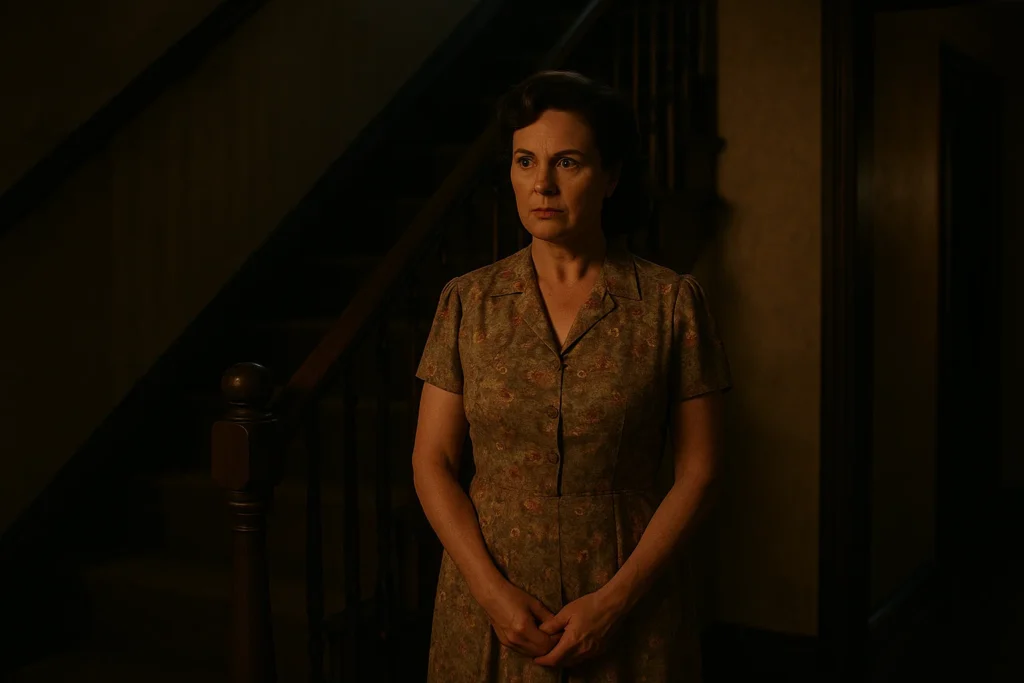
Here’s what matters: Alma is not a real person, but the emotions behind her journey feel painfully real. Her story blends ambition, insecurity, jealousy, and the desire to finally be seen. That mix is what makes viewers wonder whether she was based on somebody true. So let’s take a clear look at who she is, what shaped her storyline, and why so many people walked away feeling haunted.
The Woman Behind the Curtain: Who Was Alma Fillcot?
Alma Fillcot enters Season 2 as a gentle, almost invisible housewife someone who has spent years believing she doesn’t matter much. She dreams of joining the local Garden Club, a place where approval feels like a ticket to being seen. On the surface, her goal seems harmless. What sits underneath is something more human: she’s tired of feeling small.
As the story unfolds, Alma discovers her husband’s secrets, especially the disturbing truth about the death of Mrs. Yost. That moment becomes the turning point. Instead of walking away, she steps deeper into a world she didn’t belong to, changing piece by piece until she barely resembles the timid woman we met at the start.
Her transformation is the heart of Season 2. It’s slow, steady, and frighteningly believable.
Is Alma Fillcot a Good Person?
Here’s the honest answer: Alma begins with good intentions, but she loses herself. The need to feel important takes over everything else.
She wants respect. She wants love. She wants to fit into a world that has always shut its doors on her. When those doors open only partway, she forces them wider using choices that cross every moral line in front of her.
Viewers debated this endlessly. Some felt sympathy because her pain was recognizable. Others were shocked at how quickly she embraced darker decisions. But by the end, Alma becomes someone driven more by fear and pride than kindness.
She isn’t a villain in the traditional sense. She’s someone who let a lifelong wound guide her down the wrong road.
Did Rob Love Beth Ann?
This question surfaces often because it highlights a theme shared across the series: broken marriages, emotional distance, and the longing for something better.
Rob and Beth Ann’s relationship belongs to Season 1, but it still echoes in the conversation around Alma because both stories deal with spouses who feel unseen. Rob did care about Beth Ann, but he failed her emotionally. His love wasn’t strong enough to keep him faithful or present. Beth Ann loved deeply, while Rob loved in pieces.
Why does this matter to Alma’s story? Because the show uses these parallel marriages to remind us that pain inside a home doesn’t always come from physical harm. Sometimes it comes from being ignored for too long. That’s something Alma understood well.
Do They Find Mrs. Yost?
Mrs. Yost’s disappearance is the spark that lights Alma’s entire storyline. Her death, originally accidental, becomes a secret that Alma and her husband Bertram try to hide. That choice sets everything else in motion.
The search for Mrs. Yost becomes an ongoing threat. People grow suspicious. Clues start to surface. And the quiet panic in Alma’s home becomes impossible to ignore. By the time the truth surfaces, Alma is already too deep in her own ambition to turn back. She no longer panics at the idea of being caught she panics at the idea of losing everything she worked to gain.
Mrs. Yost is eventually discovered, but by then, Alma’s transformation is complete. She has become the kind of woman who believes image matters more than honesty.
Is Alma Fillcot Based on a True Story?
The simple answer is no. Alma Fillcot is a fictional character created for Why Women Kill. No real historical person inspired her directly.
But here’s the reason people keep asking: her emotions feel familiar.
Online discussions on Reddit show viewers reacting strongly to her final episodes, saying her sudden coldness felt “too real” and “deeply uncomfortable.” That’s because her arc mirrors something many people understand what happens when loneliness mixes with envy and the fear of being forgotten.
Her story pulls pieces from universal human struggles:
- Wanting approval
- Losing control of your image
- Feeling invisible
- Reaching for status that never belonged to you
Those emotions come from real life, even if Alma herself does not.
Her Rise and Fall: Why Alma’s Story Stays With You
Alma’s greatest fear wasn’t jail or judgment. It was going back to being nobody. Every decision she made good or bad was tied to that feeling.
She wanted beauty.
She wanted belonging.
She wanted to be admired.
Season 2 shows how dangerous it becomes when a person attaches their entire self-worth to the opinions of others. Alma’s climb to the top wasn’t graceful. It was desperate. And when she finally stood in the spotlight she always craved, she had already lost the parts of herself that mattered.
That is the real tragedy behind her story.
What Alma’s Story Says About Us
If Alma Fillcot feels real, it’s because her weaknesses are common. Many people have felt overlooked. Many have craved acceptance. Most wouldn’t go where she went, but they understand the emotions that pushed her.
Her story reminds us that ambition without grounding can become dangerous. It also shows how quickly a person can change when they finally taste the approval they’ve always been denied.
Bottom line: Alma Fillcot is fictional, but the fears that shaped her are not.
A Final Look at the Alma Fillcot True Story
Alma’s tale isn’t built on real events, but it carries emotional truth. She began as an ordinary woman with ordinary dreams. She ended as someone hardened by her own hunger for recognition. What makes her unforgettable is not the crimes she covered up but the loneliness that drove them.
She is a warning wrapped in a character study: if you chase admiration long enough, you might lose yourself in the process.
Her story shows how thin the line can be between wanting a better life and becoming someone you never meant to be.

Jessica Savitch, with a deep passion for journalism, brings her expertise to istruestory.com as a dedicated author. MA in Arts & Journalism.