No, Ohio State Murders is not a true account of a double murder at Ohio State University. It is a fictional play by Adrienne Kennedy, shaped by her real experiences as a Black student at the university. The central murders are part of the drama, not a documented event from the playwright’s life. Ohio State University itself explains that the killings in the story are not strictly autobiographical.
That distinction matters. The play tells a painful story about a woman looking back on racism, grief, and the way a place can change a person’s life. Its emotional truth comes from real experiences, but its crime plot is invented. Here is what happened in the play, what Kennedy actually lived through, and how the story reached Broadway.
What Is Ohio State Murders About?
The main character is Suzanne Alexander, a successful Black writer who returns to Ohio State University to speak about violence in her work. As she prepares for her talk, she remembers arriving on campus as a student in 1949, hoping to study literature and build a future.
Her memories are not happy ones. She faces exclusion, hostility, and unequal treatment. The events become darker as she recalls a relationship with a professor and the loss of her twin daughters. The play reveals the murder of the children through Suzanne’s memories rather than through a police-style investigation. The official licensing synopsis calls Suzanne a fictional writer whose life partly resembles Kennedy’s.
Plot clarification: The twins, Suzanne, and the central murder mystery belong to Kennedy’s fictional story. They should not be presented as victims or evidence from an actual Ohio State criminal case. For another example of a fictional story rooted in a writer’s observations of racism, see our discussion of To Kill a Mockingbird and its real-life influences.
Which Parts Came From Adrienne Kennedy’s Real Life?
The setting is real. Adrienne Kennedy entered Ohio State University in 1949 and graduated in 1953. She later became an influential American playwright. Her time on campus, however, left painful memories. In a 1992 profile published by American Theatre, Kennedy and the journalist discussed the racism she encountered, including barriers faced by Black students who wanted to study English literature.
Kennedy studied elementary education. Years later, she turned her memories of campus life into a play that explores exclusion through an imagined tragedy. Ohio State’s Department of Theatre, Film, and Media Arts identifies Ohio State Murders as one of her autobiographically inspired works. Inspired is the important word: it does not mean that every character or event happened.
The university’s College of Arts and Sciences makes an especially useful distinction. It says the murders at the center of the drama are not strictly autobiographical and connects the violent imagery to the emotional harm caused by racism, including the loss of innocence and educational hopes.
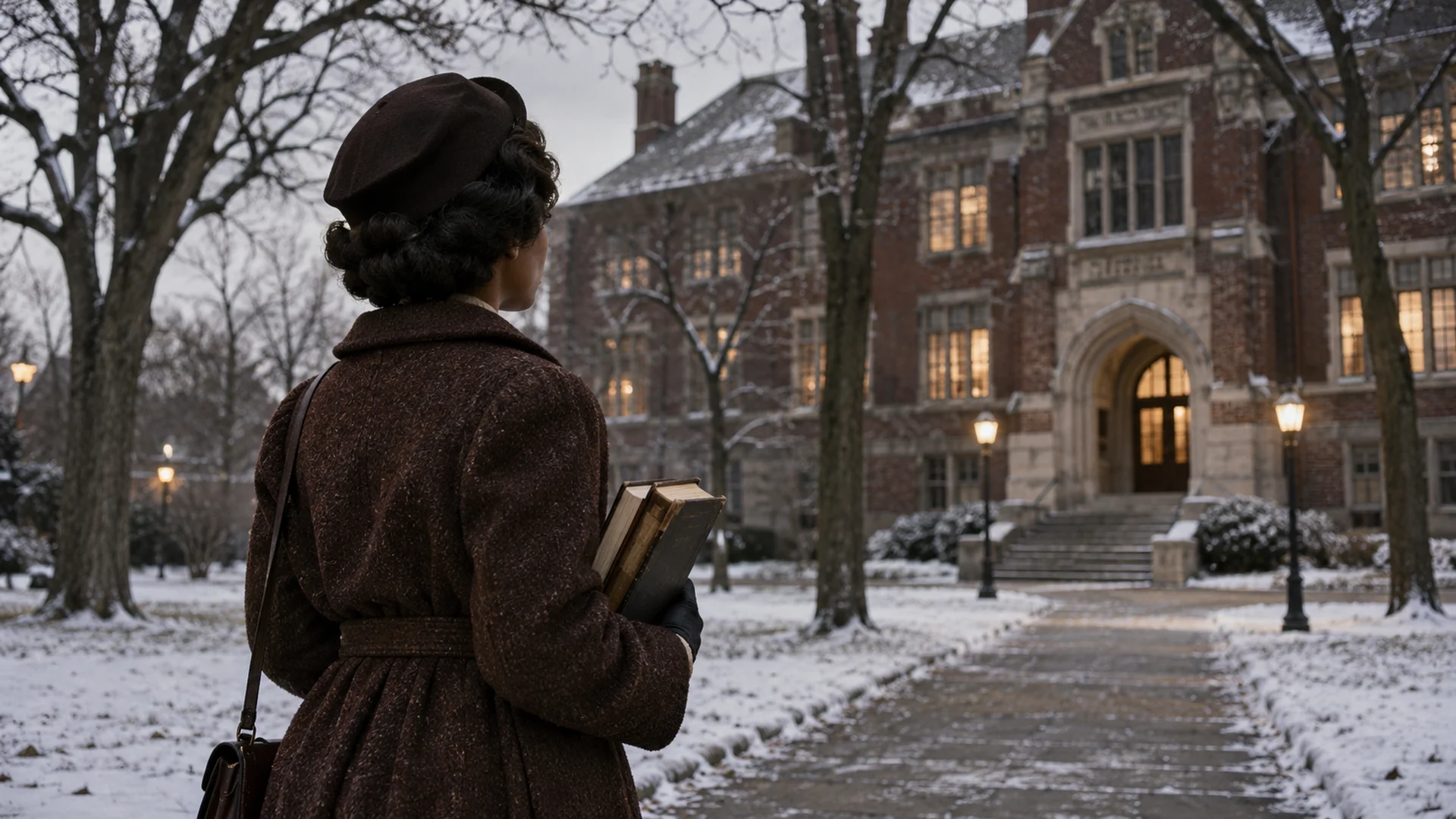
The campus scenes accompanying this article are editorial illustrations, not photographs of Kennedy or documentary images of a crime. They help suggest the period and atmosphere without pretending to show real evidence.
Did the Murder of Suzanne Alexander’s Twins Really Happen?
There is no basis in the play’s documented background for treating the twins’ murders as a real case involving Kennedy. Suzanne Alexander is fictional. Her daughters’ deaths are part of the script, and the playwright did not describe that plot as an incident from her own life.
Kennedy explained the difference in a revealing 2000 interview with the American Repertory Theater. She said she had long wanted to write about Ohio State but knew the story needed to be fictionalized. She also separated her ordinary student experiences from the much darker world of Suzanne’s play.
This does not make the story’s message false. A drama can show the damage of real discrimination without reconstructing a literal crime. But it would be wrong to suggest that investigators were still seeking answers to a real pair of child murders just because the play uses the language of mystery.
That is different from a film such as Till, which portrays an actual, documented killing. Both works address racism and its consequences, but they have very different relationships to historical evidence.
How Did Kennedy Get the Idea for the Play?
The spark came decades after college. During the 1989 California earthquake, Kennedy was teaching at Stanford University. The earthquake and its aftershocks left her frightened and forced her to leave her damaged home for a time.
In the same first-person interview, she recalled that the experience brought back memories of Ohio State. She completed the play in about six weeks. That history explains why the script feels personal even though it is not a literal memoir.
Kennedy was interested in suspense, memory, and the feelings people carry long after events have passed. She used an imagined crime to explore those feelings. The result is a story about emotional harm as well as a stage mystery. Readers do not need to search for a matching murder file to understand what she wanted to express.
When Was Ohio State Murders Written and Performed?
The play is sometimes mistaken for a movie or a television series because of its dramatic title and well-known Broadway cast. It is, first and foremost, a work written for the stage.
| Year | What happened |
|---|---|
| 1949 | Adrienne Kennedy began studying at Ohio State University, the real-life setting that later inspired the play. |
| 1992 | Ohio State Murders premiered at the Great Lakes Theater Festival on March 7, according to Concord Theatricals. |
| 2007 | Theatre for a New Audience produced an Off-Broadway staging, also recorded by Concord Theatricals. |
| 2022 | The Broadway production starring Audra McDonald and directed by Kenny Leon opened December 8 at the James Earl Jones Theatre. |
| 2023 | That Broadway run ended January 15, according to the Tony Awards production record. |
Audra McDonald played Suzanne Alexander in the Broadway staging. The production earned her a Tony Award nomination. It also marked Kennedy’s Broadway debut as a playwright, many years after her work first gained recognition. The university production announcement confirms these details.
Stage stories can relate to history in very different ways. For comparison, Newsies draws on a documented historical labor strike, while Ohio State Murders blends a real writer’s memories with a fictional family tragedy.
Why Does the Play Use a Murder Mystery?
The title creates a strong question: Who died, and what happened? Kennedy uses that curiosity to lead the audience toward something wider. Suzanne’s story asks what happens when a young person comes to a university looking for knowledge but meets racism and rejection instead.
In Playbill discussion of the Broadway production, Audra McDonald describes how the play communicates the effects of systemic racism. The suspense keeps the audience listening, but the emotional weight comes from Suzanne’s memories and the life she believes was taken from her.
There is also a reason the story is told by an older writer looking back. Distance does not erase painful memories. Suzanne can now speak clearly about her past, yet the past still shapes how she understands herself. That tension gives the drama much of its force.
Questions Readers Often Ask
Is Suzanne Alexander a real person?
No. Suzanne is a fictional character created by Adrienne Kennedy. Her experiences overlap with aspects of Kennedy’s life, but she should not be treated as the playwright’s exact biography.
Were the Ohio State murders an actual campus crime?
Not the murders depicted in Kennedy’s play. They are fictional plot events. The title does not establish a historical murder investigation.
Who played Suzanne Alexander on Broadway?
Audra McDonald played her in the production that opened on December 8, 2022, directed by Kenny Leon.
Is Ohio State Murders a film or television series?
It is best known as a stage play, first premiered in 1992 and later produced on Broadway. The 2022 production was theater, not a television crime series.
What the True Story Question Really Reveals
Ohio State Murders is not a factual record of murdered twins. It is a fictional drama with autobiographical roots: a real university, a real playwright, and real experiences of discrimination shaped into a deliberately darker story. Kennedy did not need an actual murder case to say something serious about the impact of racism.
So the answer is clear. The play is inspired by true experiences, but the central murders are fiction. Understanding both sides makes its title less misleading and its message more powerful.

I am Jeremy Jahns – Your Cinematic Explorer
Immerse in movie reviews, Hollywood insights, and behind-the-scenes stories.