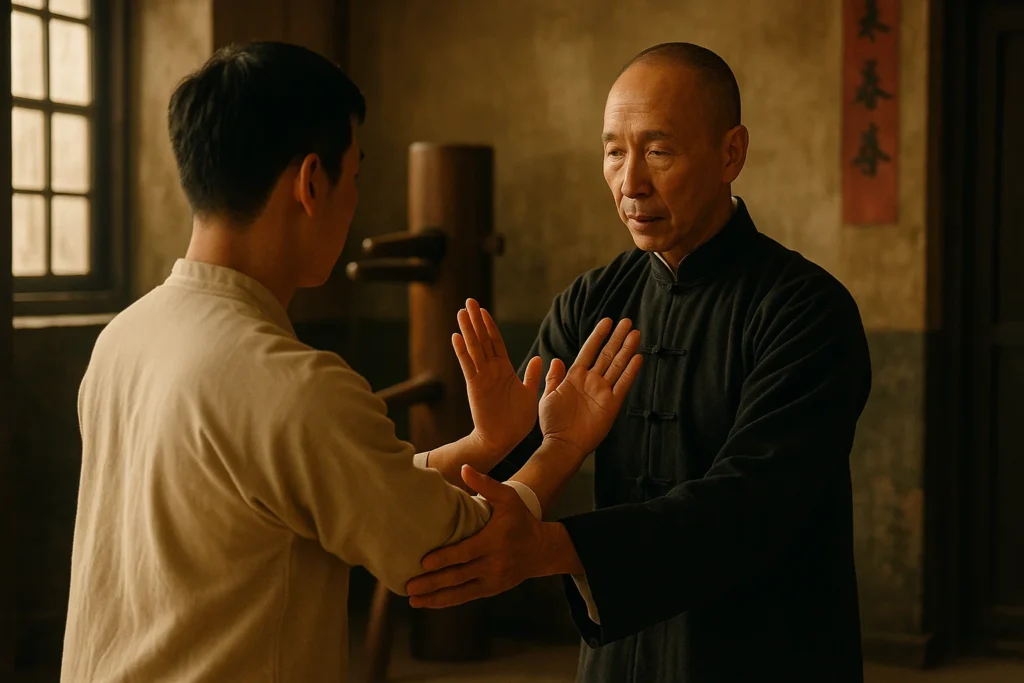
The honest answer sits in the middle. The man was real. His influence was real. Many events were not.
Let me explain where history ends and storytelling begins.
Who Was Ip Man in Real Life?
Ip Man was born in 1893 in Foshan, China. He came from a wealthy family, received a formal education, and trained in Wing Chun under respected teachers. This part of the story is solid history.
He was not a wandering street fighter. He was not known for public duels. And he was not famous in his youth.
His real legacy came later.
After fleeing to Hong Kong during political turmoil in China, Ip Man began teaching Wing Chun openly. That decision mattered. Before him, the art was guarded and passed down quietly. Ip Man made it public.
Most importantly, he became the teacher of a young martial artist who would later change global cinema forever.
What the Ip Man Movies Get Right
The films do capture several truths, even when wrapped in drama.
These elements are accurate:
- Ip Man was a real Wing Chun master
- He taught Wing Chun in Hong Kong
- He trained Bruce Lee
- He lived modestly later in life
- He valued discipline, restraint, and respect
The emotional core of the character is believable. Those who knew Ip Man described him as calm, private, and principled. The movies lean into that personality, and that part rings true.
Where things change is scale.
What the Movies Change or Exaggerate
Cinema needs conflict. History often does not provide it cleanly.
The “Ten Black Belts” Fight
One of the most famous scenes shows Ip Man defeating multiple opponents alone. There is no historical record of this event. It’s symbolic, not factual.
The scene exists to establish moral authority and physical mastery in minutes. Real life doesn’t work that way.
The Japanese Occupation Narrative
Ip Man did live through the Japanese occupation of China, and those years were difficult. But the movies compress events, heighten cruelty, and invent confrontations to create a clear villain.
History was messier. Less cinematic. More tragic than triumphant.
Ip Man and Bruce Lee: What Really Happened?
This relationship is real. The legend around it is not.
Bruce Lee studied Wing Chun under Ip Man as a teenager in Hong Kong. Ip Man did not personally train Lee every day. Senior students handled much of the instruction.
Still, the mentorship mattered. Wing Chun shaped Bruce Lee’s foundation, even as he later moved beyond it.
Did Bruce Lee Fight Wong Jack Man?
Yes. This fight happened.
Bruce Lee fought Wong Jack Man in 1964 in California. What exactly happened remains debated. Some say the fight was brief. Others say it was exhausting and changed Bruce Lee’s approach to training.
Ip Man was not present. He did not influence the fight directly. The movies often blur timelines to suggest otherwise.
Did Donnie Yen Actually Fight Mike Tyson?
No.
This one is simple. The fight between Ip Man and an American boxer is pure cinema.
Mike Tyson appears in Ip Man 3 in a choreographed exhibition scene. It’s symbolic. It’s entertaining. It never happened.
The real Ip Man never fought a Western heavyweight champion. The scene exists to dramatize East-meets-West tension and nothing more.
Are All Ip Man Movies Based on True Stories?
No. They are historical fiction inspired by real people.
Here’s a clear breakdown:
- Ip Man himself: real
- His role as a teacher: real
- Bruce Lee as a student: real
- Major fights: mostly fictional
- Timelines: heavily rearranged
- Antagonists: often invented or exaggerated
The films use history as a skeleton. The muscle and movement are storytelling.
Why the Ip Man Legend Still Matters
Here’s the part that often gets missed.
Even stripped of exaggeration, Ip Man’s real impact is enormous. Wing Chun spread globally because of his teaching. Bruce Lee carried that influence into film, philosophy, and modern martial arts.
The movies don’t document history. They translate legacy.
They turn quiet influence into visible drama. They turn teaching into heroism. That’s not accuracy, but it is meaning.
The Bottom Line
Is Ip Man based on a real story?
Yes. The man existed. His influence is real. His legacy is undeniable.
But the fights, rivalries, and heroic moments are mostly fictionalized to serve the screen.
Think of the Ip Man films the way you’d think of a historical epic. Rooted in truth. Shaped by myth. Powered by symbolism.
The real Ip Man didn’t need to defeat armies to matter. He changed martial arts by teaching, by restraint, and by shaping the man who would take kung fu to the world.
And that part is completely true.

Jessica Savitch, with a deep passion for journalism, brings her expertise to istruestory.com as a dedicated author. MA in Arts & Journalism.