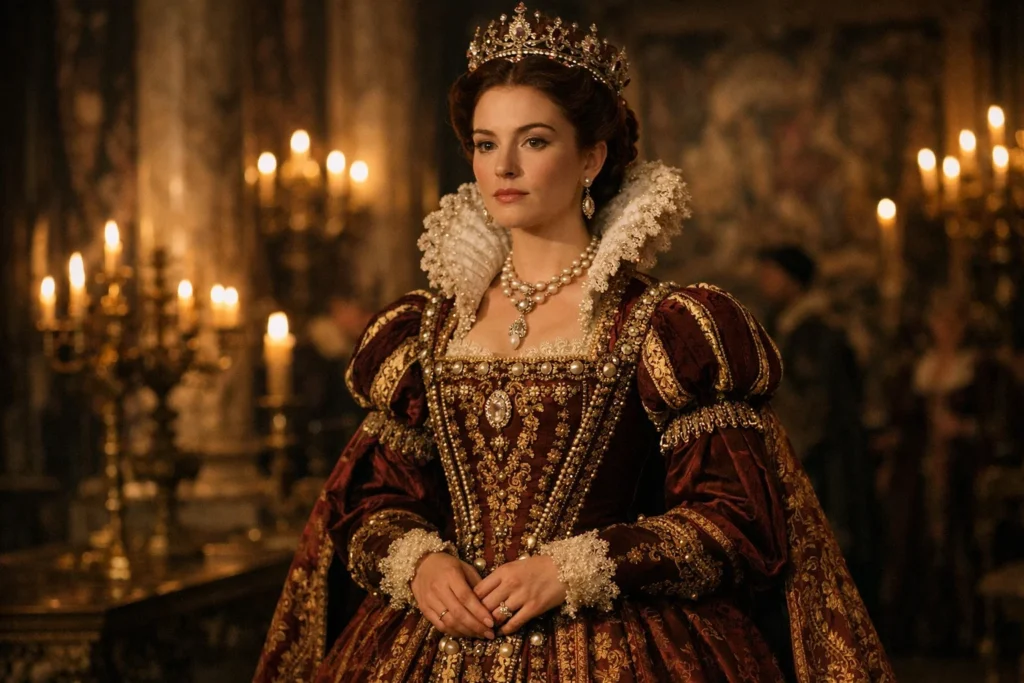
So the big question is simple:
Is The Serpent Queen a true story?
The short answer: Yes – but with dramatic changes.
The series is based on real history. Catherine de Medici was a real queen of France. Many political events in the show truly happened. But like most historical dramas, it reshapes details for entertainment.
Let’s break it down clearly and carefully.
What Is The Serpent Queen Based On?
The Serpent Queen is inspired by the real life of Catherine de’ Medici.
Catherine was born in Florence, Italy, in 1519. She later married Henry II of France and became Queen of France. After his death, she ruled as regent for her young sons.
The show is adapted from the book Catherine de Medici: Renaissance Queen of France. It focuses on:
- Her forced marriage into French royalty
- Court politics and betrayal
- Religious conflict in France
- Her struggle to protect her children and power
These parts are rooted in history. But the tone and some characters are dramatized.
Is The Serpent Queen Historically Accurate?
Now we get to the heart of it.
Is The Serpent Queen historically accurate?
Partly.
Here’s what the show gets right:
✔ Catherine’s Background
- She was orphaned young.
- She married into French royalty for political reasons.
- Her husband openly favored his mistress, Diane de Poitiers.
All of that is historically supported.
✔ Religious Conflict
France in the 1500s faced violent conflict between Catholics and Protestants (Huguenots). Catherine played a major role in navigating those tensions.
✔ Her Political Influence
After King Henry II died in 1559, Catherine became one of the most powerful women in Europe. She acted as regent for her sons:
- Francis II
- Charles IX
- Henry III
That political power is real history.
Where the Show Takes Creative Liberties
But not everything is exact.
- Dialogue is modern and stylized.
- Some timelines are compressed.
- Certain relationships are exaggerated for drama.
- The show presents Catherine breaking the fourth wall – something obviously fictional.
Also, some characters are adjusted or partially fictional.
That brings us to another important question.
Was Edith a Real Person in Serpent Queen?
Edith appears as a key character in the series.
However, there is no strong historical record confirming an Edith in Catherine’s inner circle exactly as portrayed.
This suggests she may be:
- A fictional character
- A composite of multiple real figures
- A dramatized version of someone minor in history
Historical dramas often combine characters to simplify complex court politics.
So while many central figures are real, Edith likely serves storytelling purposes.
What Happened to The Serpent Queen in Real Life?
Catherine de Medici’s life did not end in fantasy or mystery.
She ruled behind the throne for decades during one of France’s most violent eras.
One of the most controversial events linked to her is the St. Bartholomew’s Day Massacre (1572) – a mass killing of Protestants in Paris.
Historians still debate her exact level of responsibility. Some argue she helped plan it. Others say she was trying to control an already explosive situation.
What we know for certain:
- She survived political chaos for years.
- She outlived several of her sons.
- She died in 1589 at age 69.
After her death, the Valois dynasty soon collapsed.
Catherine was never officially called “The Serpent Queen” during her lifetime. That nickname came later, shaped by her enemies and later historians.
Did Mary, Queen of Scots, and Catherine de Medici Get Along?
Mary, Queen of Scots also appears in the historical timeline.
Mary married Catherine’s son, Francis II.
Their relationship was politically tense.
Mary was young, confident, and deeply Catholic. Catherine was protective of her own power and suspicious of foreign influence.
When Francis II died after only one year of marriage, Mary returned to Scotland. Catherine then maintained stronger control over France.
So did they get along?
History suggests they were not close allies. Their relationship was cautious, strategic, and shaped by politics rather than friendship.
Why Is Catherine Called The Serpent Queen?
The title reflects how history judged her.
For centuries, Catherine was painted as:
- Manipulative
- Ruthless
- Power-hungry
Much of this reputation came from Protestant writers who blamed her for religious violence.
Modern historians take a more balanced view. They see her as:
- A woman surviving in a male-dominated world
- A political strategist protecting her children
- A ruler navigating civil war
The show leans into both sides – the villain and the survivor.
So… Is The Serpent Queen a True Story?
Let’s summarize clearly.
Yes, the series is based on real historical figures and events.
No, it is not perfectly accurate in every detail.
Think of it this way:
- The skeleton is real history.
- The muscle and clothing are a dramatic interpretation.
If you want emotional truth and political intrigue, the show delivers.
If you want strict documentary-level accuracy, you’ll need history books alongside it.
Final Thoughts
The Serpent Queen brings Catherine de Medici back into public conversation.
It challenges the old image of her as simply a villain. Instead, it asks us to see her as a woman shaped by power struggles, religion, betrayal, and survival.
History is rarely simple. And this story proves it.
The real Catherine was neither pure hero nor pure villain. She was human. Complex. Strategic. And unforgettable.
That part, at least, is absolutely true.

Jessica Savitch, with a deep passion for journalism, brings her expertise to istruestory.com as a dedicated author. MA in Arts & Journalism.