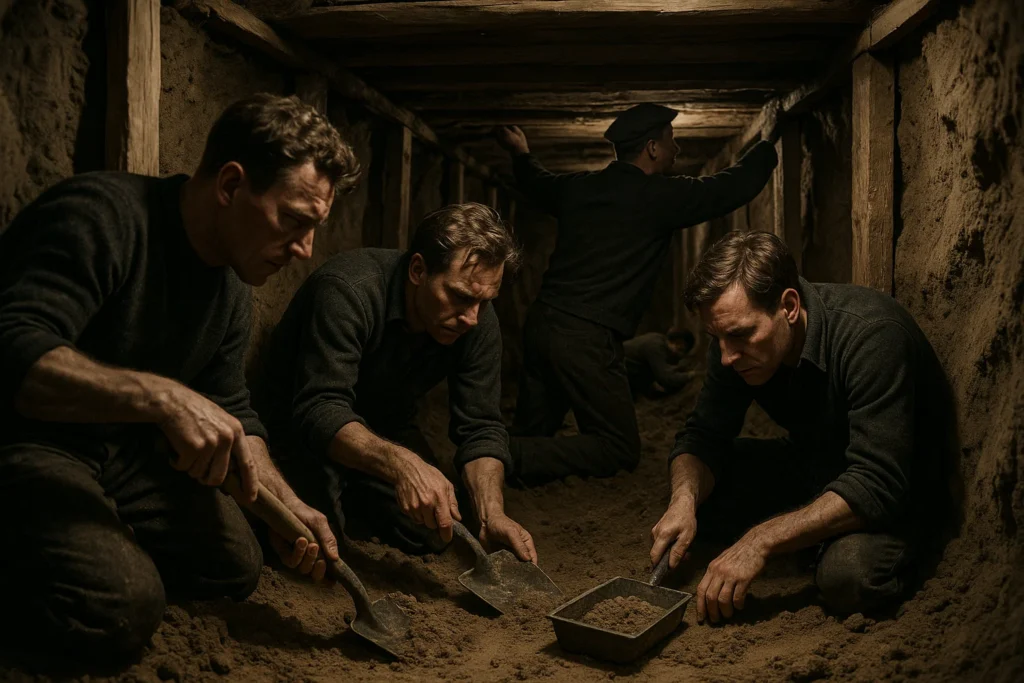
The real story begins in 1942, when the camp became home to Allied airmen who had one stubborn habit escaping. The Germans thought they had designed a place no one could break out of: raised huts, alert guards, sandy soil that collapsed easily, and an isolation meant to wear prisoners down. But these men were tired of waiting for the war to end. They didn’t want to feel like the world had forgotten them. So, they found a way to fight back.
Where the Real Story Starts
Stalag Luft III wasn’t just any POW camp. Its prisoners were pilots, engineers, carpenters, and thinkers. Together, they built escape committees, scouted weaknesses, and designed some of the most complex tunnels ever attempted in a prison setting.
Their goal wasn’t small. They wanted to break out as many men as possible, overwhelm German forces, and force the Nazis to spend time, fuel, and manpower chasing escaped airmen instead of fighting the war. It was a disruption mission wrapped in a survival mission.
The movie captures the tone well, but it simplifies everything. The truth required math, engineering, patience, and months of planning.
Were the Tunnels Real? Yes and Even More Impressive.
Three tunnels existed: Tom, Dick, and Harry. The names sound playful, but their construction was anything but.
Here’s what made them remarkable:
- Each tunnel was around 30 feet underground, deeper than guard dogs could smell and farther than microphones could detect.
- Wooden bed slats became support beams.
- Tin cans became ventilation ducts.
- Clothing dyed with boot polish was stitched into civilian “escape outfits.”
- Forged documents were made inside a POW camp with nothing but pencils, stolen ink, and imagination.
And yes, the tunnels did exist. They weren’t fiction. “Harry,” the tunnel used for the actual escape, ran over 300 feet long one of the most ambitious tunnel operations of the war.
Modern historians and investigators have visited the site. Some tunnel segments and remains of ventilation systems have been uncovered, confirming how real and advanced these structures were.
How Much of the Movie Is Real?
Bottom line: the escape itself is real, but the characters and some dramatic sequences are fictionalized.
What’s accurate:
- The tunnels existed.
- More than 600 prisoners worked on the escape over many months.
- 76 men made it out through the tunnel.
- The escape was one of the most organized POW breakouts of WWII.
- The German response was harsh and unforgiving.
What’s inaccurate:
- The Steve McQueen motorcycle chase never happened. It’s iconic, but it’s Hollywood.
- Many film characters are composites or entirely fictional.
- The movie adds humor and action where the actual event was slow, cold, and exhausting.
- In reality, the breakout night was chaotic, cramped, quiet, and desperate.
The truth carries a different kind of intensity less cinematic action, more fear and determination.
How Many Really Escaped?
This is where the story changes from daring to tragic.
- 76 prisoners escaped through the tunnel.
- 73 were captured.
- Only 3 men reached freedom.
Those three men made it safely to:
- Sweden
- Spain
- British-controlled territory
For the rest, the consequences were brutal.
The Darkest Part of the True Story
After the escape, Adolf Hitler reacted with fury. He wanted all escapees executed, but Nazi officials pushed back. The final decision was horrific nonetheless: 50 prisoners were murdered by the Gestapo, taken to secluded areas, and shot under false “attempted escape” reports.
This is the part the movie softens. In reality, these were targeted killings across Germany and Eastern Europe quiet, deliberate, and far from the heroic tone of the film’s final minutes.
It remains one of the most disturbing war crimes committed against Allied POWs during World War II.
What Happened to the Camp After the Escape?
The breakout didn’t stop the war, but it forced the Germans to rethink their entire POW security system. Stalag Luft III tightened restrictions, relocated surviving escape organizers, and became a symbol of both defiance and sacrifice.
As the war neared its end, the camp was eventually evacuated in 1945 during the harsh “Long March,” when prisoners were forced across freezing terrain before liberation.
Do the Tunnels Still Exist Today?
Parts of them, yes.
Time, soil pressure, and weather have destroyed most structures, but archaeologists and military historians have uncovered:
- Wooden tunnel supports
- Rusted ventilation pipes
- Small fragments of tools
- Narrow tunnel sections still intact under collapsed sand
The site is now a protected historical location in Żagań, Poland. Memorials honor the men who worked on the escape and especially the fifty who lost their lives.
What’s the True Story Behind The Great Escape?
Strip away the Hollywood layers, and here’s the truth:
- It was an act of resistance from men who wanted to regain a sense of control.
- It was an engineering feat carried out with almost no resources.
- It was a human story of unity, courage, and risk.
- It ended in both triumph and tragedy freedom for a few, death for far too many.
The Great Escape remains one of the most studied POW events of the war because it speaks to something universal: when everything is taken away, people still find a way to fight back.
The movie keeps the heroic spirit alive, but the real story honors the people who never got to see that heroism celebrated.
Why the Story Still Matters
The Great Escape isn’t remembered for its success rate. It’s remembered for what it represented:
- The refusal to surrender.
- The belief in freedom even when freedom felt impossible.
- The bravery to try, knowing the cost could be your life.
It forces us to look past the film screens and into a moment where human determination stood against a system built to crush it.
That’s what gives the true story its power.

Jessica Savitch, with a deep passion for journalism, brings her expertise to istruestory.com as a dedicated author. MA in Arts & Journalism.