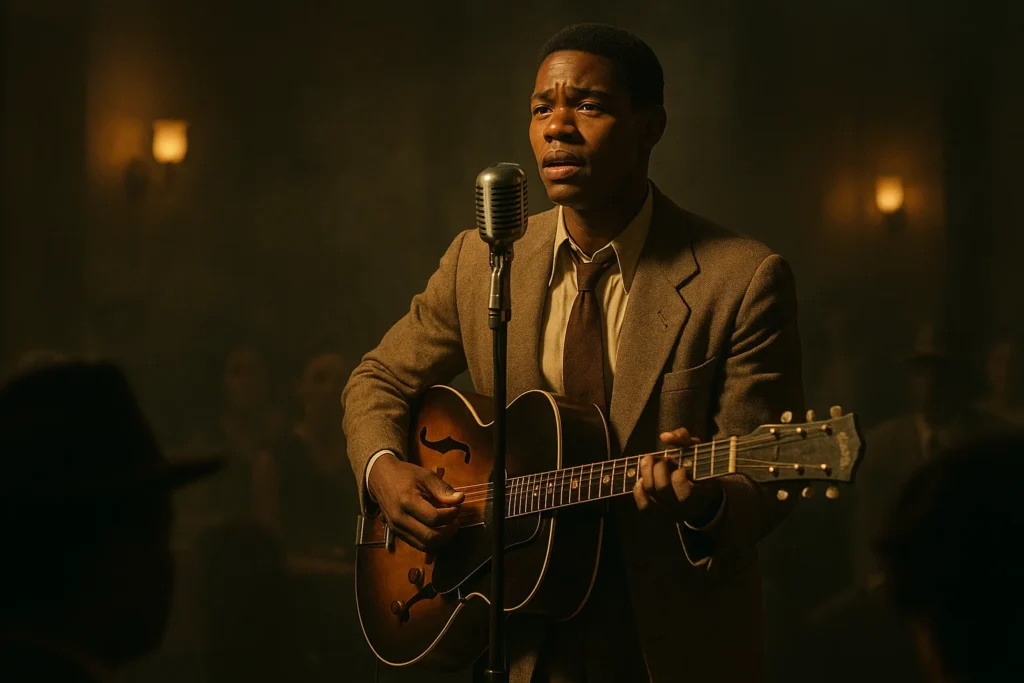
Here’s what matters. The film isn’t based on one real person. Instead, Perry pulled pieces from real history, real experiences, and real Southern stories he grew up hearing. That mix of truth and fiction gives the movie its weight.
Where the Story Really Comes From
A Jazzman’s Blues follows Bayou, a young Black musician, and Leanne, a girl forced to hide her identity to survive. Their love is powerful, but the world around them is stronger.
Tyler Perry explained in interviews that the film grew from his childhood memories of hearing adults whisper about mixed-race families who “passed” as white to avoid danger. He also studied how the Jim Crow era shaped people’s lives in ways they often never spoke about. The result isn’t a retelling of a single true event. It’s a story shaped by hundreds of real ones.
The emotional truth is real. The exact story is fiction.
Was Leanne’s Baby Bayou’s?
Many viewers walk away with this question still lingering. The movie doesn’t show a DNA test or give a direct line of confirmation, but the emotional cues point toward one answer.
Leanne’s connection to Bayou never disappears, even after she builds a life pretending to be someone else. The timing, the looks, and the silence all suggest the baby was Bayou’s. Perry leaves it open enough for viewers to sit with the ache of it, which is exactly what he intended. These stories don’t tie themselves neatly. Real life rarely does.
Who Was the Woman at the Beginning of the Film?
The movie opens with a woman who brings an old stack of letters to a politician during a campaign scandal. She isn’t just a side character. She’s the thread that pulls the entire past into the present.
The woman is Hattie Mae, Bayou’s mother. She is the reason the truth finally comes into the light after years of silence. Her appearance shows how secrets travel through generations, waiting for the right moment to be heard.
What Actually Happens in A Jazzman’s Blues?
Here’s a clear, simple breakdown of the story without overcomplicating it.
Bayou grows up in a struggling Georgia family during the Jim Crow era. His father leaves, his brother becomes the favorite, and Bayou discovers he has a voice that can move people. Then he meets Leanne a girl forced by her family to pretend she is white.
Their bond turns into a secret love that brings danger with it. When the truth threatens to surface, Leanne is pushed deeper into her new identity, and Bayou is chased out of town. He finds success as a jazz singer, but the past eventually pulls him back home.
What happens next is tragic. Bayou returns hoping to reconnect, but the people who feared the truth make him the target again. The final scenes show how hatred can destroy a life that deserved better. It’s painful, beautiful, and unforgettable.
Is The Jazz Singer Related to This Story or Based on Similar Truth?
People sometimes confuse A Jazzman’s Blues with older films about musicians, including The Jazz Singer. But the two movies are not connected.
The Jazz Singer (1927) was about a man torn between tradition and career. A Jazzman’s Blues is about identity, race, and love in a dangerous time. Both include music, but their themes, characters, and inspirations come from completely different worlds.
Is A Jazzman’s Blues Really a True Story?
The final answer sits somewhere in the middle.
No the characters aren’t pulled from public records or historical documents.
Yes the experiences come from real history, real racism, and real stories people carried quietly for generations.
Tyler Perry created a fictional love story wrapped around true social conditions. That blend is why the movie feels so honest. Fiction is the body; history is the heartbeat.
Why the Film Hits So Hard
The power of the movie isn’t just in the plot. It’s in the things it doesn’t say loudly.
Passing.
Silence.
Fear of being seen.
Love that can’t survive the world it lives in.
These are things countless families especially in the American South lived through. Some spoke about it. Most never did. Perry gives those untold stories a voice.
The Heart of the Film Lives in the Details
Bayou’s music is more than soundtrack. It’s expression.
Leanne’s choices are more than romance. They’re survival.
Every whisper, every hidden glance, every letter carries the weight of what was possible and what never could be.
When viewers ask if it’s a true story, what they’re really asking is: Why does it feel so real?
Because the emotions are real. The fear was real. The world Perry recreates was painfully real. And in that world, love like Bayou and Leanne’s often ended the way the film does quietly, unfairly, and remembered only by those who were brave enough to keep the truth alive.
Bottom Line
A Jazzman’s Blues is not the retelling of one real-life couple. But it is built from the truth of a time, a place, and the countless lives shaped by them. Tyler Perry created fiction, but he grounded it in history so deeply that it feels like memory.
That is why people leave the film asking if it really happened.
In many ways, it did.
Just not in one single chapter rather, in thousands.

Jessica Savitch, with a deep passion for journalism, brings her expertise to istruestory.com as a dedicated author. MA in Arts & Journalism.