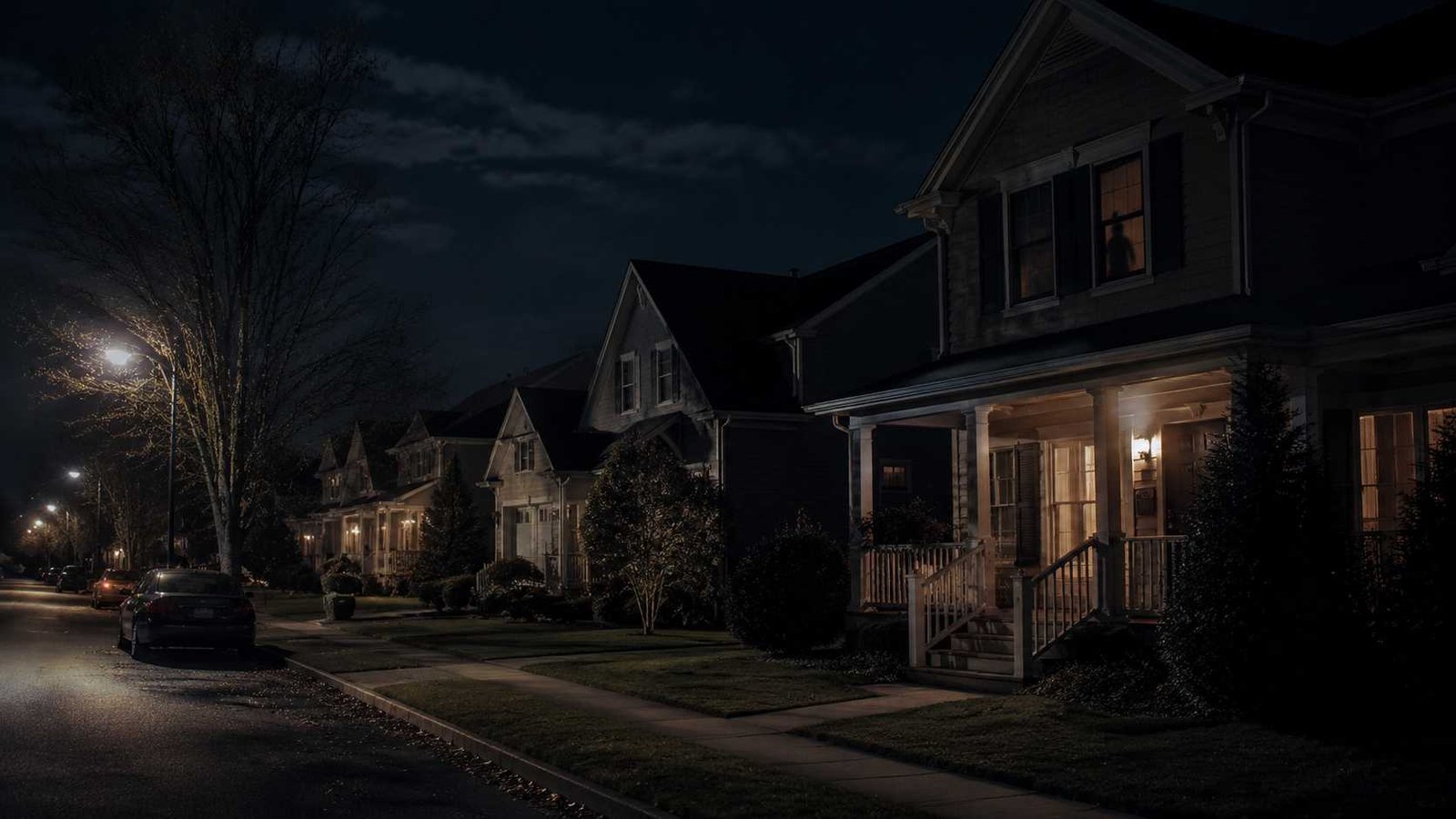
The six-part Peacock show mixes several different kinds of truth. Some episodes deal with documented murderers and stalking cases. Others are built around people who say they experienced ghosts, curses, possessions, or other unexplained events.
That means you should not watch every episode in exactly the same way.
Peacock describes John Carpenter’s Suburban Screams as an unscripted horror anthology built around true tales told by the people who lived through them. The production combines firsthand interviews with reenactments, personal photographs, archives, and historical news material.
So, is Suburban Screams a true story? The best answer is: yes, the series is based on stories presented as real experiences, but the evidence behind those experiences varies greatly from episode to episode.
And that difference matters.
What Is John Carpenter’s Suburban Screams About?
John Carpenter’s Suburban Screams looks at frightening events hidden behind an ordinary suburban setting.
That contrast is really the show’s central idea.
A quiet street can look harmless. The lawns are trimmed. Cars sit in driveways. Families know their neighbors.
Then something disturbing happens behind one of those doors.
Season 1 contains six episodes:
| Episode | Story | Type of Case |
|---|---|---|
| Kelly | Friends encounter what they believe is the spirit of a murdered girl | Paranormal testimony |
| A Killer Comes Home | A convicted killer terrorizes a community | Documented crime |
| House Next Door | A teenager believes his girlfriend’s house is haunted | Paranormal testimony |
| Bunny Man | Residents discuss encounters behind a famous Virginia legend | Crime reports mixed with folklore |
| Cursed Neighborhood | A family believes something supernatural is attacking them | Paranormal testimony |
| Phone Stalker | A woman describes years of threatening harassment | Stalking testimony |
Peacock lists all six stories as part of the documentary series and describes the episodes using real people recounting frightening events.
But this table also shows why the word true needs a little care.
A convicted killer can be checked against court records.
A reported haunting cannot be proven in the same way.
Is John Carpenter’s Suburban Screams Based on True Stories?
Yes. That is how Carpenter and Peacock describe it.
John Carpenter himself explained that researchers found the stories and that they were presented to the production as true accounts. He also made an interesting distinction while discussing the show: the ordeal could be supernatural, or it could involve something very real.
That comment tells us almost everything we need to know about the series.
Suburban Screams does not limit itself to traditional true crime.
Instead, it asks people to tell stories they say actually happened to them. The production then recreates those experiences with horror-style cinematography.
This creates three different levels of reality.
Some events are historically documented
The clearest example is A Killer Comes Home.
The episode deals with the terror surrounding Canadian killer Allan Legere, who became known as the Monster of the Miramichi.
Legere had already been imprisoned for the murder of John Glendenning when he escaped custody during a hospital visit in New Brunswick on May 3, 1989. During his 201 days as a fugitive, four more people were murdered in the Miramichi area.
The University of New Brunswick maintains an extensive digital archive covering Legere’s crimes, capture, and trial.
Rick MacLean, who appears in connection with the story, was editor of the Miramichi Leader while Legere was terrorizing the community. MacLean covered the murders and later described receiving threats connected to Legere.
So this part of Suburban Screams has a strong documentary foundation.
There is also a sad update to the story. Allan Legere died in custody on March 9, 2026, at age 78, according to Correctional Service Canada.
Some stories begin with real incidents and grow into legends
Then there is the Bunny Man.
This is where things get much stranger.
The modern Bunny Man legend centers on Fairfax County, Virginia. Over the years, stories have included an axe-wielding killer, murders near a railway bridge, escaped inmates, hanging bodies, and a supernatural figure returning from the dead.
The dramatic versions are frightening.
The historical record is much smaller.
Research into the legend traces it mainly to two reported incidents in 1970 involving a strangely dressed man and threats involving a hatchet or axe. In one famous account, a man in a white outfit reportedly threw a hatchet through a car window after accusing the occupants of trespassing.
From those incidents grew one of Northern Virginia’s most enduring urban legends.
So the Bunny Man is a great example of how Suburban Screams can contain both reality and folklore at the same time.
There was a real reported scare.
That does not automatically make every later Bunny Man legend factual.
Is Suburban Screams: House Next Door Based on a True Story?
This is probably the episode that creates the most confusion.
House Next Door is presented by Suburban Screams as a true personal account, but its supernatural events should be treated as claims rather than established facts.
Peacock describes the episode as the story of a teenage boy who believes dark spirits are threatening his girlfriend. The episode follows Torrence, who becomes concerned about strange activity connected to the house next door.
The show treats those experiences seriously.
However, there is an important difference between saying:
The people involved say these events happened
and saying:
The existence of dark spirits has been independently proven.
Those are not the same claim.
I could find official descriptions confirming that House Next Door is presented within the series as one of its real-life accounts. What I could not find was reliable independent documentation proving the supernatural explanation shown in the episode.
That does not prove the witnesses invented their experiences.
It simply means the paranormal part cannot be verified in the same way we can verify Allan Legere’s crimes, imprisonment, court proceedings, or escape.
For a true-story article, that distinction is essential.
What About Kelly and Cursed Neighborhood?
The same caution applies to episodes such as Kelly and Cursed Neighborhood.
In Kelly, friends describe an experience involving what they believe is the spirit of a murdered local girl.
In Cursed Neighborhood, a family describes disturbing events they interpret as supernatural activity connected to their home and neighborhood.
Peacock presents these stories through documentary interviews combined with cinematic reenactments.
The witnesses themselves are part of the documentary reality.
Their memories and testimony are real interviews.
But an interview describing a ghost is evidence that a person reported seeing or experiencing something. It is not scientific confirmation that a ghost existed.
That sounds like a small distinction, but it changes how the whole series should be understood.
Phone Stalker Feels Different Because the Threat Is Human
The final episode, Phone Stalker, moves away from ghosts and curses.
It follows a Long Island woman identified as Beth who says an unknown person subjected her to years of threatening calls, messages, and harassment.
John Carpenter personally directed the dramatic recreations for this episode. He told the Los Angeles Times that he was drawn to the story and listened to the real woman’s interview before deciding which moments could be translated visually.
According to Carpenter and producer Sandy King, the stalking had continued for years without a clear resolution at the time the episode was made.
This episode also explains something important about how Suburban Screams is constructed.
The frightened person you see in a dramatic scene is not necessarily the actual victim at the moment the original event occurred.
Actors recreate those moments.
For example, actress Julie Stevens portrays Beth in the reenactments, while the real account provides the basis for the story.
Are the Reenactments Real Footage?
No.
This is one of the easiest things to misunderstand while watching.
Suburban Screams uses a documentary-horror hybrid.
You get real interviews and some archival material, but you also get carefully filmed recreations designed to look and feel like scenes from a horror movie.
Peacock says the show uses firsthand accounts together with cinematic reenactments, personal archives, and historical press coverage.
So when you see someone moving through a dark hallway or being chased in a dramatic sequence, you are often watching an actor recreating the person’s story.
That does not necessarily make the underlying event fictional.
It means the visuals have been dramatized.
Think of it like a true-crime documentary that hires actors to recreate a robbery because no camera was present when the real robbery happened.
How Much Did John Carpenter Actually Make?
The title may make you expect every episode to be personally directed by the filmmaker behind Halloween and The Thing.
That is not what happened.
Carpenter served as an executive producer and composed music for the series, but he personally directed only Phone Stalker, the sixth episode.
There is another interesting behind-the-scenes detail.
Carpenter directed his episode remotely from Los Angeles while the dramatic production was being filmed in Prague.
He watched the camera feed from home and gave instructions to the crew from there.
That unusual setup gives the series Carpenter’s name and influence without making it a six-hour John Carpenter-directed production.
Is Suburban Screams a Good Show?
This depends heavily on what you expect from it.
If you are expecting another Halloween, probably not.
If you enjoy true crime mixed with paranormal storytelling and dramatic reenactments, you may find certain episodes interesting.
Critics, however, were mostly disappointed.
Rotten Tomatoes lists Season 1 at 18% from 17 critic reviews, while Metacritic gives the series a 30 out of 100, placing it in the generally unfavorable range.
A major complaint was that Carpenter’s involvement was smaller than the title might suggest.
Other critics felt the reenactments sometimes looked more like ordinary true-crime television than the work of one of horror cinema’s most respected filmmakers.
Still, the idea itself is effective.
There is something naturally disturbing about hearing someone describe a terrible experience in a place that looks completely normal.
No isolated cabin.
No abandoned asylum.
Just another house at the end of the street.
So What Does True Story Really Mean Here?
This is where I think Suburban Screams becomes more interesting than its title suggests.
The series is not really asking us to accept six stories with exactly the same level of proof.
Instead, it moves between several kinds of fear.
There is documented fear.
Allan Legere was real. His crimes were real. His escape and prosecution are matters of public record.
There is folkloric fear.
The Bunny Man grew from reported incidents into something much larger through decades of storytelling.
And there is personal fear.
People interviewed in episodes such as House Next Door describe events they genuinely present as experiences from their lives, even though an outside viewer cannot independently verify a supernatural cause.
Those categories should not be blended together.
Doing so would make the paranormal stories seem more proven than they actually are.
But dismissing every episode as fiction would also be inaccurate.
Quick Answers About Suburban Screams
Is John Carpenter’s Suburban Screams based on true stories?
Yes. Peacock and John Carpenter describe the series as being built around true accounts researched by the production and told by people connected to the events. Some episodes have strong historical documentation, while others rely primarily on paranormal eyewitness testimony.
Is John Carpenter’s Suburban Screams: House Next Door based on a true story?
It is presented as a true personal experience, not as pure scripted fiction. However, the claims involving spirits or a haunted house have not been independently established as factual. The most accurate description is a dramatization of a reported paranormal experience.
What is John Carpenter’s Suburban Screams about?
It is a six-episode Peacock documentary-horror anthology about disturbing events in suburban communities, including murder, stalking, hauntings, alleged curses, and urban legends.
Is Suburban Screams a good show?
Reviews were mostly negative. Rotten Tomatoes records an 18% critics score, while Metacritic gives it 30/100. Still, viewers who enjoy reenacted true crime and paranormal testimony may get more from it than viewers expecting a traditional John Carpenter horror production.
The Truth Behind the Screams
So, is Suburban Screams a true story?
It would be more accurate to say it is a collection of stories rooted in real people, real testimony, documented crimes, historical reports, and alleged supernatural experiences.
Some parts can be checked against court files and newspaper archives.
Some began with real incidents before turning into folklore.
And some ultimately depend on whether you believe the person sitting in front of the documentary camera.
That uncertainty is actually where Suburban Screams finds its strongest idea.
The frightening house does not always look frightening.
Sometimes it looks exactly like the one next door.

Jessica Savitch, with a deep passion for journalism, brings her expertise to istruestory.com as a dedicated author. MA in Arts & Journalism.