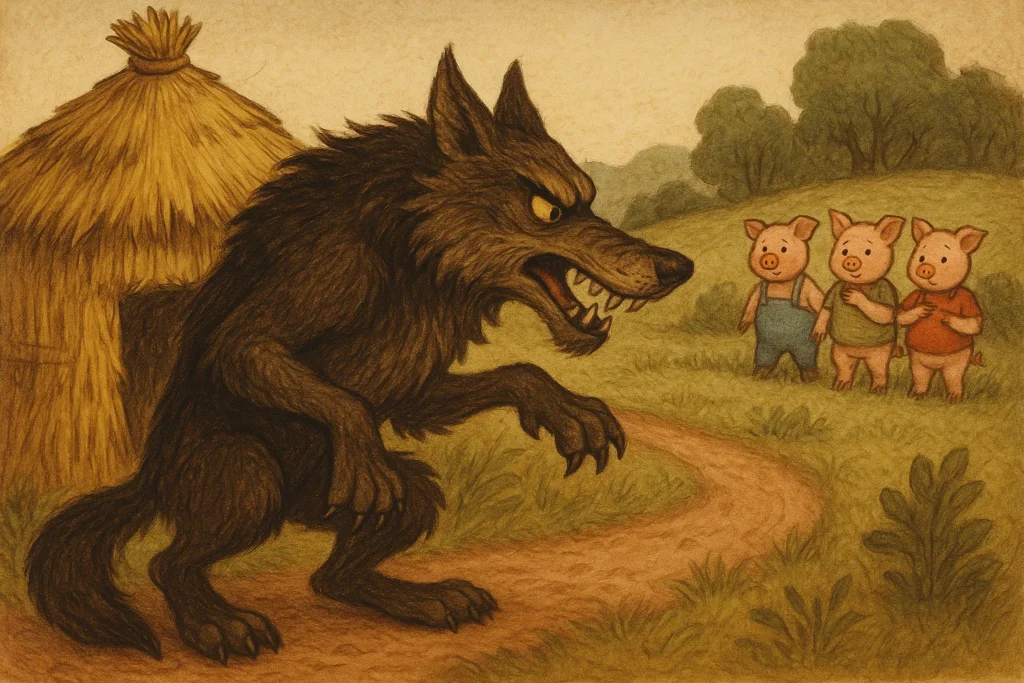
This is the real story behind one of the most famous villains in childhood stories where he came from, why he became “bad,” and what his legend actually means.
How the Big Bad Wolf Became a Villain
Let’s step back in time. Long before The Three Little Pigs was written, wolves lived close to towns and farms across Europe. People didn’t know much about nature. If livestock disappeared, wolves became the easiest thing to blame. Stories spread quickly, and fear traveled even faster.
Folktales grew out of this atmosphere. Wolves were powerful, clever, and mysterious. People rarely saw them up close, which made them perfect characters for storytellers who needed a threat. Over the years, the wolf was shaped into something larger and darker than reality.
That fear didn’t stay in real life. It crept into stories meant to guide children warnings about danger, trust, and cleverness. And from there, the Big Bad Wolf was born.
The Three Little Pigs and What the Story Really Means
The tale might look simple, but there’s more sitting behind the scenes.
The Big Bad Wolf appears in “The Three Little Pigs” as the unstoppable danger. He blows down two houses and famously says, “I’ll huff and I’ll puff and I’ll blow your house down.” Kids remember that line for years because it’s frightening and playful at the same time.
But the deeper meaning is about preparation and responsibility.
The pig who builds the stronger house survives. The story isn’t about evil wolves. It’s about facing challenges wisely. In older versions, the wolf wasn’t even the central focus. He was simply the danger used to teach a lesson.
So when we ask, “What is the true story of The Three Little Pigs about?” the answer is this: the power of good choices, the value of effort, and the reality that shortcuts rarely hold up when pressure arrives.
Where the Wolf’s Reputation Really Came From
Here’s the turning point: the Big Bad Wolf isn’t based on one real wolf. He’s based on how people felt about wolves as a species.
Hundreds of years ago, wolves were linked to everything unknown and frightening. If a child went missing, if crops failed, if the forest felt too quiet, people imagined the wolf lurking nearby. With no scientific knowledge and plenty of superstition, wolves were painted as villains long before anyone wrote about them in stories.
Fairy tales from France, Germany, and Eastern Europe kept repeating the same image: strong jaws, clever mind, dark intentions. Over time, these stories spread to England and America. With each retelling, the wolf became more sinister, more dramatic, more “bad.”
Once the image was set, it never really left.
Different Cultures Told Different Wolf Stories
Not every culture agreed on the wolf’s nature. Some saw the animal as a teacher or protector.
In Native American traditions, wolves symbolize loyalty and teamwork. In parts of Asia, they represent courage. But European folklore had the biggest influence on the stories we still read to children today.
And in those stories, the wolf became the go-to villain not because of who wolves were, but because of what humans feared.
A Look at His Most Famous Line
When the Big Bad Wolf says, “I’ll huff and I’ll puff and I’ll blow your house down,” it captures everything people once believed.
He wasn’t just threatening the pigs. He was the storm that knocks down weak choices, the wild force outside your safe little home, and the fear that something bigger might be waiting in the woods.
The line stayed because it taps into something deep: the idea that danger gives us a chance to grow stronger.
Modern Retellings: A Wolf With More Layers
Today, we’re not as afraid of wolves. Science and conservation have changed how we see them. With that shift, new stories have tried to repair the wolf’s image.
Some books tell the pigs’ story from the wolf’s point of view. Others show wolves as misunderstood outsiders. Modern audiences want nuance characters who aren’t simply good or bad.
These retellings remind us that the original villain was created during a time of fear, not fact.
So What Is the True Story of the Big Bad Wolf?
When we strip away the exaggeration, the Big Bad Wolf isn’t a real animal at all. He’s a symbol.
Here’s the simple truth:
- He represents fear of the unknown.
- He reflects old beliefs about danger and the wilderness.
- He shows how humans used stories to teach lessons.
- He carries the weight of centuries of misunderstanding about wolves.
The wolf became “big” because the fear was big. He became “bad” because that fear needed a face.
Why the Story Still Matters Today
The Big Bad Wolf continues to show up in movies, books, and children’s stories because he plays an important role. He helps us understand the balance between caution and wisdom. He asks us to think before we build, prepare before we act, and believe in our ability to face challenges.
At the same time, the real wolf the animal deserves a fairer picture. Modern science shows they are social, loyal, intelligent, and far less dangerous to humans than old stories suggested.
The tale survives because it speaks to something we all face: moments when the world feels bigger than us. The wolf stands at the door, breathing hard. The test is simple did we build strong enough?
Final Thoughts
The Big Bad Wolf isn’t a monster, and he never truly was. He’s a character shaped by fear, carried through generations of storytelling, and rebuilt into something larger than life. When we look closer, we find a creature who belongs more to our imagination than to nature itself.
The real wolf is complex. And the legendary one? He exists so we can understand our own strengths, choices, and the stories we believe about danger.

Jessica Savitch, with a deep passion for journalism, brings her expertise to istruestory.com as a dedicated author. MA in Arts & Journalism.